

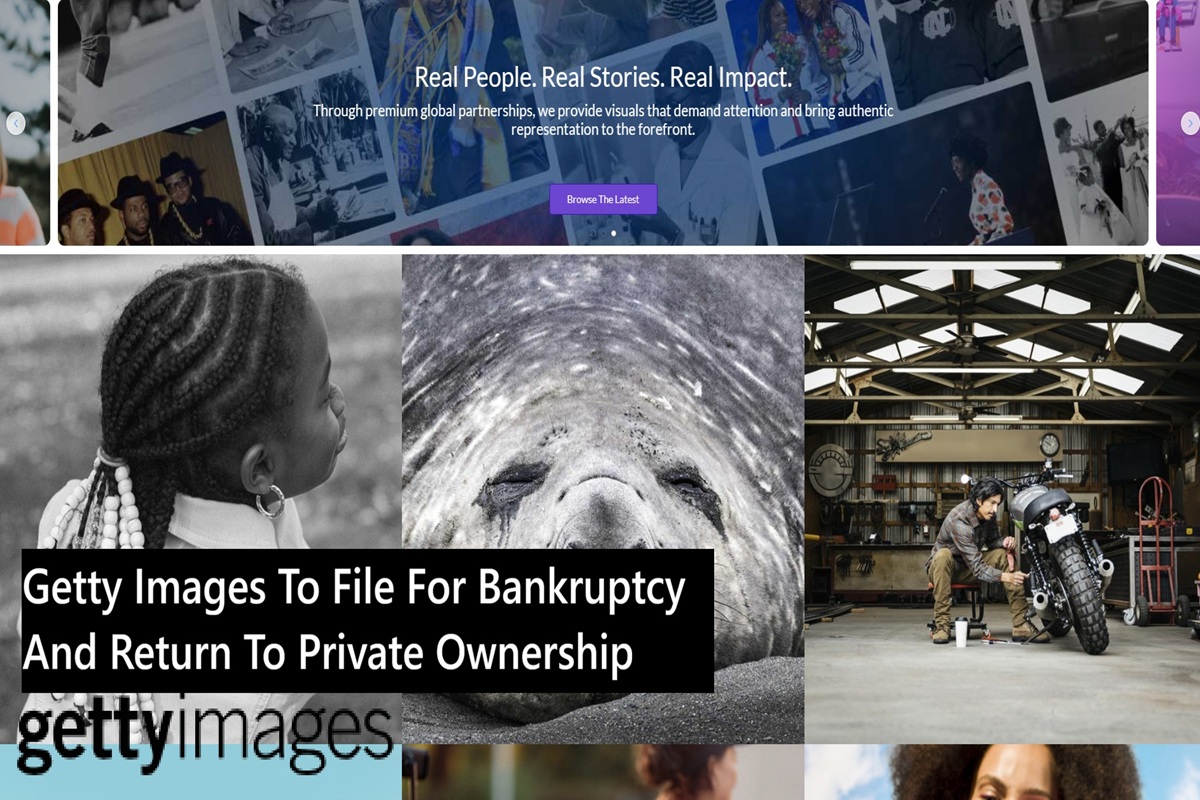
Getty Images, one of the most recognisable names in the stock photography and licensed visual-content industry, is preparing to file for bankruptcy as it struggles with heavy debt, a dramatic collapse in market value and a rapidly changing creative landscape increasingly shaped by generative AI. The company is not expected to disappear altogether. Instead, the bankruptcy filing will form part of a restructuring process that ultimately takes Getty Images private again under the ownership of investors connected to the Getty family and Koch Equity Development.
This one feels a little more personal to me than the typical business restructuring story. Around five to 15 years ago, I was actually a very active Getty Images user. A large portion of the royalty-free artwork and professional images I used for my projects were purchased and licensed through Getty Images. Back then, paying for professionally produced stock photography was simply part of creating good websites, articles and digital content. Seeing such a familiar name reach this point is genuinely quite sad, especially when I look at how dramatically my own image workflow has changed today.
Getty Images Faces Bankruptcy Under Heavy Debt
According to the report, Getty Images plans to seek bankruptcy protection as part of a broader financial restructuring. One of the biggest pressures is its debt load, which stood at approximately US$2.1 billion, or around RM8.6 billion, as of 30 June.
That figure looks particularly striking when compared with the company's more recent stock market valuation. Getty Images was reportedly valued at only around US$20.74 million, approximately RM84.9 million, showing just how far investor confidence in the company had fallen.
The bankruptcy process is therefore not simply about a bad quarter or temporary slowdown. Getty Images is attempting to fundamentally restructure its financial position and ownership after years of declining market value.
The Shutterstock Merger Never Happened
Getty Images had previously pursued a merger with Shutterstock, one of its biggest competitors in the stock-media industry. Such a combination could have created a much larger company capable of consolidating resources, customer bases and enormous visual libraries.
However, that merger ultimately failed to materialise.
Without the deal, Getty Images was left facing its existing debt and structural challenges independently. The company now appears to be pursuing bankruptcy restructuring as another path towards stabilising the business.
For an industry already experiencing enormous technological disruption, losing the opportunity to consolidate with a major competitor may have made an already difficult situation considerably more challenging.
AI-Generated Imagery Has Changed The Market Completely
One of the factors reportedly contributing to Getty Images' difficulties is increasing competition from AI-generated imagery.
This is probably the part of the story that I can relate to most directly.
Years ago, whenever I needed professional artwork for a website, article or digital project, my first instinct was often to search through stock-photo libraries. Getty Images was one of the places where I would actually pay for royalty-free imagery because having the correct licence mattered, and the quality of the available material was usually much higher than what you could find freely elsewhere.
Today, my workflow is almost completely different.
For most article artwork, illustrations and creative visual concepts, I now rely primarily on AI-generated images. Instead of searching through hundreds of stock photos hoping to find something close to what I have in mind, I can describe the exact scene, composition, mood, colour palette and aspect ratio that I want.
That is an enormous change in only a relatively short period.
Stock Photography Used To Solve A Very Real Problem
It is easy to forget how important stock-photo companies once were to web designers, publishers and digital creators.
Not every company could afford to hire a photographer whenever it needed an image. Bloggers could not organise a professional photoshoot for every article, and smaller businesses rarely had the budget to produce custom photography for every marketing campaign.
Stock libraries solved that problem.
You searched for a subject, purchased the appropriate licence and received a professional-quality image that could legally be used for your project. Getty Images built one of the strongest brands in the industry around precisely this model.
Its enormous archive also gave it an advantage. Whether you needed business photography, technology, healthcare, lifestyle imagery, editorial photography or something very specific, there was a good chance Getty had something suitable.
The Problem Was Always Finding The Right Image
The traditional stock-photo model worked, but it also came with limitations.
You could spend a long time searching through images that were almost right but never quite matched what you had imagined. Maybe the people looked wrong for the intended audience. Perhaps the background was unsuitable, the composition left no room for article text, or the image orientation did not fit the website layout.
There was also the familiar problem where the same stock photograph would appear across numerous unrelated websites.
Once you recognised a popular stock image, you might notice it being used for a bank advertisement one week, a healthcare website the next and perhaps a business-consulting article somewhere else.
The photograph was technically professional, but it was not truly unique.
Generative AI Changes That Equation
AI image generation approaches the problem from the opposite direction.
Instead of searching for an existing photograph and adapting your idea around whatever is available, you generate the image around the idea.
Want a 3:2 article image involving a futuristic workstation, Malaysian city backdrop and specific lighting? Generate it.
Need an editorial-style cybersecurity image showing a compromised digital wallet rather than another generic padlock photograph? Generate it.
Want an image that matches an article about a particular technology announcement while leaving enough negative space for a stylised headline? Generate that too.
This flexibility fundamentally changes the economics of stock photography.
For many everyday publishing needs, people no longer necessarily have to browse a catalogue and pay for an existing image. They can create a new one specifically for the article.
That Does Not Mean Professional Photography Is Dead
There is still an important distinction between generated artwork and genuine photography.
News organisations, sports publishers, entertainment companies and historical archives still need authentic photographs of real events and people. You cannot responsibly replace genuine documentary photography with an AI-generated interpretation when the authenticity of what happened matters.
Getty Images remains enormously valuable in that area because of its extensive editorial and archival photography.
There will also continue to be demand for professional commercial photography where brands want real products, genuine locations and identifiable people rather than synthetic alternatives.
The challenge is that the huge middle ground of generic commercial imagery is becoming much easier to replace.
That is where generative AI has arguably changed the market most dramatically.
Getty Images Has Had An Unusual Public And Private History
The company's ownership history also makes the latest development interesting.
Getty Images was publicly traded before being taken private in 2008. It later returned to the public markets in 2022 through a special purpose acquisition company, commonly known as a SPAC.
That transaction valued Getty Images at around US$4.8 billion, approximately RM19.66 billion at the referenced exchange rate.
Since then, the company has reportedly lost approximately 99% of its market value.
Going from a multibillion-dollar valuation to tens of millions of dollars illustrates the scale of the collapse far more clearly than almost any other statistic.
NYSE Had Already Started Delisting Proceedings
The financial situation had already become serious before the latest bankruptcy announcement.
The New York Stock Exchange reportedly began proceedings to delist Getty Images towards the end of September. That provided another indication that its position as a publicly traded company was becoming increasingly difficult to sustain.
The planned restructuring will effectively complete the transition away from public ownership.
Once the process is finished, Getty Images is expected to be entirely owned by affiliates of the Getty family and Koch Equity Development.
Investors Are Putting In Fresh Capital
The restructuring is not simply about reducing debt and walking away from the existing business.
The investors have reportedly committed to providing as much as US$533 million, approximately RM2.18 billion, in new equity.
That injection gives Getty Images additional capital to continue operating after the restructuring and potentially rethink how the business competes in the evolving visual-content market.
Going private could also give management more freedom to make long-term changes without constantly responding to public-market expectations and share-price movements.
In that sense, bankruptcy may represent a painful reset rather than the end of Getty Images.
Getty Still Has Assets That Are Difficult To Replicate
Despite everything happening around the company, Getty Images owns something extremely valuable that generative AI cannot simply recreate: an enormous archive of genuine photography.
Decades of historical events, celebrities, sports, politics, entertainment, culture and news have been documented through its collection.
AI can generate an impressive image of a football match, but it cannot replace an authentic photograph of an actual championship-winning goal.
It can create a convincing political press conference, but it cannot substitute for verified documentary photography of what really happened.
That archive gives Getty Images an important foundation for whatever comes next.
The question is whether that strength is enough to support the company as the commercial-stock side of the industry continues changing.
Creative Workflows Have Changed Faster Than Many Expected
My own experience probably mirrors what has happened to many designers, developers and content creators.
Years ago, purchasing stock artwork was a normal expense. I regularly bought royalty-free Getty Images content because it gave me high-quality visuals with proper licensing and saved the enormous effort involved in creating original photography.
Today, I rarely approach article artwork that way.
Most of the visual material I need can now be generated according to the precise article context, with the composition and styling created specifically for that story.
That does make this news somewhat bittersweet.
Getty Images was genuinely useful to me for many years. It was part of the web-development and publishing workflow during a period when stock photography was arguably one of the best options available.
Technology simply moved on extraordinarily quickly.
AI Did Not Cause Every Getty Images Problem
It would also be unfair to describe generative AI as the sole reason Getty Images reached this position.
The reported US$2.1 billion debt, unsuccessful Shutterstock merger, changing licensing market, competition from other stock-media platforms and dramatic decline in market valuation all contributed to the company's financial difficulties.
AI is better understood as another major disruptive force arriving at a particularly difficult time.
Generative imagery did not create Getty's debt, but it undoubtedly challenges one of the fundamental reasons people historically paid for generic stock artwork.
And unlike many previous competitors, AI does not merely provide another library. It changes the workflow itself.
Stock Media May Need To Become More About Authenticity
One possible future for companies like Getty Images is to focus increasingly on what generative AI cannot easily provide: verified authenticity.
As synthetic imagery becomes more convincing, genuine photographs may actually become more valuable in journalism, historical documentation and other contexts where provenance matters.
Knowing that an image genuinely came from a photographer at a particular event could become an increasingly important distinction.
Getty's future may therefore depend less on competing with AI-generated lifestyle illustrations and more on strengthening the value of its authentic editorial, archival and professionally documented material.
That would represent a significant shift from the traditional stock-photo business model.
Final Thoughts
Seeing Getty Images prepare for bankruptcy and return to private ownership is genuinely sad from my perspective because I remember when the company was a regular part of my own creative workflow. Between roughly five and 15 years ago, Getty Images was one of the services I actively used, and many of the royalty-free images and artwork for my projects were purchased through its platform.
Today, the situation could hardly be more different. For most article artwork and creative visuals, I now use AI-generated imagery because it gives me far greater control over composition, context and presentation without searching endlessly for a stock photograph that only partially matches what I need.
Getty Images' difficulties cannot be blamed entirely on AI, especially with the company carrying significant debt and facing other business challenges. But its situation illustrates just how rapidly creative technology has changed. A service that once felt essential to digital publishing is now competing against systems capable of creating original images in seconds.
Getty Images is not disappearing, and its archive of genuine editorial and historical photography remains extraordinarily valuable. But the company emerging from this restructuring may need to look very different from the Getty Images many of us knew during the golden age of stock photography.











Comments 0