

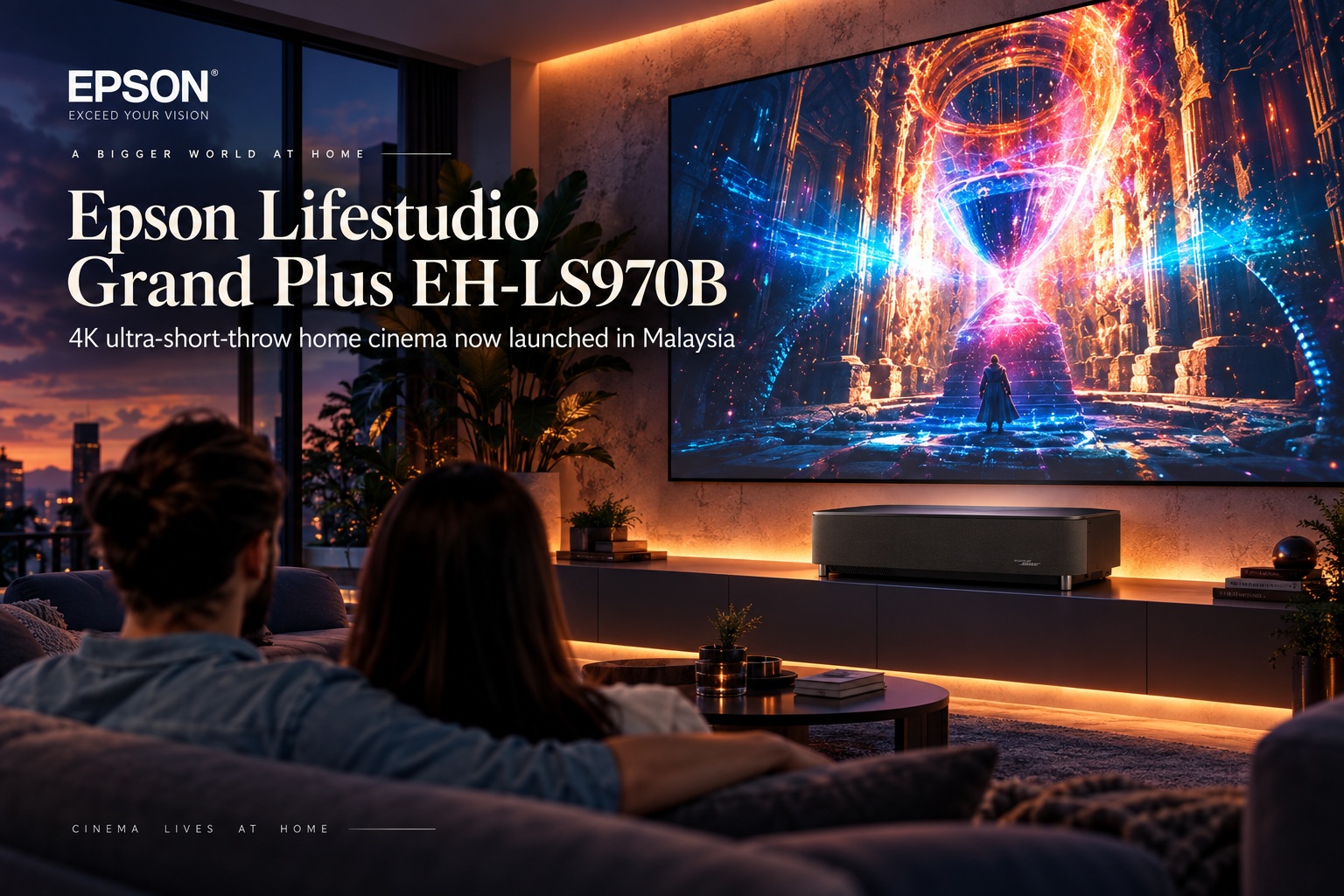
Epson has officially expanded its home entertainment lineup in Malaysia with the launch of the Lifestudio Grand Plus EH-LS970B, a premium ultra-short-throw projector designed to deliver a cinema-sized viewing experience without requiring a large room. The new model combines 4K projection, a laser light source, AI-assisted image processing, Google TV, and an integrated Bose audio system in a single unit. With the ability to create images as large as 150 inches while remaining close to the wall, Epson is positioning the EH-LS970B as an alternative to increasingly large televisions.
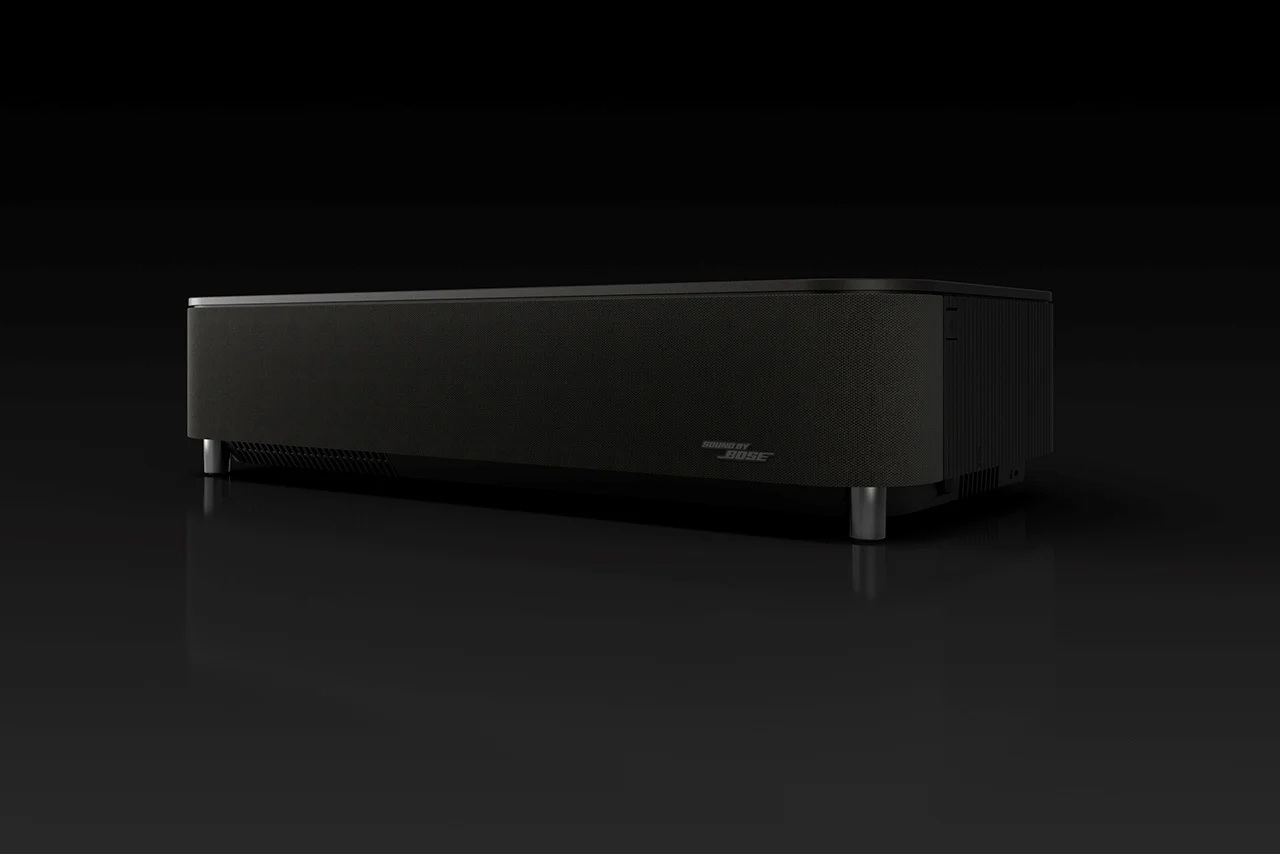
The projector joins Epson's established Lifestudio family and focuses heavily on simplifying home theatre installation. Ultra-short-throw projectors are particularly attractive for living rooms because they avoid the long projection distances normally required by conventional models. Instead of mounting hardware on the ceiling or running cables across the room, the EH-LS970B can sit on a cabinet directly beneath the projection surface.
Up to a 150-Inch Image From Close to the Wall
One of the EH-LS970B's biggest advantages is its 0.16 ultra-short-throw ratio. Epson says the projector can produce a 120-inch image while positioned approximately 17.3cm from the screen, making it possible to achieve a very large picture without sacrificing much living space. The projector supports image sizes ranging from approximately 80 inches all the way up to 150 inches.
That flexibility gives homeowners a way to create a large-screen entertainment setup in rooms where a conventional long-throw projector would be impractical. There is no need to place the projector several metres away from the wall, and people walking around the room are much less likely to interrupt the projection beam. It also avoids having a projector mounted overhead, which can make installation more complicated and less visually appealing.
For anyone considering a very large television, this is where ultra-short-throw technology becomes interesting. A 120- or 150-inch conventional television would be extremely expensive, difficult to transport, and physically dominant in most living rooms. A projector can achieve a comparable image size while occupying far less physical space when it is not being used.
3LCD Laser Projection Delivers 4,000 Lumens
The EH-LS970B uses Epson's 3LCD laser projection system, with the company rating it for up to 4,000 lumens of both white and colour brightness. This should give the projector enough brightness for normal home environments, although image quality will naturally benefit from controlling ambient light and using a suitable projection screen.
Epson claims a contrast ratio exceeding 5,000,000:1, which should help darker scenes maintain deeper blacks while preserving highlights. As with most projector contrast specifications, real-world performance will depend on the room, screen, and viewing conditions, but the high claimed figure shows that Epson is targeting serious home entertainment rather than casual portable projection.
The projector also produces a 4K image containing approximately 8.3 million pixels, giving movies, television programmes, and games considerably more detail than conventional Full HD projection. On a screen measuring well over 100 inches, additional resolution becomes particularly valuable because individual pixels are much easier to notice than they would be on a smaller television.
The Laser Light Source Is Rated for 20,000 Hours
Unlike traditional projectors that rely on replaceable lamps, the EH-LS970B uses a laser light source rated for up to 20,000 hours. Epson estimates that this could translate to more than ten years of operation for someone watching approximately five hours per day.
The practical advantage is reduced maintenance. Conventional projector lamps eventually dim and need replacement, adding another long-term operating cost. A laser system is designed to remain usable for years without requiring regular light-source replacement, making it better suited to users who want their projector to function like an everyday television.
Laser projection also allows much quicker startup and shutdown compared with older lamp-based technology. Users do not have to wait through long warm-up or cooldown periods whenever they want to watch something, which makes the projector feel less like specialist home theatre equipment and more like a normal entertainment device.
AI Processing Works on the Picture in Real Time
Epson has equipped the EH-LS970B with what it describes as an AI-powered TV chip capable of analysing video in real time. One of its main features is AI Super Resolution, which is designed to improve perceived sharpness and bring additional detail to lower-quality content.
Another feature, AI Picture Quality, automatically adjusts image processing according to what is currently being displayed. The objective is to optimise the image without requiring users to constantly switch picture modes or manually adjust settings when moving between films, television programmes, sports, or other content.
Additional processing includes Dynamic Colour Booster, Local Contrast, and De-contour Processing. Together, these features are intended to improve colour vibrancy, preserve contrast across complicated scenes, and reduce visible banding in gradients such as skies, shadows, and other areas where subtle colour transitions can expose compression artefacts.
AI Enhancement Matters More on a Giant Screen
Image processing becomes particularly important when content is being projected at 120 or 150 inches. Any softness, compression artefacts, or poor gradients that might be difficult to notice on a 55-inch television become much more obvious when magnified across an entire wall.
Super-resolution processing can therefore be genuinely useful rather than simply another AI-labelled feature. Not everything available through streaming platforms is produced or delivered at pristine 4K quality, and older content may be significantly lower resolution. Effective upscaling can help those sources look more comfortable on an extremely large screen.
The challenge for Epson is ensuring the processing improves the picture without making it look artificial. Excessive sharpening, noise reduction, or colour enhancement can sometimes produce a more dramatic image while removing natural detail. Users who prefer a cinematic presentation will likely want some control over how aggressively these features operate.
Built-In Bose Audio Reduces the Need for a Soundbar
The projector also includes a 20W 2.1-channel Sound by Bose audio system, giving it integrated stereo sound and dedicated bass support. Epson says the system is designed to provide a wider, room-filling listening experience without requiring users to immediately connect separate speakers.
Built-in audio is particularly important for an ultra-short-throw projector because these devices are often marketed as complete television replacements. Requiring a separate amplifier and speaker installation would undermine some of that simplicity, especially for buyers who want a clean living-room setup.
Home theatre enthusiasts may still prefer a dedicated surround-sound or Dolby Atmos system, particularly when pairing the projector with a 120-inch image. For more casual viewing, however, the Bose system could provide enough performance to avoid purchasing a soundbar separately.
Google TV Is Built Directly Into the Projector
The EH-LS970B runs Google TV, putting major streaming applications and content recommendations directly onto the projector. Services such as Netflix, Disney+, and YouTube can therefore be accessed without connecting a separate streaming stick or media box.
Google TV also provides a familiar interface for users who already have Android or Google-based devices around the home. Content from different services can be presented through one interface instead of requiring users to manually open every streaming app whenever they want to find something to watch.
Google Cast support allows compatible smartphones, tablets, and computers to send content wirelessly to the projector. Voice control is available as well, giving users another way to search for programmes, open applications, or navigate the interface without relying entirely on the remote.
Setup Can Be Assisted Using a Smartphone
Projector installation traditionally involves plenty of manual adjustment, particularly when trying to align a large image perfectly with the edges of a screen. Ultra-short-throw models can be even more sensitive because very small changes in positioning near the wall can significantly affect geometry across a large projected surface.
Epson attempts to simplify this process through the Epson Setting Assistant app. Users can take a photograph of the projected image using their smartphone, after which the app analyses the picture and automatically adjusts distortion and alignment.
That should make initial installation considerably less intimidating for buyers who do not have experience setting up projectors. Instead of repeatedly adjusting corners and geometry manually, users can let the software handle much of the correction process and perform only minor adjustments afterward if necessary.
Ultra-Short-Throw Projectors Are Becoming Serious TV Alternatives
Products such as the EH-LS970B increasingly blur the distinction between projectors and televisions. Older projectors typically required dark rooms, ceiling mounting, separate speakers, long cable runs, and external media players. Modern ultra-short-throw models try to combine all of those functions into something much closer to a television experience.
There are still important differences. Projectors generally perform best when paired with a suitable screen, especially in brighter rooms, while conventional TVs can deliver deeper blacks and stronger HDR performance without depending as heavily on the surrounding environment. A projector also requires a large clean wall or screen area even if the hardware itself is compact.
The advantage remains sheer size. Creating a 120- or 150-inch viewing experience with a conventional television is either prohibitively expensive or simply impractical for most homes. Ultra-short-throw projection provides a much more achievable path to that scale.
The EH-LS970B Is Priced at RM18,388 in Malaysia
Epson has launched the Lifestudio Grand Plus EH-LS970B in Malaysia for RM18,388, clearly positioning it in the premium home entertainment category. At that price, buyers will naturally compare it with large OLED, Mini LED, and other high-end televisions rather than ordinary projectors.
The value proposition therefore depends heavily on screen size. Someone satisfied with a 65- or 75-inch television may find many strong alternatives at the same or lower price. Someone specifically wanting a 100-inch-plus experience without installing an enormous television may find the Epson considerably more appealing.
Potential buyers should also factor a suitable projection screen into the overall budget. An ambient-light-rejecting screen designed for ultra-short-throw projectors can significantly improve daytime performance and contrast, but it also adds to the total cost of the setup.
Final Thoughts
The Epson Lifestudio Grand Plus EH-LS970B is clearly designed for people who want a cinema-sized experience without turning their living room into a traditional projector installation. Its ultra-short-throw design can generate a 120-inch image from only around 17.3cm away, while support for displays up to 150 inches gives it a scale that conventional televisions struggle to match.
The combination of 4K projection, 4,000 lumens of colour and white brightness, a 20,000-hour laser source, AI-assisted image processing, built-in Bose audio, and Google TV makes it more of an all-in-one entertainment system than a conventional projector. The Epson Setting Assistant also helps address one of projection's traditional weaknesses by making alignment and installation considerably easier.
At RM18,388, this is certainly not an inexpensive way to watch television. Buyers are paying for the ability to create an exceptionally large screen while keeping the projector close to the wall and avoiding the physical bulk of an equally enormous TV.
For users chasing that home-cinema experience, however, the appeal is straightforward: instead of trying to fit a bigger television into the room, Epson is offering a way to turn the wall itself into the screen.











Comments 0