

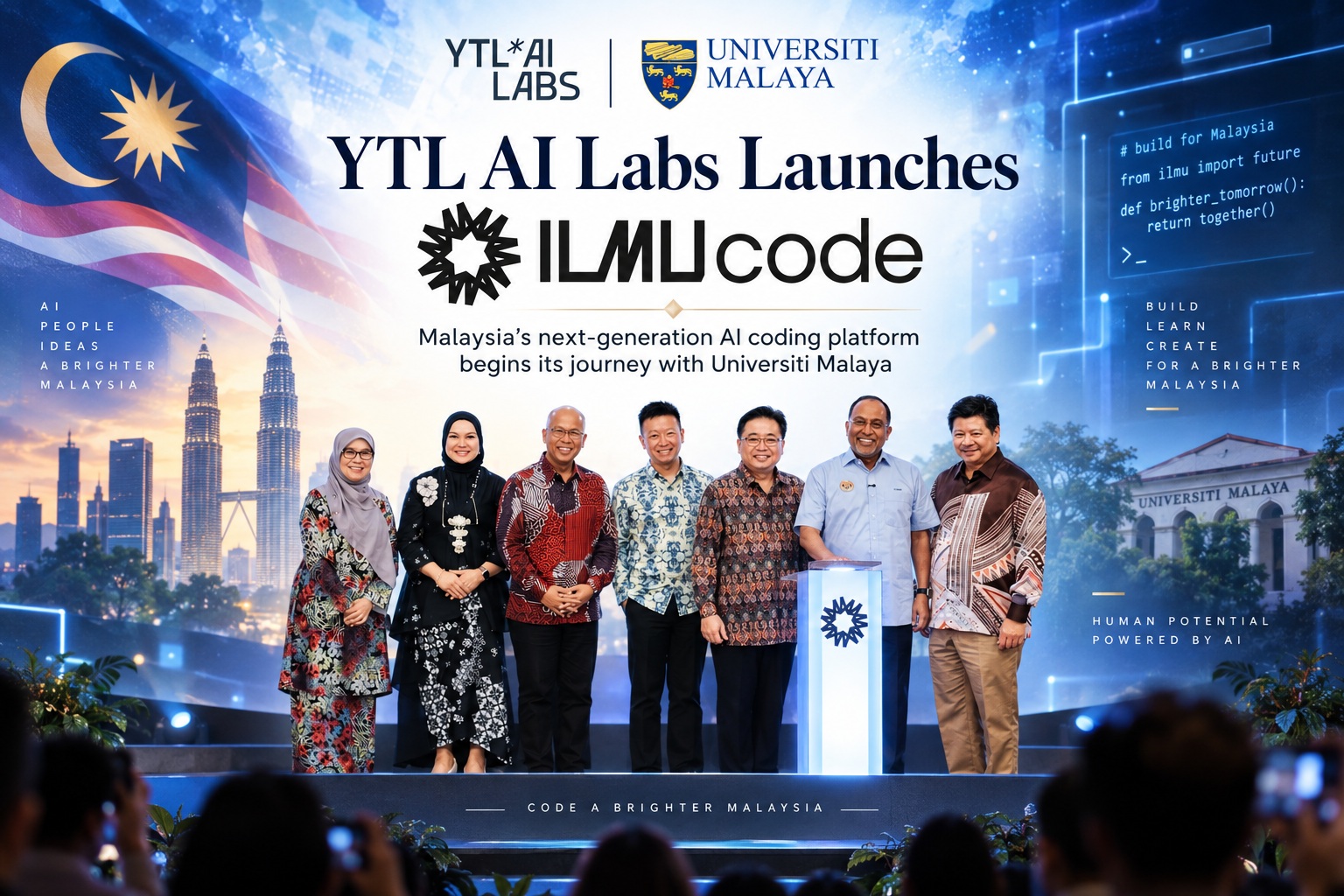
YTL AI Labs has expanded its growing artificial intelligence portfolio with the launch of ILMUCode, a new AI-powered coding platform designed to give developers, students and aspiring software builders access to advanced coding capabilities through sovereign Malaysian infrastructure. The company says the platform aims to deliver frontier-level coding assistance at a significantly lower cost, while keeping the underlying infrastructure and AI development closer to home.
ILMUCode combines agentic AI capabilities with YTL AI Labs' own language model, ILMU-GLM-5.3, developed in partnership with Z.ai. Rather than functioning only as a code autocomplete tool, the platform is intended to assist across a much wider portion of the software development lifecycle.
AI Assistance Across the Development Process
YTL AI Labs says ILMUCode can help users understand complex codebases, write new code, modify existing projects, troubleshoot problems and turn ideas into working applications more quickly. The platform's agentic capabilities mean it can potentially work through multiple stages of a development task rather than simply responding to isolated coding questions.
That could make ILMUCode useful for both experienced developers and people still learning programming. A student might use it to understand unfamiliar code or identify why an application is failing, while a professional developer could use the same platform to explore a repository, make changes or accelerate repetitive engineering work.
The company says ILMUCode performs competitively on coding evaluations including Terminal-Bench 2.1 and DeepSWE, placing it among leading coding models according to YTL AI Labs' benchmark claims.
Built Around Malaysia's Sovereign AI Infrastructure
One of the major themes behind ILMUCode is sovereign AI. Instead of relying entirely on foreign AI infrastructure, YTL AI Labs is building models, datasets and platforms intended to support Malaysian developers, institutions and businesses through infrastructure operated within its own ecosystem.
This approach could become increasingly important as organisations consider where their data is processed, how AI services are governed and whether critical technology depends entirely on overseas providers. Sovereign infrastructure does not necessarily mean abandoning global AI research, but rather combining international technology partnerships with locally controlled platforms and priorities.
ILMUCode reflects that strategy by pairing YTL AI Labs' own models with technology developed alongside Z.ai.
Universiti Malaya Will Be an Early Deployment Site
The platform is already being introduced into education through Universiti Malaya, where ILMUCode has been set up ahead of deployment in the coming semester. According to the university, around 800 first-year students from the Faculty of Computer Science and Information Technology are expected to use the platform.
Each participating student will receive RM100 worth of ILMUCode credit per month for three months. Those credits can be used while learning, experimenting and building software through the platform.
Providing students with direct access to an AI coding environment could significantly change how introductory programming is taught. Instead of only writing code manually and waiting for feedback, students can potentially ask questions about errors, explore alternative solutions and receive explanations while they work.
AI Coding in Education Needs More Than Just Code Generation
For first-year students, the biggest value may not necessarily be having AI write complete programs for them. A coding assistant can also help explain unfamiliar syntax, identify mistakes, break down complicated concepts and show how different pieces of a program interact.
Used properly, that could make programming more approachable without removing the need to understand the underlying concepts. The challenge for educators will be ensuring students use AI as a learning tool rather than simply accepting generated answers they cannot explain.
Deploying ILMUCode within a university environment therefore provides YTL AI Labs with an interesting real-world test case. The company can observe how students interact with an agentic coding platform while educators explore how AI fits into formal computer science education.
ILMU-GLM-5.3 Forms Part of the Foundation
At the heart of ILMUCode is ILMU-GLM-5.3, part of YTL AI Labs' expanding family of locally focused AI models. The company says its wider multimodal technology performs strongly on the MalayMMLU benchmark for Bahasa Melayu, reflecting its focus on improving AI capabilities for Malaysian language and context.
The broader ILMU ecosystem also incorporates capabilities such as speech recognition, text-to-speech and embedding models. These technologies could eventually allow coding and development tools to operate across more than traditional text prompts.
A multimodal development environment could, for example, allow users to interact with AI through speech, analyse different forms of project information or retrieve relevant technical context more efficiently.
ILMUCode Joins a Growing Family of Malaysian AI Platforms
ILMUCode is not YTL AI Labs' first attempt to build a broader AI ecosystem under the ILMU branding. Earlier this year, the company introduced the ILMU Claw Agentic AI Platform, developed in collaboration with NVIDIA.
That platform uses the ILMU-Nemo-Nano model, which is believed to be based on NVIDIA's Nemotron 3 Super mixture-of-experts architecture. The collaboration demonstrates how YTL AI Labs is combining locally developed AI initiatives with technology from some of the world's largest AI infrastructure companies.
ILMUCode extends the same strategy specifically into software engineering.
The NVIDIA Partnership Has Also Expanded Into Malaysian Data
YTL AI Labs strengthened its partnership with NVIDIA further in September with the launch of Nemotron-Personas-Malaysia. The open dataset contains approximately 1.35 million synthetic personas designed to represent different aspects of Malaysia's population.
Those personas are derived from Malaysian demographic and labour statistics and are intended to help developers build and evaluate AI systems that better understand local social, linguistic and economic contexts.
The dataset complements platforms such as ILMUCode because locally relevant AI depends on more than computing infrastructure. Models also need data and evaluation environments that reflect the population and language they are expected to serve.
A Malaysian Alternative in a Crowded AI Coding Market
AI coding tools have become one of the most competitive areas of generative AI. Developers can already choose from coding assistants integrated into IDEs, autonomous coding agents and general-purpose language models capable of working across entire repositories.
ILMUCode therefore enters a market filled with powerful alternatives. Its differentiation will likely come from a combination of pricing, sovereign infrastructure, Bahasa Melayu capabilities and integration with YTL AI Labs' wider ecosystem.
For Malaysian institutions in particular, the ability to access advanced coding assistance through locally controlled infrastructure could become an attractive option where governance and data residency are important considerations.
Lower Cost Could Be Just as Important as Model Performance
YTL AI Labs is also emphasising affordability, saying ILMUCode provides frontier-level capabilities at a fraction of the typical cost.
That could matter significantly for universities, startups and individual developers. AI coding agents can consume considerable resources when they are analysing large repositories, repeatedly executing tasks or maintaining long development sessions.
A platform that remains capable while reducing the cost of experimentation could make advanced AI development tools accessible to a much wider group of Malaysian users.
The university credit programme is an early example of that strategy, giving hundreds of students an opportunity to use the technology directly rather than only learning about AI coding tools theoretically.
Final Thoughts
The launch of ILMUCode shows that YTL AI Labs is moving beyond building individual Malaysian AI models and toward creating a broader ecosystem of practical AI products. Coding is a logical area to target because software development is already one of the fields where generative and agentic AI are having the clearest impact.
Combining ILMU-GLM-5.3 with agentic capabilities gives ILMUCode the potential to support everything from understanding codebases and debugging software to building complete applications. Its deployment to 800 Universiti Malaya students will also provide an early indication of how locally developed AI coding tools can fit into education.
More importantly, ILMUCode fits into a much larger strategy involving sovereign AI infrastructure, Malaysian datasets, multimodal models and partnerships with companies such as Z.ai and NVIDIA.
The real test will be how well the platform performs outside benchmarks when developers and students begin using it for everyday software development. But its launch makes one thing increasingly clear: Malaysia's AI ambitions are expanding from building local models toward building complete AI platforms that people can actually use.











Comments 0