

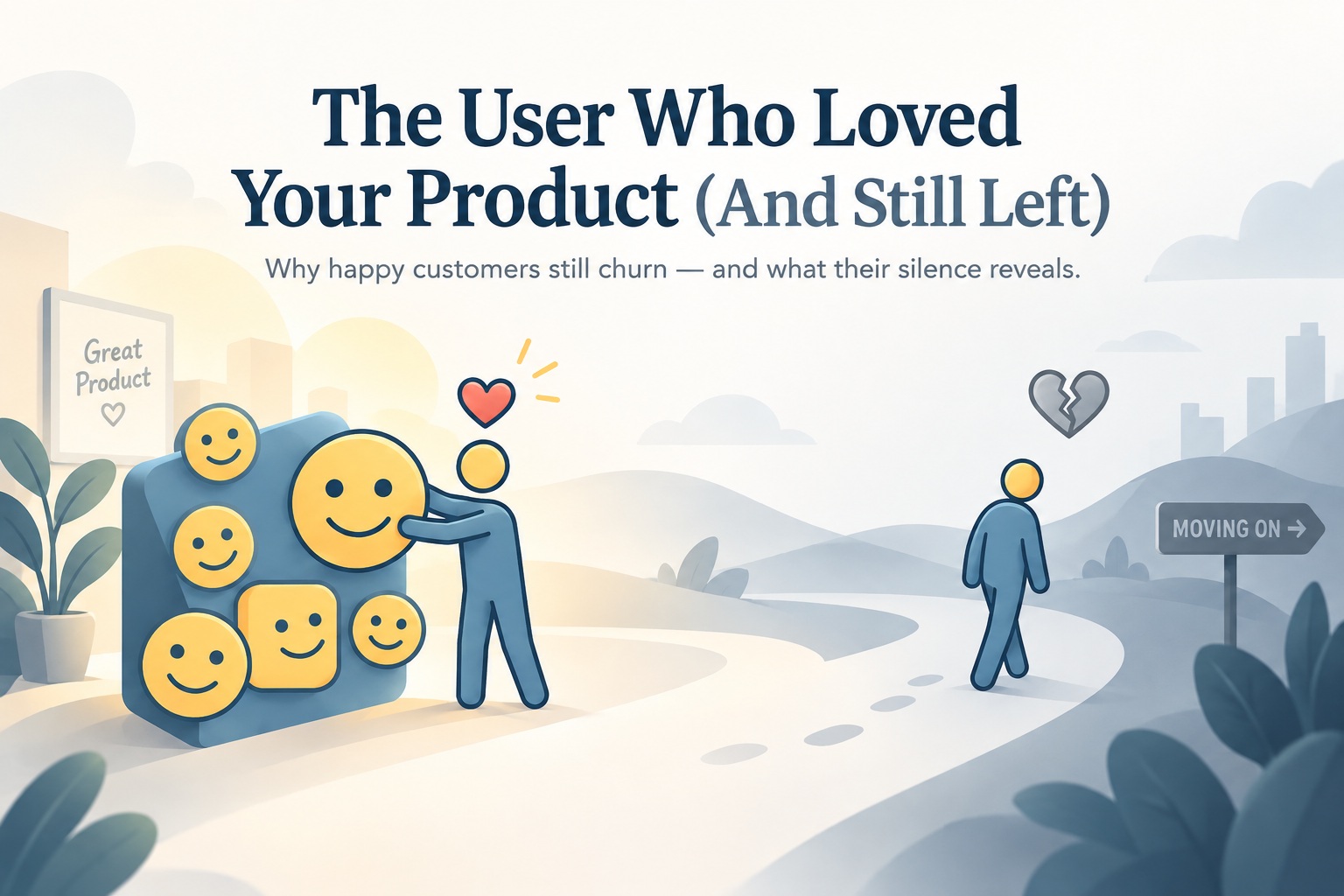
Few things are more confusing for a product team than losing a user who appeared to be happy. They used the product regularly, spoke positively about its features, responded well in surveys, and looked like exactly the kind of person who should become a long-term customer. Then one day, they stopped logging in. There was no complaint, no dramatic cancellation message, and often no obvious warning at all.
That kind of departure can be more valuable than it first appears. A user who disliked the product from the beginning is relatively easy to understand, but a satisfied user who eventually leaves is telling you something much more interesting. It suggests the product may have worked well for one stage of their journey but stopped fitting as their circumstances, expectations, or priorities changed.
The Problem Is That Users Do Not Stay the Same
Products are often designed around the problem a customer has when they first arrive. A beginner may need simplicity, guidance, and a carefully structured workflow, while an experienced user may later want speed, flexibility, automation, or deeper control. If the product continues treating that person exactly as it did on day one, the experience can gradually become limiting even though nothing is technically broken.
This is what I think of as the suitcase problem. A suitcase that was perfect for a weekend trip may become useless when the traveller starts taking month-long journeys. The suitcase did not suddenly become badly designed; the needs around it changed. Products work the same way.
A user who loved your product six months ago may simply have outgrown the version of the problem you originally solved. Retention therefore depends not only on continuing to deliver value, but on understanding how that value needs to evolve as the user becomes more experienced.
The User Who Leaves May Actually Be a Success Story
It is tempting to treat churn as proof that something failed, but that interpretation can be too simplistic. In some cases, the product worked so well that the user progressed beyond the need that originally brought them in. A learning tool may help someone master a skill, a budgeting app may help them build habits, and a beginner design platform may eventually prepare them for more advanced software.
The important question is what happens next. Does the product offer a natural path for that person's growing needs, or does the relationship end the moment the original problem disappears? Products that retain users well often create new layers of value as customers mature.
This does not mean every user should remain forever. Some products are naturally temporary. But when a valuable customer leaves for a competitor because they needed something your product could reasonably have provided, that is not just churn. It is information about where the product stopped growing with them.
Your Analytics Can Tell You What Happened, but Not Always Why
Most product dashboards are excellent at showing behaviour. You can see when someone signed up, how frequently they logged in, which features they used, how long their sessions lasted, and the exact date they disappeared. What those dashboards often cannot tell you is why the departure happened.
A user may have found a competitor with one critical feature. Their job may have changed, their team may have grown, their workflow may have become more complicated, or the product may simply have stopped feeling worth the effort. All of those situations can produce the same analytics pattern: activity declines, then eventually reaches zero.
This is why quantitative data needs context. A retention chart can show you where customers are leaving, but interviews, cancellation feedback, support conversations, and win-back research can reveal what changed in the user's world. The reason for churn often exists outside the product analytics entirely.
Small Frictions Become Bigger as Expectations Rise
Users do not always leave because of one catastrophic experience. More often, they accumulate minor frustrations until the value of staying no longer feels greater than the effort required. A feature that is slightly difficult to find, a repetitive workflow, a missing integration, or a process that takes three clicks too many can all seem harmless individually.
The problem is that tolerance changes over time. A new user may happily accept a clumsy workflow because they are excited about what the product allows them to do. Six months later, that same workflow may feel painfully inefficient because they now repeat it dozens of times every week.
This creates an important distinction between visible failure and invisible friction. Nothing crashes, no error appears, and the user still completes the task, so the product team assumes everything is fine. Meanwhile, the customer is quietly comparing the experience with alternatives that remove the small annoyances they have learned to notice.
Eventually, one competitor eliminates enough of those frustrations and the user moves on.
High Satisfaction Does Not Guarantee High Retention
Another trap is assuming that positive feedback automatically means the customer intends to stay. Someone can genuinely like a product and still decide that another option better fits what they need today. Satisfaction measures how someone feels about the current experience; retention depends on whether that experience remains relevant in the future.
This is why a strong NPS score should never be treated as proof that churn is under control. A customer may happily recommend your product for beginners while personally moving to a more advanced alternative. Their praise was real, but so was their reason for leaving.
The more useful question is not only, "Do users like this?" but also, "Does this product continue becoming more valuable as they become more capable?" That shift changes the way teams think about roadmaps, segmentation, and long-term product development.
Study the Users Who Left Quietly
The customers who complain loudly often receive the most attention because their problems are visible. The ones who simply disappear can be much harder to understand, yet they may provide more valuable insight into retention. They did not leave because they hated the product; they left because something else became more relevant.
Those users are worth contacting. Ask what they were trying to accomplish when they first joined, what changed over time, which frustrations became more noticeable, and what ultimately caused them to choose another solution. Avoid turning the conversation into a sales attempt, because the objective is not immediately winning them back. It is understanding the point where your product stopped fitting.
Patterns will eventually emerge. Several departed users may mention the same missing feature, the same scaling limitation, or the same workflow problem. That is the kind of feedback that can shape the next stage of the product far more effectively than another dashboard metric.
Retention Is Really About Continuing Relevance
Product teams often talk about stickiness as though the goal is simply making people come back. That framing can lead to superficial tactics such as notifications, streaks, reminders, and engagement prompts designed to increase activity without necessarily increasing value.
Real retention comes from relevance. Users continue returning because the product remains useful as their needs change. That may mean introducing advanced features gradually, supporting larger teams, adding integrations, allowing greater customisation, or making repetitive tasks easier once someone becomes an experienced user.
A good product should not force everyone to remain at the same level forever. It should create a journey where users can move from beginner to intermediate to advanced without feeling that they need to abandon the platform to keep progressing.
That progression is often where long-term loyalty is created.
Do Not Ignore the Silence
One of the hardest things about churn is that the most important feedback may never arrive. Users rarely schedule a meeting to explain exactly why they are leaving. They simply stop opening the application, remove the subscription from the company budget, or begin doing the same work somewhere else.
That silence can create a dangerous illusion. The product team sees fewer complaints and assumes the experience is improving, while unhappy or outgrown users have simply stopped caring enough to complain. By the time churn becomes visible in aggregate, the underlying problem may have existed for months.
This is why teams need deliberate processes for understanding departures. Exit surveys, cancellation questions, periodic interviews with inactive users, customer-success follow-ups, and competitor research can all reveal information that active-user analytics cannot provide.
Sometimes the most useful feedback comes from someone who is no longer using the product at all.
Final Thoughts
The user who loved your product and still left is not a contradiction. They may have genuinely valued what you built, recommended it to other people, and achieved exactly what they hoped to achieve when they first signed up. Their departure simply means the relationship between their needs and your product changed.
That makes them incredibly valuable to study. They can show you where your product stops growing with its customers, where small friction begins outweighing value, and where competitors are solving the next problem better than you are.
Retention is not about trapping people inside a product. It is about continuing to earn a place in their lives as those lives change.
So when a seemingly happy user disappears, do not dismiss it as random churn. Ask what changed, what they needed next, and why your product was no longer the answer.
The analytics will tell you that they left. The user can tell you what your next version needs to become.











Comments 0