

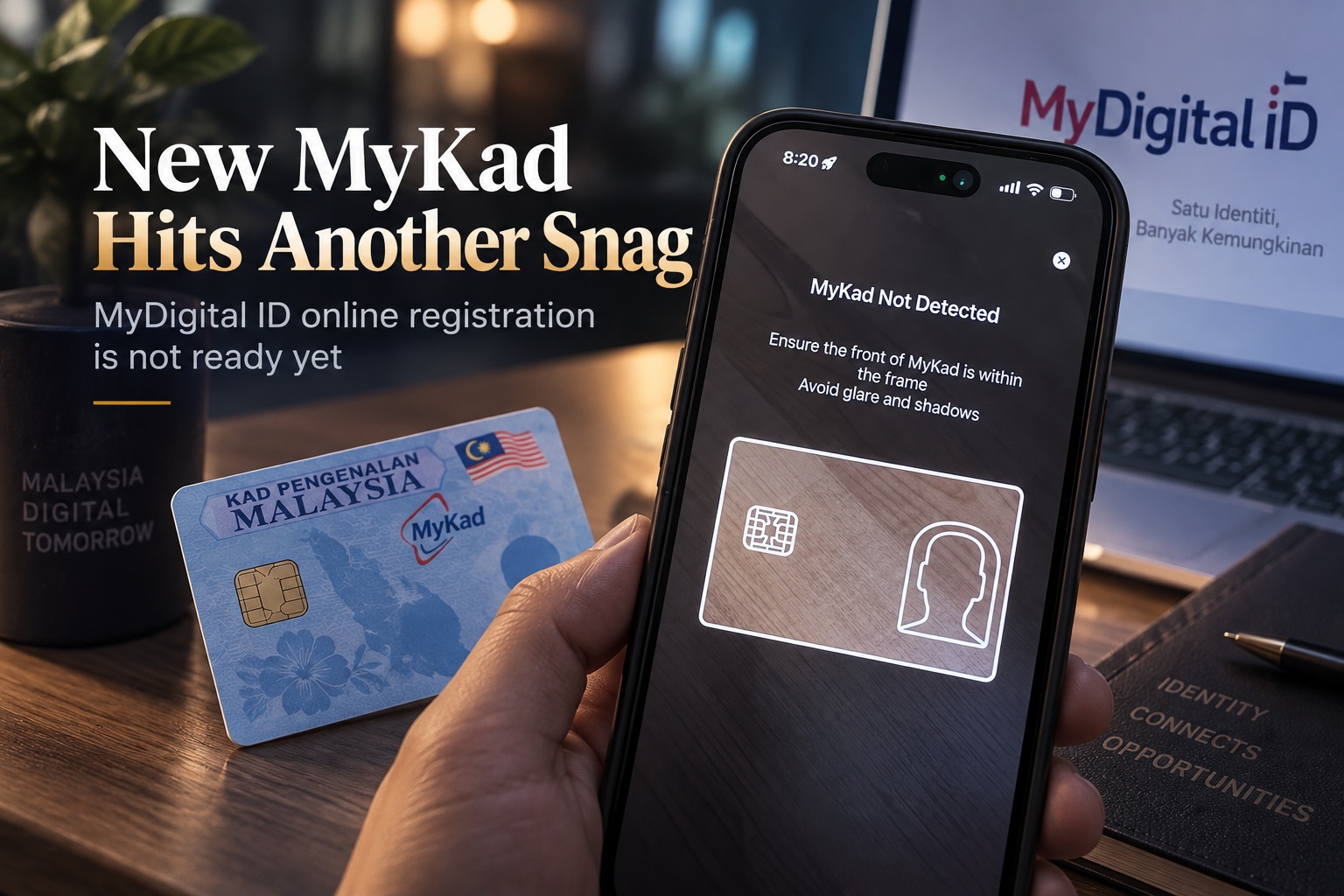
Malaysia's new-generation MyKad has only been available nationwide for a few days, but the redesigned identity card is already exposing compatibility gaps across several digital services. Automated identity-verification systems that were built around the previous MyKad layout are struggling to recognise the new card, creating problems for Malaysians trying to complete electronic Know Your Customer, or eKYC, checks.
The issue has already surfaced with services such as Touch 'n Go eWallet, Ryt Bank, AEON Bank and GXBank, where attempts to verify the new MyKad have reportedly failed. Now MyDigital ID has joined that list, with first-time users discovering that its mobile application cannot yet recognise the redesigned card during online registration. The situation highlights one of the challenges of changing a national identity document: updating the physical card is only one part of the job, because every system that scans or interprets it also needs to be ready.
MyDigital ID Still Expects the Old MyKad Layout
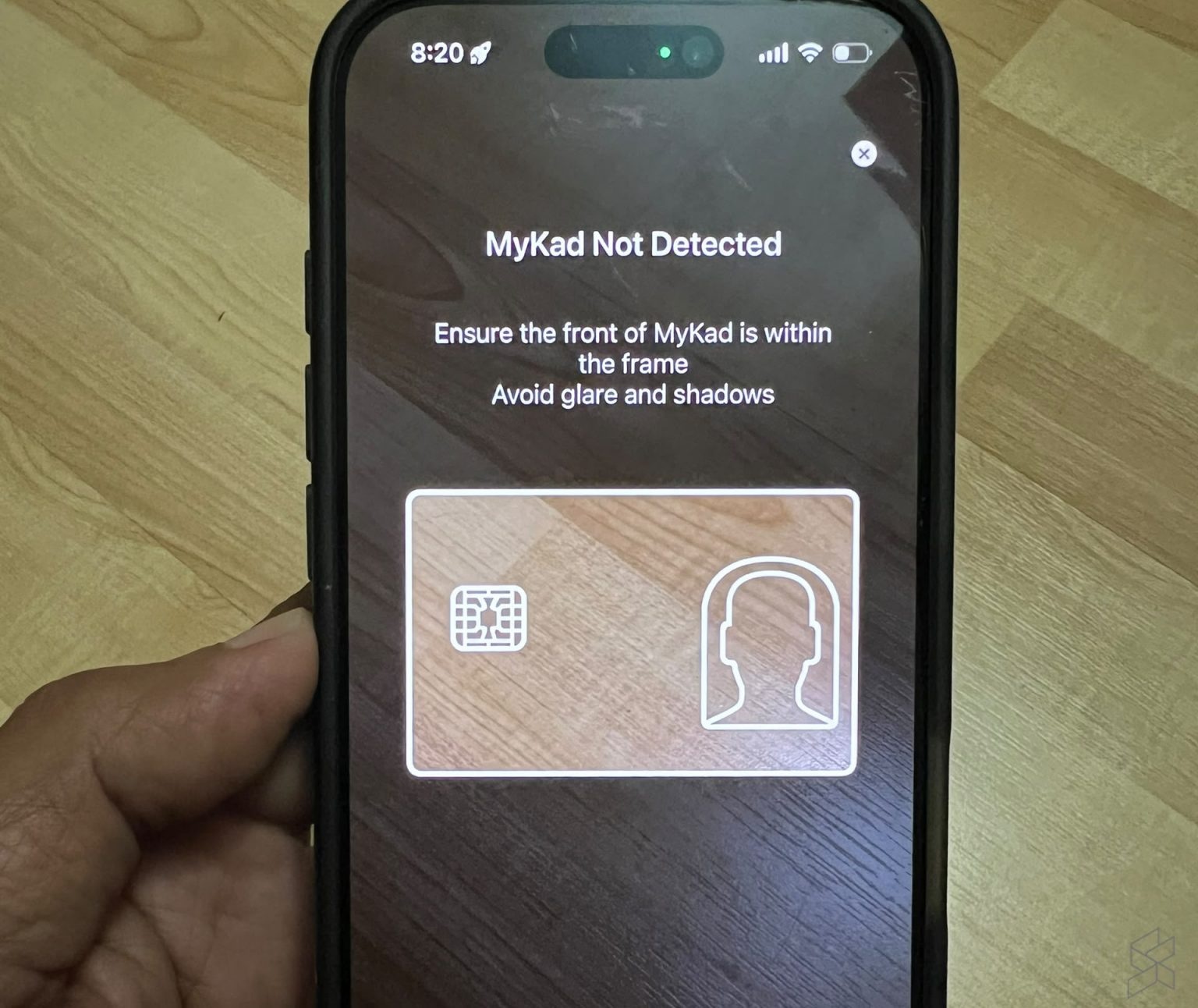
The problem becomes obvious when a new MyKad holder attempts to register through the MyDigital ID app. Instead of accepting the card, the application displays an error stating that the wrong ID has been detected and asks the user to ensure the correct MyKad is positioned inside the frame.
The registration screen itself provides a clue as to why this is happening. MyDigital ID is still displaying a scanning template based on the previous-generation MyKad, where the cardholder's photograph appears on the right side and the physical chip is located on the left. The new card reverses some of those familiar design elements, including moving the photograph to the left and relocating the chip to the rear.
Automated eKYC systems often use computer vision to identify expected regions of a document before extracting text, photographs and other information. When the card suddenly changes its layout, a system trained or configured around the old design may reject the document even though it is completely genuine. That appears to be what is happening across several services now encountering the seventh-generation MyKad.
Online Registration Support Is Coming on 1 October
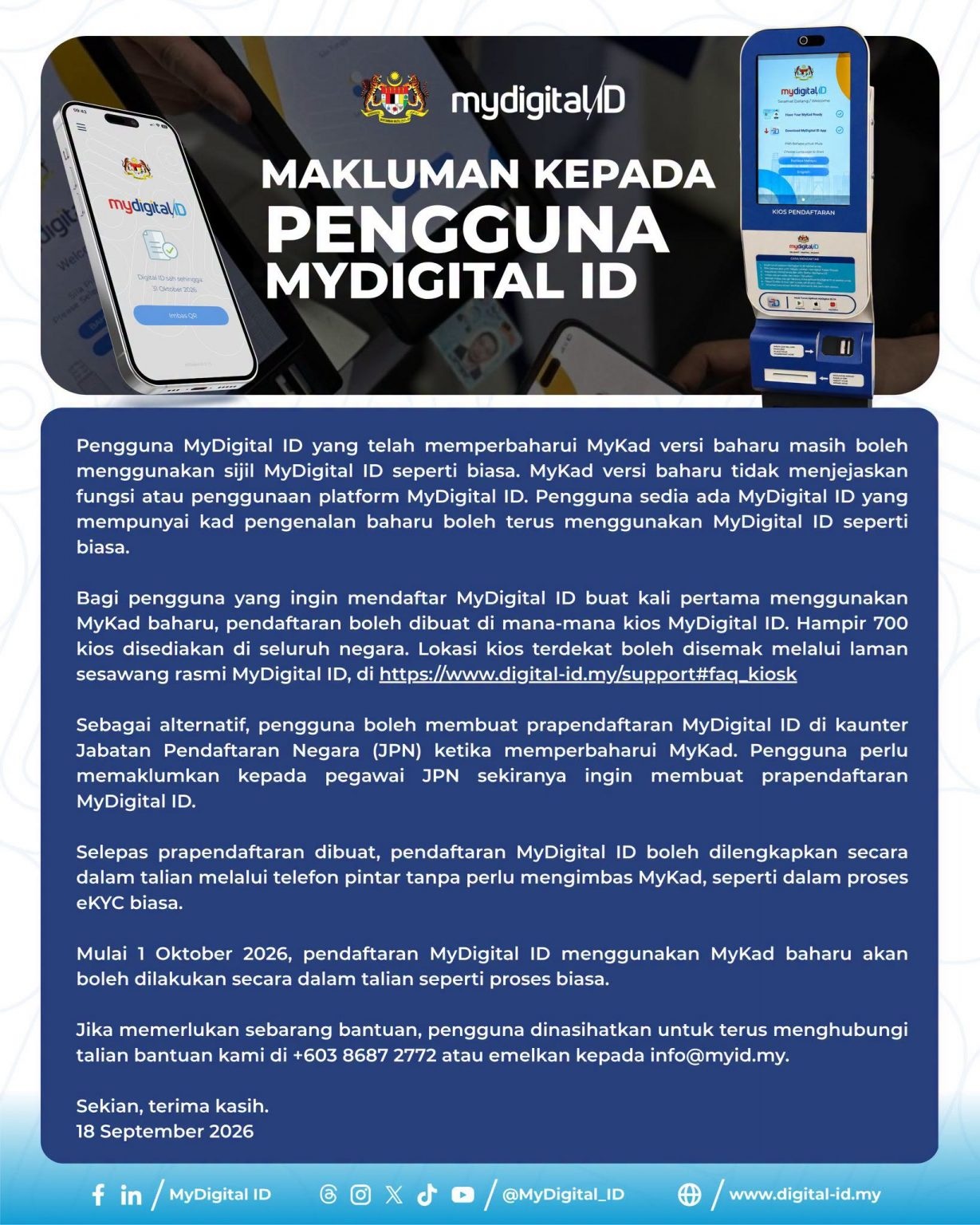
MyDigital ID has acknowledged the problem and confirmed that first-time users with the new MyKad cannot currently complete the normal online registration process. Support for scanning and registering with the redesigned card is scheduled to become available from 1 October 2026.
That at least gives affected users a firm date, rather than leaving them waiting indefinitely for compatibility. Once the update is rolled out, the mobile registration process should recognise the new MyKad layout without requiring users to find an alternative registration method.
Existing MyDigital ID users are not affected in the same way. If someone already completed MyDigital ID registration using their previous MyKad and later replaced it with the new card, their existing MyDigital ID certificate remains valid. They can continue using the service normally without repeating registration simply because their physical identity card has changed.
The inconvenience therefore falls mainly on people trying to register for MyDigital ID for the first time after receiving the new-generation MyKad.
Kiosks Are the Temporary Workaround
Until online support arrives, first-time users with the redesigned MyKad can register through a physical MyDigital ID kiosk. The organisation says there are nearly 700 kiosks available nationwide, providing an alternative for people who cannot wait until the beginning of October.
There is one small physical difference users need to remember at the kiosk. Because the smart-card chip has moved from the front of the MyKad to the rear, the new card needs to be inserted differently into the reader. Users may need to turn the card over before inserting it so that the machine can make contact with the chip correctly.
The kiosk workaround is functional, but it obviously removes some of the convenience that MyDigital ID's smartphone-based registration is supposed to provide. Someone expecting to register entirely online may now have to travel to a kiosk simply because the software has not yet been updated to recognise the government's newest identity card.
For users who do not urgently need MyDigital ID, waiting until 1 October may therefore be the simpler option.
JPN Can Also Help During a New MyKad Application
There is another route for people who are already visiting a National Registration Department, or JPN, counter to apply for or replace their MyKad. Applicants can inform the officer that they would also like to pre-register for MyDigital ID during the card application process.
Once that pre-registration is completed, the user can continue setting up MyDigital ID on their smartphone without having to scan the new card through the usual eKYC process. This effectively bypasses the part of the current mobile registration flow that is having difficulty recognising the redesigned MyKad.
For someone who knows they will need MyDigital ID shortly after collecting their new identity card, asking for pre-registration at JPN could therefore save an additional trip to a kiosk. It is also a useful reminder that the issue is not with the identity information itself; the problem is specifically with automated recognition of the new physical layout.
The New MyKad Changed More Than Its Appearance
The seventh-generation MyKad represents a substantial redesign rather than a simple cosmetic refresh. It introduces 53 security features, a new polycarbonate construction, a repositioned photograph, a relocated smart chip, QR-based verification features and other anti-counterfeiting measures intended to make the national identity card considerably harder to reproduce or tamper with.
Those changes are valuable from a security perspective, but they also create compatibility consequences. Banks, eWallet providers, digital identity systems and other services have spent years building automated processes around the previous-generation card. Many of those systems expect certain information to appear at particular coordinates and may use the card's overall visual structure as part of the verification process.
Change the structure significantly enough and those assumptions stop working.
A human looking at the old and new MyKad can immediately understand that both are Malaysian identity cards. An automated system may be far less flexible unless its recognition models, templates and validation rules have already been updated.
The Rollout Raises Questions About Industry Readiness
The compatibility problems are notable because the new MyKad was not introduced without warning. It had originally been expected to launch on 1 June 2026, before being delayed and eventually unveiled on 16 September. Nationwide issuance started the following day, on 17 September.
That additional preparation time might reasonably have been expected to give major banks, eWallet operators, identity platforms and other organisations time to update their document-verification systems. Yet several widely used services still appear unable to recognise the new card properly immediately after launch.
The situation suggests that coordination between the card rollout and downstream service providers could have been stronger. A national identity card is used far beyond government counters, so changing its design affects every organisation that depends on scanning it. That includes banks, telecommunications providers, digital wallets, insurers, fintech services and countless other platforms that use MyKad for identity verification.
A controlled compatibility programme involving those industries before nationwide issuance could potentially have identified many of these problems earlier.
Why eKYC Compatibility Matters
For users, a failed MyKad scan may initially seem like a relatively minor inconvenience. In reality, eKYC has become a gateway into a growing number of essential digital services. Customers often cannot open bank accounts, activate financial products or complete identity verification until the automated check succeeds.
That means compatibility failures can temporarily prevent a legitimate Malaysian citizen with a brand-new government-issued identity card from accessing services specifically designed around identity verification. The stronger and newer card effectively becomes less usable than the older one until private-sector systems catch up.
This is particularly frustrating for younger Malaysians receiving their first MyKad or anyone replacing a damaged or lost card. They may have no older card to fall back on while waiting for the affected platforms to update their systems.
The good news is that these problems are software-related rather than defects with the MyKad itself. Once providers update their recognition systems and eKYC models, compatibility should improve without requiring cardholders to replace the card again.
There Is Still No Reason to Replace a Working MyKad Early
The latest compatibility issues reinforce JPN's earlier advice that Malaysians with an existing MyKad in good condition do not need to rush out and replace it simply to obtain the newer design. Existing cards remain valid and can continue to be used as normal.
Keeping the older card also does not affect existing government initiatives and entitlements tied to the holder's identity, including programmes such as BUDI95. The rollout is intended to be gradual, with the new MyKad becoming more common as people naturally apply for replacements or receive their first cards.
For anyone whose current MyKad still works properly, waiting also has a practical advantage: it gives banks, eWallets and identity-verification providers more time to update their systems before the new card becomes part of everyday life.
Early adopters of new technology often encounter compatibility problems, but in this case those "early adopters" are simply citizens receiving a government-issued identity document. That makes industry readiness particularly important.
A National ID Upgrade Requires an Ecosystem Upgrade
The wider lesson from the rollout is that identity infrastructure is an ecosystem. JPN can design and issue a more secure card, but the user experience ultimately depends on hundreds of other systems being able to recognise and process it correctly.
Physical security, digital identity, eKYC and financial services are increasingly interconnected. A new security hologram or chip placement may improve protection against counterfeiting while simultaneously requiring updates to card readers, optical-recognition software, mobile applications and automated compliance systems.
That does not mean the new MyKad should have retained the old layout forever. Security technology needs to evolve. It simply means major changes to something as fundamental as a national ID should ideally be accompanied by broad interoperability testing before millions of citizens begin depending on it.
The current issues with MyDigital ID and several financial services illustrate exactly why that preparation matters.
Final Thoughts
The new-generation MyKad brings meaningful improvements to security and durability, but its first few days of nationwide availability have shown that launching the card itself was only half the job. Several services relying on automated MyKad scanning were apparently not fully prepared for the redesigned layout, leaving some new cardholders unable to complete ordinary eKYC registration.
MyDigital ID has at least provided a clear short-term solution. Existing users remain unaffected, new users can register through one of nearly 700 kiosks, and online registration support for the redesigned MyKad is scheduled to arrive on 1 October 2026. Those applying for a card at JPN can also request MyDigital ID pre-registration to avoid the problematic scanning step.
The larger concern is coordination. A national identity card is connected to an enormous number of public and private digital services, so changing its design inevitably affects much more than JPN's own systems. Testing with major banks, fintech companies, eWallet operators and digital identity providers before the nationwide rollout could have helped expose these compatibility problems before citizens encountered them.
For Malaysians whose existing MyKad is still functioning properly, there remains no urgency to replace it. The new card may offer stronger security, but at least for the moment, the older design has one practical advantage: almost every digital verification system already knows how to recognise it.











Comments 0