

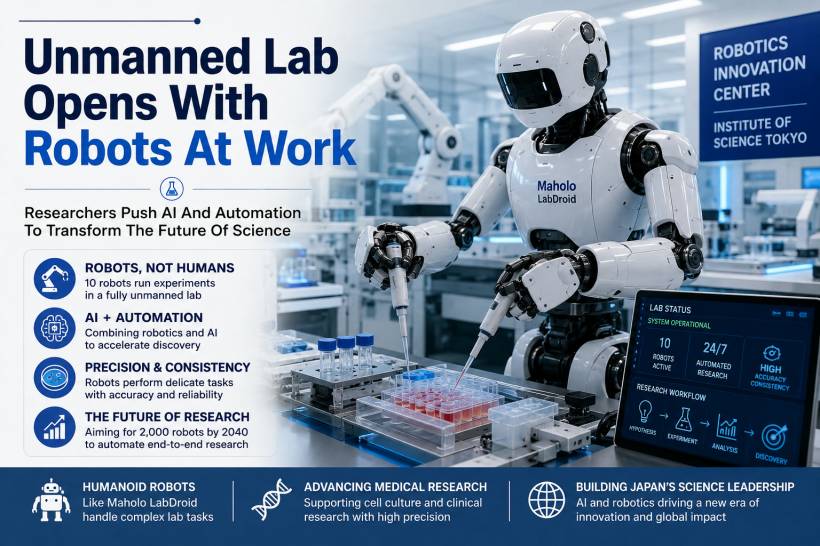
A university in Tokyo has opened a new laboratory where robots, not human researchers, are carrying out medical experiments. It may sound like something from a science fiction film, but this is now becoming part of real-world research as universities and laboratories explore how automation and artificial intelligence can support scientific discovery.
The facility, located at the Institute of Science Tokyo's Yushima campus, is known as the Robotics Innovation Center. What makes it especially interesting is that the lab operates with 10 robots and no human staff inside the experimental workspace. Among them is a humanoid robot called Maholo LabDroid, which is designed to perform precise laboratory tasks that would normally require trained researchers.
This development is not just about replacing repetitive work with machines. It points to a much bigger ambition: a future where research can be carried out with fewer delays, less human error, and eventually, far greater scale.
A Laboratory Where Robots Do The Hands-On Work
In a traditional medical research lab, human researchers spend many hours performing repetitive but delicate tasks. These may include measuring reagents, transferring liquids, preparing samples, opening laboratory equipment, moving items between temperature-controlled devices, and monitoring cell cultures.
The Robotics Innovation Center is designed to automate these kinds of tasks. The robots are equipped with arms that can handle careful movements, such as transferring fixed amounts of reagents or placing samples into controlled environments. Cell cultivation, which has already been programmed into the system, can also be performed automatically.
This matters because laboratory work often demands consistency. A small variation in timing, measurement, temperature, or handling can affect experimental results. Robots, when properly programmed and monitored, can repeat the same task with a high level of precision. That consistency could help improve reliability in research, especially for experiments that require repeated procedures over long periods.
Maholo LabDroid And The Rise Of Robotic Researchers
One of the key robots in the facility is Maholo LabDroid, a humanoid laboratory robot built to perform scientific tasks in environments originally designed for humans. This is important because many existing laboratories are not built around machines. They are built around human researchers using benches, instruments, containers, refrigerators, incubators, and other standard lab equipment.
A humanoid-style robot can be useful because it can interact with existing tools and machines without requiring the entire laboratory to be redesigned from scratch. With two arms, it can handle objects, operate equipment doors, and carry out controlled movements in a way that resembles human lab work.
Maholo is not entirely new to research environments. It has already been used at a hospital in Kobe, Hyogo Prefecture, where it supports clinical research involving induced pluripotent stem cells. Its work there includes cell culture tasks, which are highly sensitive and require careful handling. Researchers with experience operating Maholo in Kobe have also joined the new center, bringing practical knowledge into the expanded robotics programme.
Why Research Labs Are Turning To Automation
There are several reasons why universities and research institutions are becoming more interested in automation. One of the biggest is labour shortage. Scientific research requires skilled people, but not every task in the lab makes the best use of a researcher's expertise. Many hours can be spent on repeated manual procedures that are necessary but time-consuming.
Automation can help free researchers from some of these repetitive tasks, allowing them to focus more on designing experiments, analysing results, interpreting findings, and developing new ideas. This does not mean humans disappear from science. Rather, the role of researchers may shift from doing every manual step themselves to supervising automated systems and making higher-level scientific decisions.
Another reason is the need to reduce human error. Even skilled researchers can make mistakes, especially when performing repetitive tasks over long hours. Fatigue, distraction, manual inconsistency, and small measurement differences can all affect results. Robots can help standardise procedures, which may improve the quality and reproducibility of experiments.
The Bigger Goal: Combining Robotics With Artificial Intelligence
The long-term vision is even more ambitious. The university plans to increase the number of robots dramatically in the future, with a target of around 2,000 robots by 2040. The goal is not only to automate individual lab tasks, but to build an environment where robots and AI systems can support almost the entire research process.
That includes generating hypotheses, planning experiments, carrying out tests, collecting results, and assisting with experimental verification. If this vision becomes reality, research could become much faster and more scalable. Instead of waiting for human teams to manually perform every step, automated systems could run experiments continuously and analyse large amounts of data more efficiently.
This could be especially useful in medical research, biotechnology, drug discovery, cell science, and other fields where experimentation can be slow, expensive, and labour-intensive.
Japan's Push To Strengthen Scientific Research
At the opening ceremony for the facility, Keiichi Nakayama, the head of the center, said the goal is to make Japan's science the best in the world. His comments reflect a broader ambition: using AI and robotics not merely as supporting tools, but as a national strategy to strengthen research competitiveness.
Japan has long been associated with robotics, precision engineering, and advanced manufacturing. Applying those strengths to scientific laboratories is a logical next step. If successful, robot-powered labs could help Japan accelerate research output at a time when many countries are competing heavily in biotechnology, healthcare innovation, and AI-assisted discovery.
The symbolism of robots joining the ribbon-cutting ceremony also says a lot. It was not just a technical launch. It was a statement about where the university believes research is heading.
What This Means For The Future Of Scientists
The rise of robot labs may raise questions about whether machines will replace human researchers. In reality, the future is likely to be more balanced. Robots are well-suited for repetitive, precise, and time-consuming tasks. AI can assist with pattern recognition, data analysis, and experimental suggestions. But human scientists are still needed for judgment, ethics, creativity, research direction, and interpretation.
Scientific discovery is not only about performing tasks. It also involves asking meaningful questions, understanding context, challenging assumptions, and deciding what results actually mean. Automation can support that process, but it does not remove the need for human intelligence.
What may change is the daily workflow of researchers. Instead of spending so much time manually preparing samples or repeating procedures, researchers may increasingly manage robotic systems, review automated results, and design better experiments using AI-assisted tools.
A Glimpse Into The Next Generation Of Research Labs
The Robotics Innovation Center provides a glimpse of how future research facilities may operate. Labs may become more like intelligent production environments, where robots, AI systems, sensors, and human experts work together in a coordinated loop.
This could reduce bottlenecks in medical research and improve the speed of scientific testing. It could also make experiments more reproducible, because machines can document and repeat steps in a highly consistent way. For fields such as cell culture, drug screening, and regenerative medicine, that consistency could be extremely valuable.
However, the success of this model will depend on more than just having robots in the lab. The systems must be reliable, safe, properly validated, and able to operate within strict scientific and ethical standards. Human oversight will remain important, especially when research involves clinical applications or sensitive biological material.
Final Thoughts
The opening of an unmanned robot laboratory in Japan is an important sign of where scientific research may be heading. It shows that automation is no longer limited to factories or warehouses. It is now entering highly specialised research environments where precision, consistency, and scale matter.
For now, human researchers remain essential. But their role may gradually evolve as robots take over more repetitive experimental work and AI becomes more involved in research planning and analysis. If used wisely, this could make science faster, more reliable, and less constrained by labour shortages.
The real story is not simply that robots are working in a lab. The bigger story is that research itself may be entering a new era, where humans, AI, and robotics work together to push discovery further than traditional lab models could manage on their own.











Comments 0