

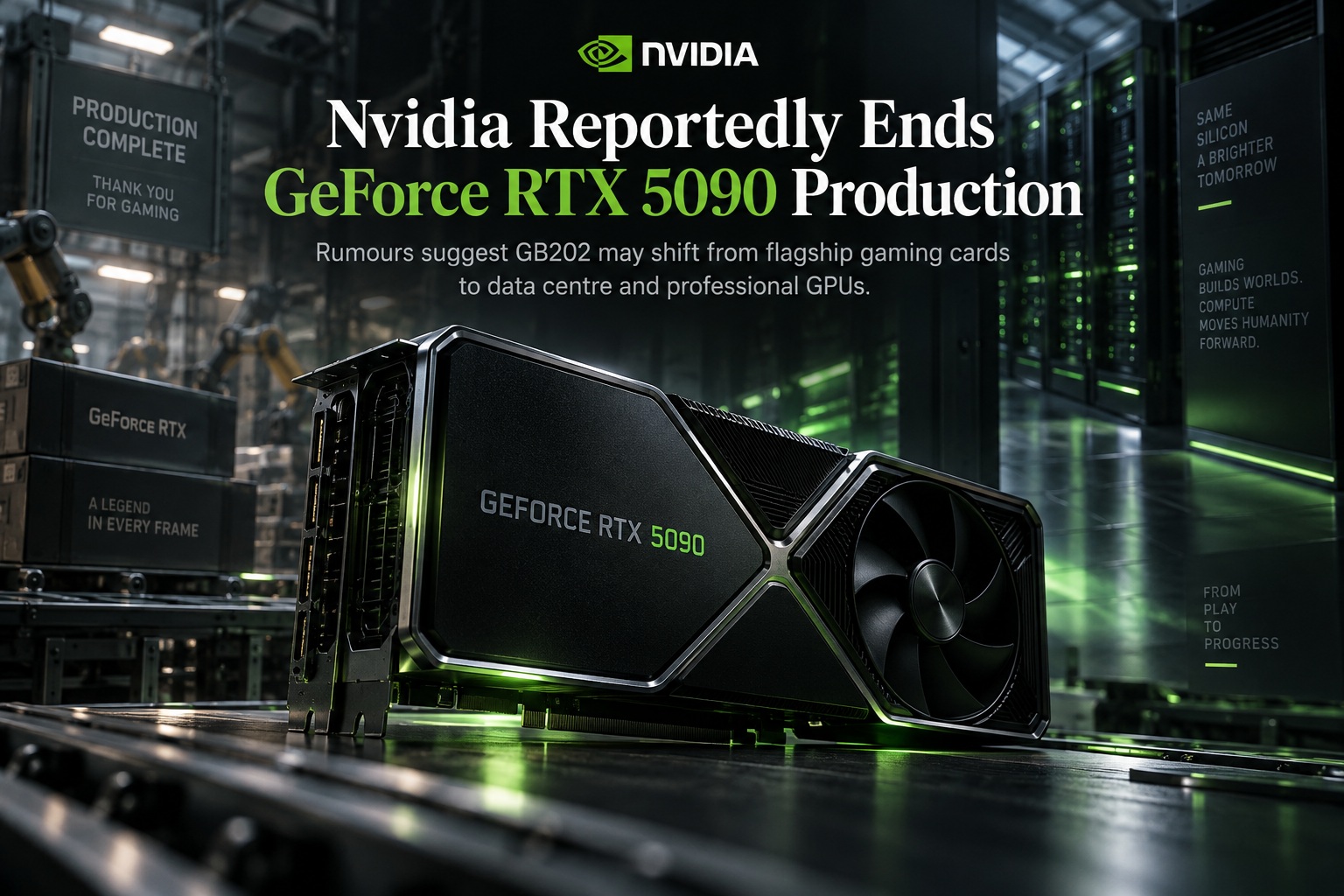
Nvidia may have quietly stopped producing its flagship GeForce RTX 5090 graphics card, including the RTX 5090 D variants sold in China. The claim has not been officially confirmed by Nvidia, but multiple leakers are now pointing to the same possibility, suggesting that the company may be redirecting its high-end GB202 silicon away from consumer GeForce products and towards more profitable data centre and professional graphics cards.
If the reports are accurate, the RTX 5090 could be reaching the end of its production run much earlier than many PC enthusiasts expected. That would also leave the RTX 5080 as Nvidia's highest-end GeForce model still in active production, although even that lineup may be changing.
Leaked Factory Notice Claims RTX 5090 Production Has Stopped
The latest rumours originated from a leaked factory notice shared by hardware leaker @hongxing2020. According to the message, Nvidia will no longer manufacture any RTX 5090 models, including the specialised D variants created for the Chinese market.
The same notice reportedly states that the RTX 5080 24GB will become the highest-end GeForce graphics card going forward. It also claims that the existing RTX 5080 16GB version will be discontinued.
That would represent a significant reshuffling of Nvidia's high-end consumer GPU lineup, especially considering how recently the RTX 50-series entered the market.
A Second Leaker Supports The Claim
Another hardware leaker, @Zed__Wang, has reportedly backed the production-cut claim. According to this source, Nvidia's GB202 GPU, which powers the RTX 5090, will no longer be allocated to consumer GeForce products.
Instead, future GB202 production is expected to be reserved for data centre and professional graphics cards.
This part of the rumour is particularly believable from a business perspective because Nvidia can generally generate significantly higher margins from enterprise AI accelerators and professional GPUs than from gaming cards.
However, until Nvidia confirms the change, the information should still be treated as unverified.
GB202 Could Become Too Valuable For Gaming
The RTX 5090 is built around Nvidia's massive GB202 GPU, one of the largest and most powerful chips in the Blackwell generation. Producing such a large processor is expensive, and every usable GB202 die can potentially be allocated to several different markets.
For Nvidia, the current AI boom creates an obvious economic incentive to prioritise enterprise products. Data centre customers are willing to pay considerably more for high-performance compute hardware than typical PC gamers, and demand for AI infrastructure remains extremely strong.
If Nvidia can use the same or similar silicon in products that generate much higher revenue, reducing GeForce allocation would make commercial sense.
That does not necessarily mean the RTX 5090 was unsuccessful. It may simply mean the underlying silicon is more valuable elsewhere.
Chinese RTX 5090 D Models Are Reportedly Affected Too
The production halt is also said to include RTX 5090 D variants designed specifically for the Chinese market.
These versions were created to comply with export restrictions affecting high-performance computing hardware. Nvidia has repeatedly adjusted its product configurations for China as regulations surrounding advanced processors have changed.
If all RTX 5090 D production is also ending, it would suggest Nvidia is simplifying GB202 allocation globally rather than merely restructuring one regional lineup.
Again, Nvidia has not officially announced any such discontinuation.
RTX 5080 Could Become The New GeForce Flagship
Should the reports prove accurate, the RTX 5080 would effectively become Nvidia's highest-end consumer graphics card.
The leaked factory notice specifically mentions an upcoming RTX 5080 24GB model taking that position. Meanwhile, the existing RTX 5080 16GB is reportedly expected to be phased out.
A higher-memory RTX 5080 could make sense as a replacement at the top of the GeForce lineup, especially for gamers and creators who need more VRAM but do not necessarily require the full performance or price of the RTX 5090.
The move could also create a cleaner product stack if Nvidia proceeds with its rumoured RTX 50 Super refresh.
RTX 50 Super Refresh May Be Delayed
Rumours have circulated for some time that Nvidia is preparing refreshed RTX 50 Super graphics cards, including a possible RTX 5080 Super equipped with 24GB of memory.
However, those plans have reportedly been delayed because of memory supply constraints.
High-capacity graphics memory has become increasingly important not only for gaming but also for AI workloads and content creation. As demand rises across multiple industries, securing enough suitable memory at acceptable prices can become a limiting factor.
If the RTX 5080 24GB is indeed intended to become Nvidia's new consumer flagship, memory availability could directly influence when that transition happens.
The RTX 5090 Could Become Harder To Find
If manufacturing has genuinely stopped, retail availability could gradually tighten as remaining inventory works its way through distributors and stores.
That could create an unusual market situation. Instead of prices falling as the product gets older, limited supply could keep RTX 5090 pricing elevated or even push it higher in certain regions.
High-end Nvidia cards already tend to experience strong demand from gamers, AI enthusiasts, creators and workstation users. A sudden production stop could make remaining units even more desirable.
Of course, this depends heavily on how much unsold inventory is still in the channel.
Used Market Prices Could Also Be Affected
A confirmed discontinuation could also influence second-hand pricing.
Owners of RTX 5090 cards may hold onto them longer if they know no direct replacement is coming soon. Buyers unable to find new stock could turn to the used market, increasing demand there as well.
This would be especially likely if the next generation remains more than a year away.
On the other hand, pricing could still soften if a stronger RTX 5080 Super or similar product delivers enough performance at a significantly lower price.
RTX 60-Series May Still Be A Long Way Off
Nvidia's next major consumer GPU generation is expected to use its Rubin architecture, but current rumours suggest RTX 60-series products may not arrive until late 2027 at the earliest.
Some reports even point towards a 2028 launch.
If that timeline is accurate, retiring the RTX 5090 now would create a relatively long gap before a true next-generation flagship replacement appears.
That would make an RTX 5080 refresh even more important because Nvidia would need something capable of serving enthusiast buyers during the transition.
Why Nvidia Might Prefer Professional Markets
The broader shift towards professional and data centre hardware reflects how much Nvidia's business has changed over the past few years.
Gaming remains important, but AI infrastructure has become the company's biggest growth engine. Enterprise customers purchase enormous numbers of accelerators for training and running large AI models, often at prices far above consumer GPUs.
When production capacity is limited, the company naturally has to decide where each high-end chip generates the most value.
From that perspective, diverting GB202 away from GeForce products may simply be a matter of prioritising the most profitable market.
This Would Not Be The First Time Gaming Takes A Back Seat
PC gamers have already experienced similar situations during previous GPU shortages, cryptocurrency mining booms and manufacturing constraints.
Whenever demand from another market increases dramatically, consumer GPU availability tends to suffer first.
The difference today is that AI demand appears more structural than temporary. Data centre expansion is being driven by major cloud providers, technology companies and governments investing heavily in AI infrastructure.
That could mean high-end gaming GPUs increasingly compete directly with professional products for silicon allocation.
Nvidia Has Not Confirmed Anything Yet
Despite the growing number of reports, Nvidia has not officially announced that RTX 5090 production has ended.
The company has also reportedly not responded to requests for clarification.
That means all current information should still be treated as a rumour rather than a confirmed product discontinuation.
It is possible that manufacturing has paused temporarily, regional supply is being adjusted or certain production batches are being reallocated without permanently ending the RTX 5090.
Until Nvidia issues a statement, those possibilities remain open.
What Existing RTX 5090 Owners Need To Know
If you already own an RTX 5090, there is no immediate reason for concern.
A production stop would not affect the performance of existing cards, and Nvidia would still be expected to provide drivers and software support as normal.
The main impact would be on future availability and pricing rather than existing hardware.
In fact, if supply becomes limited, current owners could end up holding one of the more unusual flagship cards of this generation.
Should You Buy One Now?
Anyone considering an RTX 5090 should avoid panic buying based solely on leaked information.
If you genuinely need the performance and can find the card at a reasonable price, the potential production halt may be relevant. But paying a large premium simply because of rumours could be risky.
The situation could change quickly if Nvidia launches an RTX 5080 Super with more memory, resumes production or introduces another high-end model.
For most buyers, waiting for clearer official information would be the safer approach.
Final Thoughts
Reports that Nvidia has stopped manufacturing the GeForce RTX 5090 are significant, particularly because the GB202 chip may reportedly be redirected entirely towards professional and data centre products. If true, the RTX 5080 24GB could become Nvidia's new consumer flagship while the current 16GB model is phased out.
The move would also highlight how strongly AI demand is reshaping the graphics hardware market. High-end silicon that once primarily served gaming is now increasingly valuable for enterprise compute, where Nvidia can earn far more per chip.
For now, though, the story remains unconfirmed. Until Nvidia officially announces a change, the RTX 5090 should be considered potentially discontinued rather than definitively gone.











Comments 0