

Xiaomi has officially introduced its latest flagship mobile chipset, the Xring O3, as the company continues pushing deeper into custom silicon development. Alongside the announcement, Xiaomi also confirmed that the processor will make its first appearance inside the upcoming Xiaomi 18 Fold, which is expected to launch in China this September.
The new chip is being positioned as a flagship-class system-on-chip capable of competing with high-end offerings from Qualcomm and MediaTek. While Xiaomi has confirmed the existence of the Xring O3, many of its detailed specifications remain based on reports and leaks, so some information could still change before devices using the chip reach consumers.
Interestingly, Xiaomi appears to have skipped the Xring O2 branding entirely, moving directly to O3 without publicly explaining the reason.
Xring O3 Aims for Flagship Performance
According to current reports, the Xring O3 carries the internal codename "Lhasa" and is manufactured by TSMC.
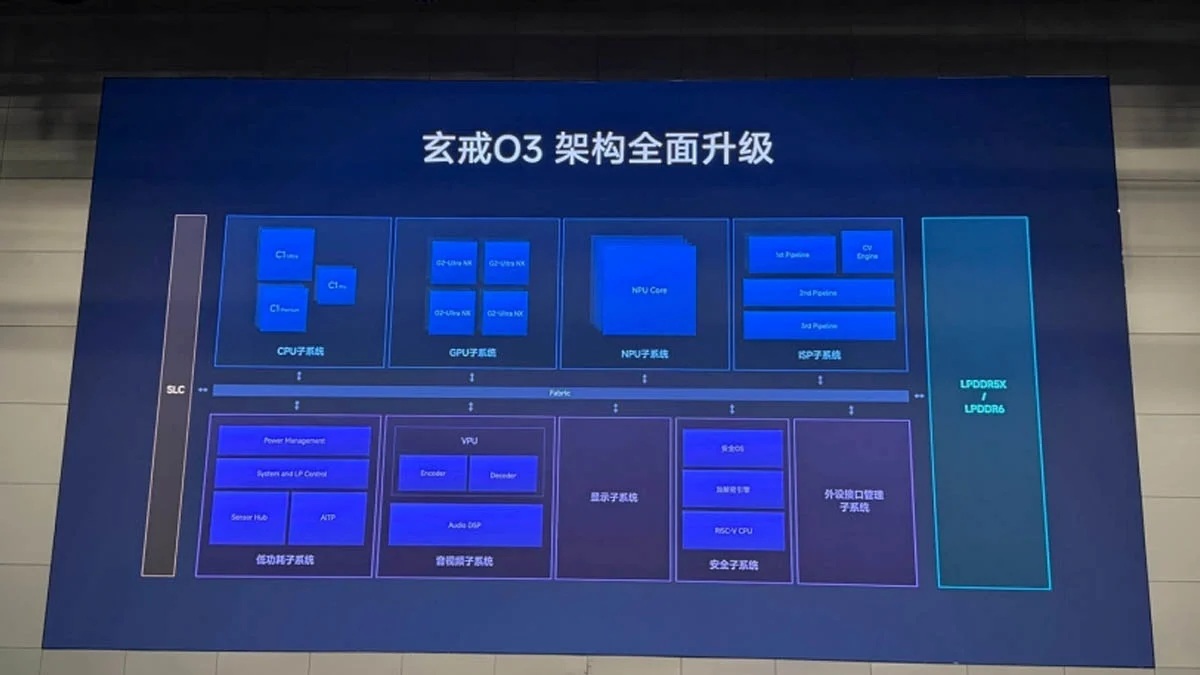
The chipset is expected to use an advanced multi-cluster CPU architecture, although reports currently disagree over the exact configuration. Possibilities include either a 1+3+4 or 1+2+5 arrangement.
Peak CPU frequencies could reportedly reach around 4.05GHz, while additional performance cores may operate at up to 3.42GHz and efficiency cores at approximately 3.02GHz.
The integrated GPU is also expected to receive a significant clock-speed increase, potentially reaching around 1.5GHz, compared with approximately 1.2GHz on Xiaomi's previous generation.
Memory support is another area where conflicting reports have emerged.
Some sources suggest memory speeds could remain around 9,600 MT/s, while others claim the Xring O3 could become the first mobile chipset supporting LPDDR6, with transfer speeds of up to 10,667Mbps and memory bandwidth reaching 113.8GB/s.
Other reported specifications include a die size of approximately 133mm², production using TSMC's 3nm manufacturing technology and more than 24 billion transistors.
Until Xiaomi releases the complete technical specifications, however, these figures should still be treated cautiously.
AI Performance Gets a Major Upgrade
Artificial intelligence appears to be one of Xiaomi's main areas of focus with the Xring O3.
The chipset has reportedly been optimised specifically for Xiaomi's MiMo on-device AI models, allowing more AI processing to happen directly on the device instead of depending entirely on cloud servers.
Its neural processing unit is claimed to deliver as much as 200 TOPS of tensor performance, together with 3.13 TFLOPS of vector performance.
Xiaomi is also said to have redesigned parts of the internal architecture to improve responsiveness and power efficiency, resulting in claimed latency as low as 82 nanoseconds.
Overall AI performance is reportedly around 45% higher than its predecessor.
The architecture may also include two dedicated CPU AI acceleration units alongside eight neural-network accelerators integrated into the GPU.
If those figures hold up in shipping devices, the Xring O3 could become particularly important for Xiaomi as smartphone manufacturers increasingly move generative AI, image processing and intelligent system features directly onto mobile hardware.
Xiaomi 18 Fold Will Be the First Device to Use It
The biggest confirmation accompanying the chipset announcement is that the Xiaomi 18 Fold will become the first smartphone powered by Xring O3.
Xiaomi has already released what appears to be an early teaser featuring company CEO Lei Jun holding a foldable smartphone.
The device shown has attracted attention partly because of its unusual burgundy finish, a colour not commonly associated with Xiaomi's previous foldable models.
Current rumours suggest Xiaomi is developing the phone as a conventional book-style wide foldable similar to Samsung's Galaxy Z Fold series rather than experimenting with a tri-fold or compact flip design.
An alleged render circulating on Weibo also claims to show the device opened, potentially giving us an early look at its overall proportions.
Again, Xiaomi has not yet confirmed most of the hardware details surrounding the phone.
A Large Display and 200MP Camera Are Rumoured
Reports currently suggest that the Xiaomi 18 Fold could feature an inner folding display measuring approximately 7.5 to 7.6 inches.
That would place it firmly within the same general size category as other premium book-style foldables.
A side-mounted fingerprint sensor is also rumoured.
Photography could become another major selling point, with reports pointing toward a 200MP primary rear camera.
Other alleged specifications include a substantial 6,000mAh battery, wireless charging support and Xiaomi's upcoming HyperOS 4 based on Android 17.
A battery of that capacity would be particularly interesting for a foldable smartphone, where manufacturers traditionally need to balance battery size against the additional space consumed by hinges and dual displays.
If Xiaomi manages to combine a large battery with an efficient custom chipset, battery endurance could become one of the 18 Fold's more compelling advantages.
Custom Silicon Gives Xiaomi More Control
The Xring O3 announcement also represents something bigger than simply another mobile processor launch.
Developing custom silicon gives Xiaomi greater control over how hardware and software work together.
Companies such as Apple and Google already demonstrate the advantages of designing processors around their own operating systems, AI models, cameras and power-management strategies.
Xiaomi is increasingly heading in the same direction.
Instead of relying entirely on Qualcomm or MediaTek to determine what processing capabilities are available, Xiaomi can potentially tailor its own chips around the features it wants to introduce.
That could include custom camera processing, AI acceleration, battery optimisation and tighter integration with HyperOS.
Of course, competing at the highest level of semiconductor design is extremely difficult.
Qualcomm and MediaTek have spent many years refining their flagship mobile platforms, while Apple has invested heavily in custom silicon for well over a decade.
The real test for Xring O3 will therefore come from actual devices rather than specification sheets.
A Xiaomi Pad 8S Pro Could Also Use Xring O3
The Xiaomi 18 Fold may not remain the only device powered by the new chipset.
Reports suggest Xiaomi is also preparing a tablet called the Xiaomi Pad 8S Pro, which could use the Xring O3.
The tablet is rumoured to launch alongside an upcoming Xiaomi MIX Ultra.
Current leaks point toward a 12.5-inch display, a massive 12,000mAh battery and configurations offering up to 16GB of RAM.
Camera hardware may include a 32MP front-facing camera alongside a 50MP primary rear camera paired with a secondary 2MP sensor.
If accurate, using the same processor across smartphones and tablets could help Xiaomi create a more consistent hardware platform across its premium ecosystem.
It could also make optimisation easier because HyperOS developers would be working with the same underlying chipset architecture across multiple product categories.
September Could Be an Important Month for Xiaomi
The expected September launch of the Xiaomi 18 Fold will therefore be about considerably more than another foldable smartphone.
It will provide the first real opportunity to see what Xiaomi's latest custom silicon can actually achieve.
CPU performance, graphics capability and benchmark scores will obviously attract attention, but efficiency may prove even more important.
A powerful mobile processor is relatively easy to demonstrate briefly.
Delivering that performance without excessive heat or battery consumption is considerably harder.
AI performance will also be closely watched given Xiaomi's emphasis on MiMo and on-device intelligence.
If the Xring O3 performs competitively against current Qualcomm and MediaTek flagship chips, Xiaomi could gain much greater independence over the technology powering its future premium devices.
Final Thoughts
Xiaomi's official announcement of the Xring O3 marks another significant step in the company's ambition to design more of its own hardware.
The chipset is being positioned as a flagship platform, with reported improvements spanning CPU performance, graphics, memory bandwidth, power efficiency and particularly on-device AI processing.
Its first major showcase will be the Xiaomi 18 Fold, expected in September and rumoured to combine a large folding display, 200MP camera and substantial 6,000mAh battery.
There is also growing speculation that the processor will eventually appear in Xiaomi tablets such as the Pad 8S Pro.
For now, however, many of the detailed specifications remain based on leaks rather than Xiaomi's complete official technical documentation.
The Xring O3 certainly sounds ambitious on paper. What matters next is whether Xiaomi can turn those impressive numbers into competitive real-world performance, strong battery efficiency and a better overall experience across its own devices.











Comments 0