

A website can be visually stunning, fast, polished and built around an exceptional brand identity, yet still struggle to appear when someone asks ChatGPT, Google AI Overviews, Perplexity or Gemini for a recommendation.
That may feel unfair to designers. For years, the web design formula was relatively straightforward: create a fast experience, make the message clear, guide visitors towards conversion and support the site with strong SEO. A well-designed website had a better chance of being discovered.
AI-powered search is changing that dynamic.
When people ask an AI assistant to recommend a branding studio, web developer, Shopify specialist or packaging agency, the system does not judge the quality of a hero animation or admire an award-winning typography system. It looks for clear information, accessible content, credible sources and signals that the business is legitimate, relevant and easy to understand.
A beautiful website still matters to people. But AI systems need a different layer of information before they can confidently recommend the business behind it.
Search Is Moving From Clicks to Answers
Traditional search encouraged people to browse through a list of links. AI search increasingly tries to provide an answer before the user visits a website.
Google's AI Overviews, ChatGPT search, Perplexity and Gemini can summarise information directly within the experience. Instead of comparing ten websites, a user may receive a short list of recommended businesses, services or products with only a few cited sources.
That creates a new visibility challenge.
For businesses, being ranked on a traditional search page is no longer the only goal. They also need to be understandable enough for AI systems to mention, cite or recommend when users ask relevant questions.
A company may have an impressive site, but if the AI cannot clearly identify what it does, who it serves, where it operates and why it is credible, it may be overlooked.
Why Design-Heavy Websites Can Be Harder for AI to Read
Many modern portfolio and brand-led websites are built around visuals, animation and minimal copy. This can create a memorable human experience, but it may leave important information difficult for crawlers and AI systems to interpret.
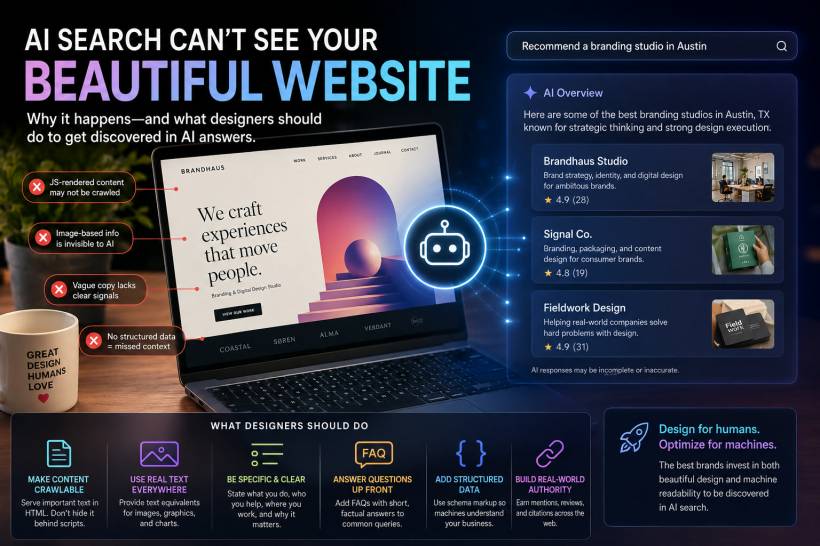
One common issue is content that only appears after JavaScript loads. Some crawlers may have limited support for complex client-side rendering, especially when important text, services or location details are not available in the initial page content.
Another issue is image-based information.
A visually attractive pricing table, service graphic or infographic may communicate everything perfectly to a visitor. However, if the information only exists inside an image, a search system may not understand it as clearly as text placed directly on the page.
Then there is the issue of vague brand language.
Statements such as "We create experiences that inspire" may sound elegant, but they do not explain what the business actually offers. An AI system trying to answer a question such as "best Shopify developer for fashion brands in Austin" needs specific details.
It needs to know whether the business provides Shopify development, whether it works with fashion brands, whether it serves Austin and whether there is enough supporting evidence to make that recommendation credible.
Clear Language Matters More Than Ever
Brands do not need to abandon strong creative copy. They simply need to support it with plain-language information.
A homepage should clearly explain:
• What the company does
• Who it works with
• Where it operates
• Which industries or customer types it serves
• What makes its approach different
• What services are available
This information should not be hidden several pages deep or placed only inside animations, graphics or sliders.
A simple, direct opening paragraph can make a major difference. It helps users understand the business quickly, but it also gives search engines and AI systems the context needed to match the site with relevant searches.
Structured Data Helps Machines Understand Context
Structured data, often implemented using schema markup, gives search engines additional context about a website.
It can help identify an organisation, its location, services, products, reviews, contact details, authors and frequently asked questions. While structured data does not guarantee that a site will appear in an AI answer or rich search result, it can make the site easier for machines to interpret.
For design teams, this is often the invisible technical layer beneath the visual experience.
It does not change the design. It does not interfere with branding. It simply makes the information more organised for systems that need to understand what the page represents.
Useful schema types may include:
• Organization
• LocalBusiness
• Service
• Product
• Article
• Review
• FAQPage
• Person
The right mix depends on the business and the page type. The important part is making sure the data matches the visible content on the page.
AI Search Looks Beyond Your Website
A business does not build credibility only through its own website.
AI systems and search engines often look for supporting evidence from across the web. A company mentioned by respected publications, industry directories, client websites, review platforms and professional profiles may appear more established than a business that only exists on its own domain.
This is sometimes described as building an entity footprint.
The goal is not to place a business name everywhere without purpose. It is to create consistent, trustworthy references that confirm the business is real, active and relevant within its field.
For example, a design studio may benefit from having consistent information across:
• Google Business Profile
• Industry directories
• Client case studies
• Professional networks
• Design publications
• Review platforms
• Local business listings
• Event speaker pages
• Award listings and portfolio features
Consistency matters. The business name, services, location and contact details should not conflict across different platforms.
Technical Accessibility Still Matters
AI visibility begins with basic website accessibility.
The site should load reliably, use crawlable HTML, avoid unnecessary blocking rules and make important pages available through clear internal links. Key content should not depend entirely on scripts that may fail, load slowly or be difficult for some crawlers to process.
For design-heavy websites, a few practical habits can help:
• Ensure important copy is available as real HTML text
• Provide text alternatives for image-based pricing, service descriptions and infographics
• Use descriptive page titles and headings
• Add useful alt text to meaningful images
• Keep navigation simple and crawlable
• Avoid hiding critical information behind interactive effects
• Make sure key pages are not blocked by robots.txt or technical restrictions
None of these practices make a site less creative. They simply ensure the creative work is supported by a clear information structure.
Why FAQ Content Can Be Useful
People often ask AI systems direct questions.
They ask who provides a certain service, how much something costs, which platform is best for a specific business type or whether a company operates in a particular location.
A well-written FAQ section can help answer these questions clearly.
The best FAQs are not filler content created only for search rankings. They should answer genuine customer concerns in short, factual and useful language.
Examples may include:
• Do you build Shopify websites for fashion brands?
• Do you work with clients outside Austin?
• How long does a branding project usually take?
• Do you provide ongoing website maintenance?
• Can you redesign an existing e-commerce store?
This kind of content makes the business easier to understand for both people and machines.
Where UnoSearch Fits In
This growing gap between visual brand work and machine readability is where AI search optimisation specialists can be useful.
UnoSearch positions itself as a GEO and AI SEO agency serving US businesses from India, offering services that include traditional SEO, generative-engine optimisation, AI citation tracking and wider digital marketing support.
For creative studios and freelancers, the value of this type of partnership is not necessarily a redesign. The goal is to build the technical and authority layer around an existing website.
That may include improving structured data, clarifying service pages, strengthening external citations, reviewing crawlability and tracking how often a brand appears in AI-generated answers.
This allows designers to protect the visual quality of a project while ensuring the business behind it is easier for AI-powered search systems to understand.
A New Question Clients Will Keep Asking
Clients are increasingly asking a new version of an old question.
Instead of asking only, "Why are we not ranking on Google?", they may ask, "Why does ChatGPT not recommend us?"
That question requires a broader answer than keywords alone.
It involves technical SEO, content clarity, structured data, third-party credibility, local relevance and how well the business is represented across the web.
For designers, this does not mean becoming an AI SEO specialist overnight. It means recognising that a visually strong website now needs an equally strong information layer beneath it.
Final Thoughts
AI search does not make great design less important. Once a visitor reaches a website, strong branding, usability, trust and conversion design still matter enormously.
But aesthetics alone are no longer enough to guarantee discovery.
The brands most likely to succeed in AI-powered search will be the ones that combine strong visual identity with clear writing, accessible content, technical crawlability and credible signals across the web.
A beautiful website deserves to be found. The challenge now is making sure the systems recommending it can understand exactly why it deserves to be there.

Comments 0