

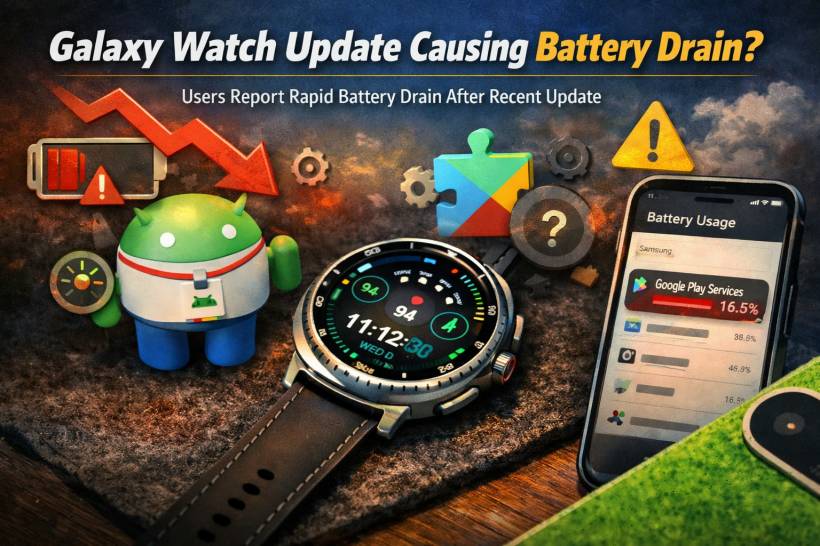
Galaxy Watch owners have started noticing something that tends to get attention very quickly with any wearable: the battery is not lasting the way it used to. A growing number of users are saying their watches are draining faster than normal, and many of them believe the problem showed up shortly after a recent update.
That naturally raises concerns, especially because Samsung's Galaxy Watch lineup usually has a fairly solid reputation for battery life. These are not devices people expect to recharge constantly. So when users suddenly start seeing a sharper drop in battery percentage, it stands out almost immediately.
Why People Are Paying Attention
Part of the reason this issue is getting noticed is because it goes against what many users expect from these watches in the first place. Models like the Galaxy Watch Ultra are generally seen as strong performers in battery endurance, often lasting several days on a charge under normal use. Even Samsung's more style-focused models are still expected to comfortably get through daily use without feeling unpredictable.
That is why recent reports feel unusual. People are not just talking about slightly lower battery life. Some are describing a noticeable decline, enough to make them check battery stats and look for what changed.
Google Play Services Is Showing Up in Battery Stats
From the user reports being shared online, one pattern appears repeatedly: Google Play Services is showing unusually high battery usage on some affected watches. In cases where users have looked into the battery breakdown, that service is sometimes sitting near the top of the list, consuming more power than expected compared to the rest of the watch's apps and background processes.
That does not automatically prove it is the sole cause, but it does make it a likely suspect in the eyes of many users. If a core background service suddenly starts using more power than usual, the effect can be felt across the whole device, even if everything else appears normal on the surface.
The Reports Are Not Limited to One Model
Another reason the situation feels a little messy is that it does not appear to be tied to just one specific watch. Users with different Galaxy Watch generations have mentioned seeing similar behavior, including owners of Watch 6, Watch 7, Watch 8, and even the Ultra.
That makes the issue harder to pin down. If it were isolated to one model, it would be easier to blame a device-specific software bug. But when multiple models are mentioned, the problem starts to look more like a broader software or service-related issue instead.
At the same time, not everyone is seeing it. Some users say their battery life has stayed perfectly normal, and others report that Google Play Services barely shows up in their battery usage at all. That inconsistency is important, because it suggests the issue may depend on a combination of factors rather than one universal bug affecting every Galaxy Watch owner.
Could It Be the Update, or Something Behind the Scenes?
Right now, there is no single confirmed explanation. Some users believe the most recent security update triggered the drain. Others suspect it may be tied to Google Play Services itself, possibly through a background change that happened independently or alongside a system update.
There is also speculation that a server-side adjustment may be involved. That kind of change can be frustrating because it can affect behavior without making the cause obvious to the user. In other words, a watch may suddenly start draining faster even if the owner did not knowingly change anything significant.
Some have also wondered whether the timing overlaps with Samsung's recent blood pressure-related update, though there is not enough evidence yet to treat that as the clear cause.
What Users Can Try for Now
Until something more official appears, the usual troubleshooting steps are fairly straightforward. Clearing the cache for Google Play Services and restarting the watch is one of the first things people are recommending. It is the kind of simple fix that sometimes resolves odd background behavior after an update.
If that does not help, then the issue may be deeper than a temporary cache problem. At that point, users may simply have to wait and see whether Samsung or Google pushes out a correction.
The Bigger Problem With Battery Issues on Wearables
Battery drain problems tend to feel worse on smartwatches than on phones. A phone with weaker battery life is annoying, but a watch that suddenly cannot make it through a day changes how useful it feels almost immediately. Wearables are supposed to be low-maintenance companions. Once charging becomes unpredictable, the whole experience starts to feel less reliable.
That is why even a limited number of reports can generate concern quickly. People buy devices like the Galaxy Watch expecting consistency, especially when battery life is one of the product's stronger selling points.
Samsung Has Not Responded Yet
For now, Samsung does not appear to have made any public statement about the reported battery drain. That leaves users in the familiar waiting phase, where online reports grow, temporary fixes circulate, and everyone tries to figure out whether the problem is widespread or just affecting a smaller group.
Until there is clearer confirmation, the situation remains a bit murky. But if your Galaxy Watch has been losing charge faster than usual lately, you are clearly not the only one noticing it.
Final Thoughts
This looks like one of those modern gadget problems that is easy to dismiss at first and then suddenly hard to ignore once enough people start comparing notes. The reports are not yet consistent enough to point to one confirmed cause, but there is enough overlap to suggest something may have changed recently.
Whether the culprit is a security update, Google Play Services, or a background rollout that is behaving badly, Galaxy Watch users will likely be watching closely for the next patch. And for a device that is supposed to quietly sit on your wrist and just work, that kind of uncertainty is exactly what people do not want.











Comments 0