

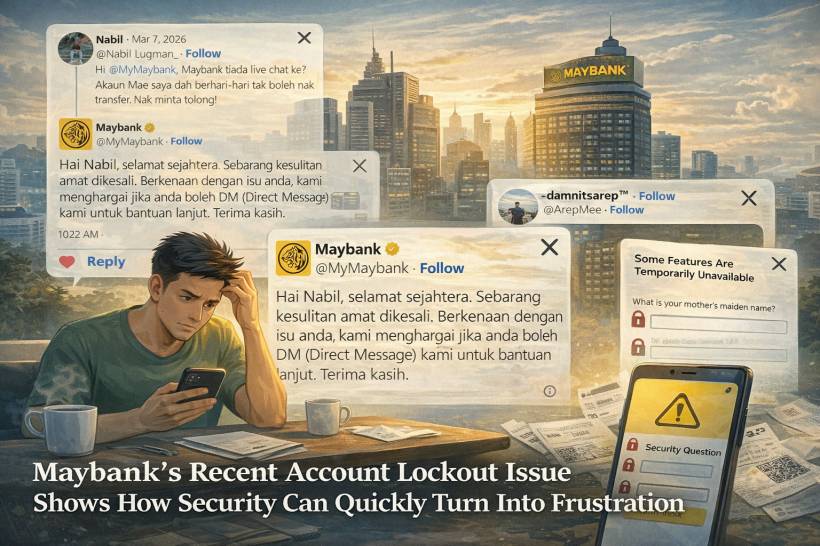
Maybank has finally shed some light on the account lockout issue that caught many MAE users off guard earlier this week, and the explanation points back to one thing: fraud monitoring. According to the bank, the Challenge Questions that suddenly appeared during certain transactions were not a new feature introduced out of nowhere, but part of an existing security mechanism meant to detect and stop suspicious activity. On paper, that sounds reasonable enough. Banks are under constant pressure to tighten protection as scams become more sophisticated. But from a customer's point of view, the problem was never just about security. It was about how abruptly it happened, how disruptive it felt, and how difficult it became for affected users to get help.
What Happened to MAE Users
The issue gained attention on 4 March 2026, when a number of Maybank customers reported being unexpectedly asked Challenge Questions while trying to make QR-based payments through the MAE app.
For some users, this was not just a minor extra step. They either could not recall the answers or did not manage to respond correctly, and that led to something much more serious: temporary deactivation of their online banking access. That immediately turned what should have been a simple payment into a stressful situation.
When this kind of thing happens during a routine transaction, it naturally causes alarm. Most people do not expect to be suddenly locked out while paying with QR, especially when the process normally feels quick and familiar. The disruption was enough to trigger concern across social media, where users began sharing similar experiences and asking whether the app had a bug, a system glitch, or some kind of experimental verification process running in the background.
Maybank Says It Was Part of Fraud Protection
In response, Maybank said the Challenge Questions are part of an existing security layer designed to combat scam-related activity. The bank explained that these questions are usually introduced during onboarding, but they may also be triggered later under certain circumstances as part of its fraud prevention measures.
That detail matters because it suggests the prompts were not random. Instead, Maybank appears to be saying that its internal systems detected a situation where extra verification was considered necessary.
From a banking security perspective, this fits the broader industry trend. Financial institutions increasingly rely on risk-based authentication, where the system decides in real time whether a transaction looks normal or suspicious. If something seems unusual, an additional verification step may be triggered automatically.
In theory, that is a smart approach. It allows banks to apply stronger checks only when needed, rather than slowing down every single transaction. The problem, however, is that when these systems are not clearly communicated to customers, the experience can feel confusing, intrusive, and even alarming.
Why the Challenge Questions Appeared
When asked whether these questions would become a permanent part of QR payments, Maybank did not give a direct yes or no answer. It also did not clearly say whether the 4 March incident was caused by a bug or a temporary test.
Instead, the bank explained that the prompts were triggered by its fraud monitoring system. According to Maybank, this system continuously reviews fraud rules and watches for changing scam patterns. When certain risk conditions are met, Challenge Questions may appear as part of a real-time authentication process.
This tells us that the bank is framing the incident not as a technical malfunction, but as the result of a live security response. In other words, the prompts were likely activated because the system believed extra verification was necessary at that moment.
That explanation helps to a point, but it still leaves important questions unanswered. Customers understandably want to know what changed, why so many users seemed to encounter the same problem at once, and whether the trigger was overly aggressive. A fraud detection system may be working as intended, but if it causes legitimate users to lose access to their accounts during ordinary transactions, then the customer experience side of the equation clearly needs attention too.
The Bigger Problem Was the Lockout Experience
For many users, the most frustrating part was not the Challenge Questions themselves. It was what happened after failing them.
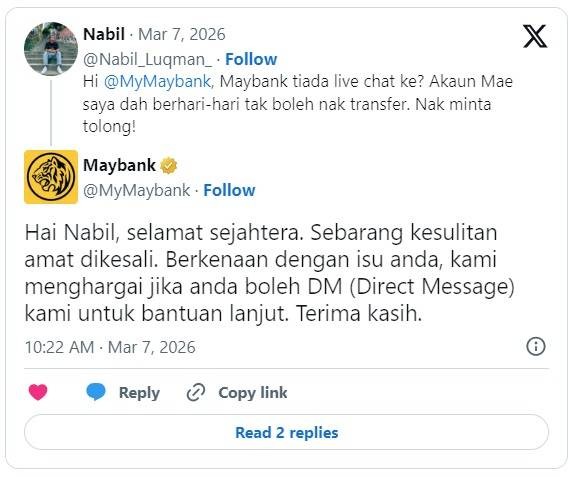
Once access was temporarily disabled, affected customers then had to go through the process of regaining access to their accounts. That would already be stressful under normal circumstances, but several people said they struggled to reach Maybank's support hotline. Some claimed their calls were disconnected before they could even speak to a representative.
That kind of complaint makes a difficult situation worse. Security systems are meant to protect customers, but when legitimate users get blocked and cannot easily get help, trust begins to erode. At that point, the issue is no longer just about fraud prevention. It becomes a service recovery problem.
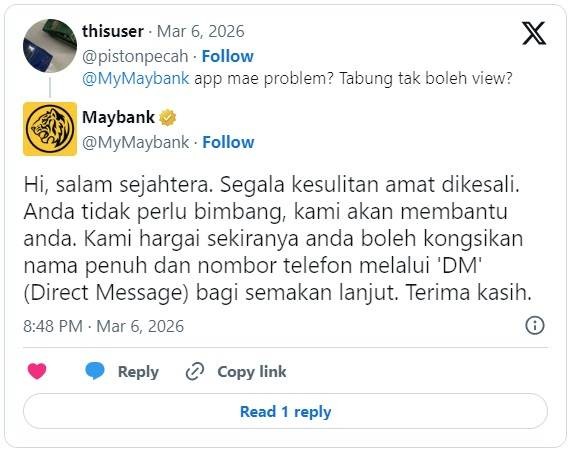
Maybank did not directly confirm whether the support issue had been resolved. Instead, the bank said its Maybank Group Customer Care channels remained fully operational, and pointed customers to its hotline as well as its official Facebook and X accounts.
Even so, customer feedback suggests that the hotline experience may not have felt fully reliable during the incident. Based on what many users observed online, Maybank's social media response team appeared to react more quickly than the traditional phone support channel. That says quite a lot about how customer support expectations are changing in digital banking. People now expect fast resolution across multiple platforms, especially when they are locked out of something as important as their bank account.
The QR Prompt Seems to Have Disappeared, but Questions Remain
More recent checks suggest that the MAE app is no longer prompting Challenge Questions during QR Pay transactions, at least for now. That may indicate the situation has stabilised, or that whatever risk conditions were triggering the prompts are no longer active.
Still, Maybank has not clearly confirmed whether the prompts were intentionally withdrawn or whether the underlying conditions simply changed. That uncertainty is part of the reason customers are still uneasy. When a major banking app behaves differently from one day to the next without a clear explanation, people are left guessing.
Clear communication matters a lot in moments like this. Even if a bank cannot disclose every detail of its fraud detection logic, customers still need a simple and transparent explanation of what happened, what to expect, and what they should do if it happens again.
Then Came Another MAE Service Disruption
Just as the earlier lockout issue was still being discussed, another MAE-related problem surfaced.
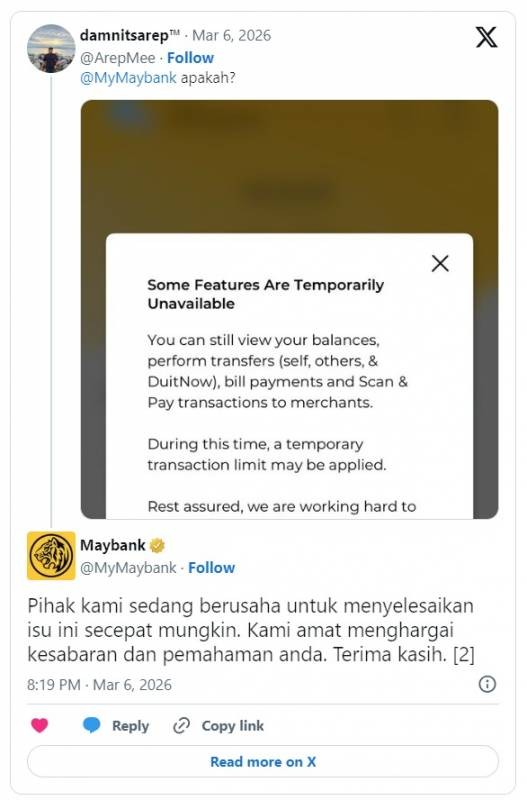
Users began reporting that the app was showing a notice saying certain services were temporarily unavailable. The same message also suggested that a temporary transaction limit had been imposed. Naturally, this added to the growing sense that Maybank's digital services were having a rough patch.
At the time, one user highlighted the message on X while questioning what was going on. Later checks indicated that the notice had disappeared and that services seemed to be working normally again.
Even so, when multiple incidents happen within a short period, public confidence takes a hit. A single technical hiccup can often be brushed aside. But when customers experience account lockouts, support difficulties, and service availability notices all in the same week, it starts to feel less like an isolated incident and more like a broader reliability concern.
Why This Matters Beyond One Week of Problems
Banking apps are no longer just convenience tools. For many people, they are the main way they access money, make payments, transfer funds, and manage daily financial activity. That means even temporary disruptions can have an outsized impact.
A fraud monitoring system may be necessary. Extra authentication may be justified. Temporary service interruptions may sometimes be unavoidable. But when these events happen, customers expect two things: stability and communication.
This is where the recent MAE situation feels shaky. The issue is not only whether Maybank's systems were doing what they were designed to do. It is whether customers were kept properly informed, whether support channels were responsive enough, and whether the bank moved quickly enough to reduce confusion.
Digital banking is built on trust. Not just trust that the platform is secure, but trust that it will remain accessible when people need it most.
Final Thoughts
Maybank's explanation makes it clear that the Challenge Questions were tied to its fraud monitoring framework, not simply some random glitch appearing during QR payments. That does provide useful context. At the same time, it does not fully erase the frustration customers felt after being locked out and struggling to get timely assistance.
The bigger takeaway from this episode is that security alone is not enough. Strong protection must be paired with clear communication, reliable support, and a customer experience that does not leave legitimate users feeling punished for trying to make a normal transaction.
After a week like this, the MAE app may be back to normal on the surface, but many users will still be wondering what really happened behind the scenes. And until Maybank offers fuller clarity, that uncertainty is likely to linger.











Comments 0