

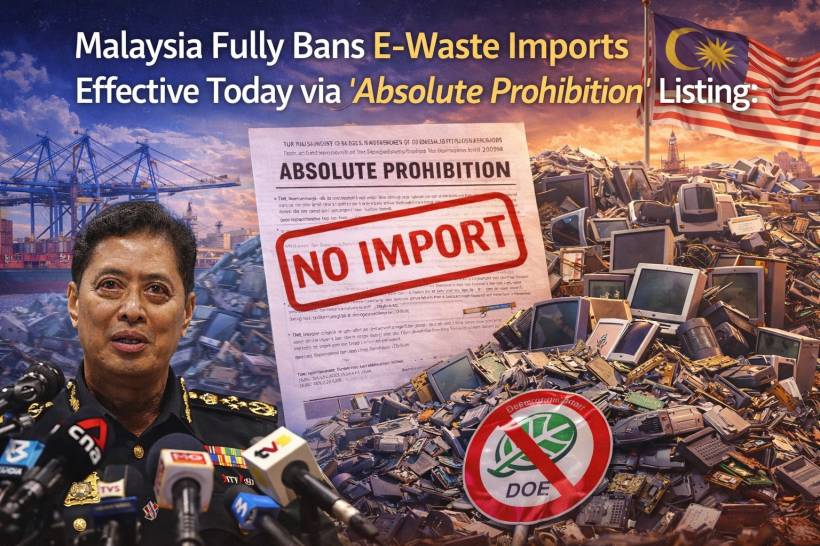
Starting today, Malaysia has moved from "controlled" e-waste imports to a full stop. Electronic waste (e-waste) is now officially placed under the Absolute Prohibition category in the Customs (Prohibition of Imports) Order 2023. In plain terms, this isn't a tightening of rules or a new checklist. It's a complete ban on bringing e-waste into the country.
What changed from yesterday to today
Previously, e-waste sat under a category that sounds strict, but still left a gap: "Conditional Prohibition Except in the Manner Provided." That meant imports were generally restricted, but exemptions could still be granted under certain conditions, with discretionary power resting with the Department of Environment (DOE) leadership.
With the move to Absolute Prohibition, that discretion effectively disappears. No more "approved under conditions." No more special exemptions. The policy direction is clear: e-waste imports are no longer allowed.
Who made the call and why enforcement is being highlighted
The decision came out of a meeting by the Special Task Force on the Direction of Enforcement Management of Plastic Waste and E-Waste Imports. The task force is chaired by MACC chief commissioner Tan Sri Azam Baki, and the emphasis in the announcement wasn't just on the ban—it was on enforcement.
Azam said the shift requires firm, integrated action by all relevant agencies, meaning this isn't meant to be a paper-only change. The DOE has been instructed to immediately submit the application to Customs to formalise the new classification under the Customs Order.
That "all agencies" line matters, because waste imports often touch multiple checkpoints: ports, customs clearance, environmental approvals, and enforcement on the ground. A ban is only as effective as the coordination behind it.
A new committee to tighten coordination
Alongside the ban, the meeting agreed to establish a special committee focused specifically on coordinating and strengthening enforcement related to e-waste.
This committee will be chaired by the Port Klang Malaysian Border Control and Protection Agency (AKPS) Control and Protection Commander, Datuk Nik Ezanee Mohd Faisal.
To keep the pace fast, outcomes from the committee's meeting must be reported back to the Special Task Force within one week. The stated goal is more systematic and effective management—basically, fewer gaps for loopholes, delays, or "miscommunication" between agencies.
What this could mean on the ground
If enforcement follows the intent, you can expect a few likely outcomes:
Ports and customs will have clearer authority to reject e-waste shipments without debating conditions or exemptions.
One common issue with waste imports globally is relabeling. Stronger enforcement coordination is usually aimed at preventing shipments being declared as something else.
If e-waste can't come in, attention often shifts to domestic e-waste generation, recycling standards, and licensed processing. The "ban" doesn't remove the e-waste problem—it changes where enforcement pressure is applied.
Plastic waste is still being discussed separately
Interestingly, while e-waste got a clear "ban effective today," plastic waste imports are still under evaluation.
The task force agreed that more detailed data is needed to assess whether a three-month moratorium on plastic waste imports is feasible. Before any final decision, several agencies have been tasked with studying and presenting the sector's economic contribution and national revenue impact, as well as industry needs, to Prime Minister Datuk Seri Anwar Ibrahim.
For e-waste: decision now, enforce immediately.
Why Malaysia is taking a harder line
Even without going into politics, the logic behind this move is easy to understand. E-waste is messy. It can contain hazardous materials, requires controlled processing, and becomes a magnet for illegal dumping or unsafe recycling if enforcement is weak. Once it enters a country, the long-term environmental and public health costs can far outweigh any short-term economic activity tied to processing.
By shifting to Absolute Prohibition, Malaysia is signalling that it doesn't want to be part of the global e-waste trade pipeline—and that enforcement bodies should treat it as a national priority.
Final thoughts
Malaysia's e-waste policy just moved from "regulated" to "no entry." Putting e-waste under Absolute Prohibition removes grey areas and makes enforcement simpler: it's not allowed, full stop. The real test now is execution—how consistently agencies coordinate at ports, how firmly customs applies the classification, and how quickly loopholes are shut down when someone inevitably tries to find them.











Comments 0