

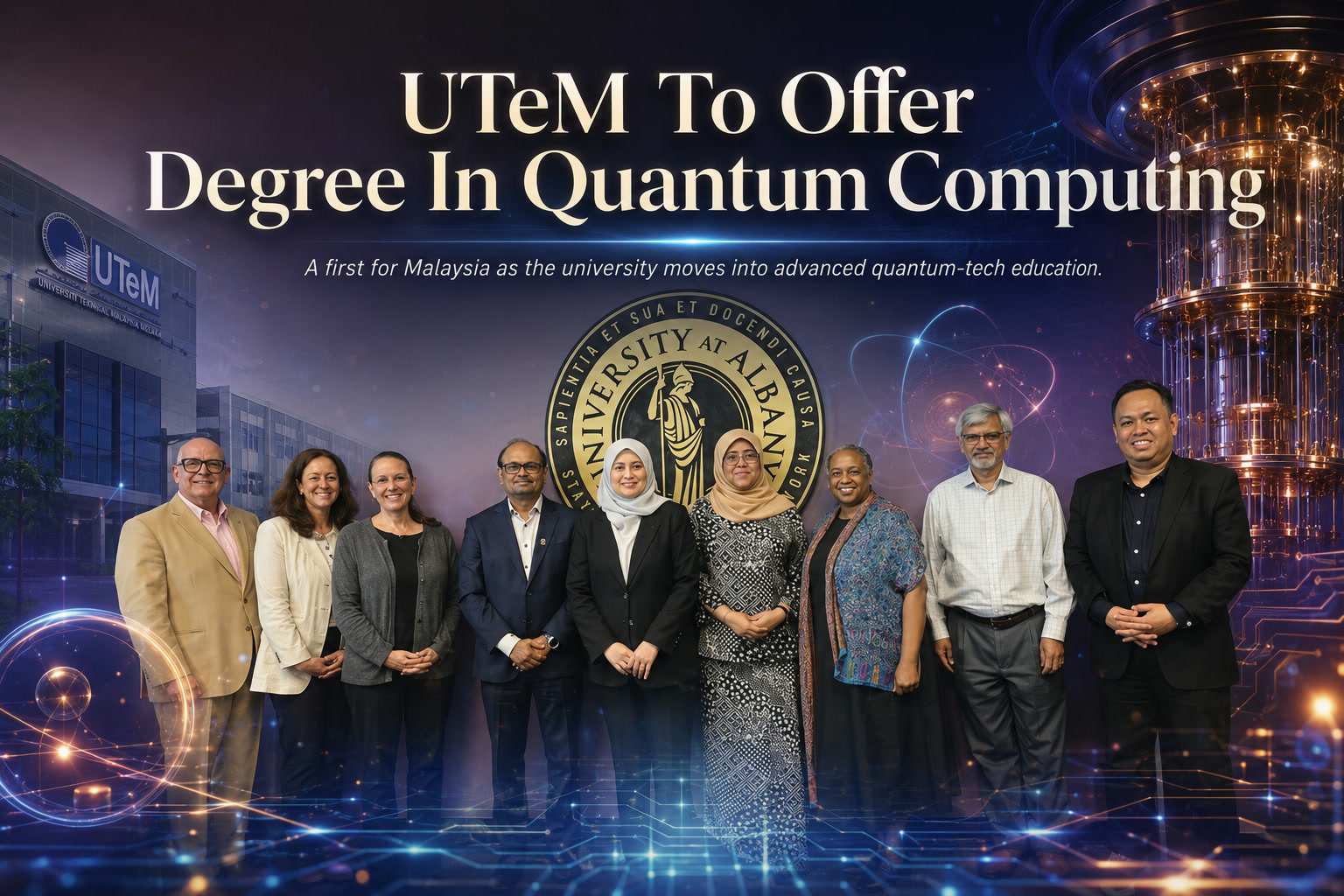
Quantum computing has traditionally felt like a field Malaysian students would need to pursue overseas. It is often associated with specialist research institutes, global technology companies and universities equipped with highly advanced laboratories. Universiti Teknikal Malaysia Melaka, better known as UTeM, is now attempting to bring that opportunity closer to home.
The university is preparing to introduce a Bachelor of Computer Science in Quantum Computing Technology, described as the first undergraduate degree of its kind in Malaysia. The programme reportedly passed an initial screening stage in July 2026 and is expected to welcome a first cohort of approximately 60 students, who would complete their studies around 2030.
The initiative is significant not merely because it introduces a new degree title. It represents an early attempt to build a Malaysian talent pipeline for a technology that could eventually influence cybersecurity, scientific research, medicine, finance, logistics and advanced manufacturing.
Bringing Quantum Computing Education Closer to Malaysian Students
Until now, Malaysian students interested in quantum computing have generally approached it through conventional computer science, physics, mathematics or engineering programmes before specialising at postgraduate level.
A dedicated undergraduate programme changes that pathway.
Students would be introduced to quantum principles earlier and could build their mathematical, programming and computing foundations around the field from the beginning. This may make quantum technology more accessible to students who are fascinated by the subject but cannot afford to pursue specialised education abroad.
UTeM is already positioned strongly in technical and applied education. Its existing academic structure covers engineering, engineering technology, information and communications technology, artificial intelligence and cybersecurity, while its current computer-related offerings include software development, networking, database management, cloud computing and computer security.
Adding quantum computing would extend that technical focus into an emerging area that may become increasingly important over the coming decade.
What Makes Quantum Computing Different?
A conventional computer processes information using bits, with each bit representing either a zero or a one.
A quantum computer uses quantum bits, or qubits. Because of principles such as superposition and entanglement, qubits can represent and manipulate information in ways that ordinary bits cannot.
This does not mean that quantum computers will simply replace laptops, servers or smartphones. They are expected to complement classical computers by addressing particular types of highly complex problems.
Potential applications include:
Much of the technology remains experimental. Present-day quantum systems are affected by noise and errors, and many of their most ambitious applications will require more reliable, fault-tolerant hardware.
Even so, researchers have already demonstrated that modern quantum processors can perform meaningful experimental calculations at scales that are difficult to reproduce through straightforward classical methods.
The Degree Must Combine Computing, Mathematics and Physics
A meaningful quantum computing degree cannot focus only on operating unusual hardware.
Students will first need strong foundations in classical computer science, including programming, data structures, algorithms, operating systems and software engineering. They will also require mathematics beyond what many conventional computing programmes demand.
Likely areas of study would include:
The precise curriculum has not yet been publicly detailed. However, the strongest programme would connect theory with practical experimentation rather than teaching quantum computing only through lectures and simulations.
Students should also learn where quantum computing is genuinely useful—and where conventional computers remain faster, cheaper and more practical.
A Dedicated Laboratory Gives the Programme Practical Value
One of the most interesting parts of UTeM's announcement is the establishment of a dedicated quantum-computing laboratory for teaching, learning and research.
The facility reportedly contains 23 small quantum computers with two- and three-qubit capabilities. These systems would allow students to conduct experiments using physical quantum hardware instead of relying entirely on software simulations or remote cloud access.
Two or three qubits may sound extremely limited compared with experimental systems containing dozens or hundreds of qubits. However, small educational machines can still be valuable for demonstrating fundamental principles.
Students can observe how quantum states are prepared, how gates affect qubits, how measurement changes the system and how noise influences the outcome of a circuit.
That direct experience can make abstract mathematical concepts easier to understand.
Small Quantum Computers Are Teaching Tools, Not Supercomputers
It is important to maintain realistic expectations about the laboratory.
A two- or three-qubit device will not solve industrial-scale optimisation problems, train large AI models or break modern encryption. Its purpose is education, experimentation and the development of basic technical skills.
This is similar to engineering students using small training robots before operating industrial automation systems. The educational machine may not match the scale of commercial equipment, but it helps students understand the underlying controls and behaviour.
Students can use these small systems to practise:
Enter your text here ...
More advanced projects can then use cloud-based quantum systems, high-performance simulations or international research facilities.
The quality of the programme will therefore depend not only on how many physical devices UTeM owns, but on how effectively the laboratory is integrated into coursework and research.
The First Cohort Could Graduate at the Right Time
The first group is expected to consist of approximately 60 students, with graduation anticipated in 2030.
That timeline could be strategically useful.
Quantum computing is still developing, giving Malaysia several years to strengthen research partnerships, attract industry participation and identify realistic commercial applications before the graduates enter the workforce.
By 2030, demand may not be limited to people building quantum processors. Organisations could also require specialists in quantum software, algorithm development, simulation, cybersecurity, education and hybrid computing.
Graduates may find opportunities in:
Some may also continue into postgraduate research rather than moving immediately into industry.
International Collaboration Will Be Essential
UTeM says it is expanding its international relationships with the University at Buffalo, the University at Albany and the University of Texas at Dallas.
The proposed collaborations are expected to involve curriculum development, research, academic mobility, talent development and exchanges of technical expertise.
These relationships could help UTeM avoid developing the programme in isolation.
The University at Buffalo, for example, has established a dedicated Quantum Institute that brings together researchers from computer science, physics, engineering, chemistry and materials science. The institute focuses on research, education and collaboration with government and industry.
The University at Albany is also involved in a growing New York quantum ecosystem that includes university partnerships, semiconductor research and major public investment in quantum-computing development.
Access to institutions already participating in larger quantum ecosystems could give Malaysian lecturers and students exposure to more advanced hardware, research methods and specialist expertise.
Academic Mobility Could Be Particularly Valuable
Student and lecturer exchanges should be more than ceremonial visits.
The greatest value would come from structured placements where UTeM participants can work inside established laboratories, contribute to research projects and experience quantum systems beyond the university's own educational hardware.
International partners could also provide:
Similarly, international researchers could benefit from working with UTeM on regional problems involving manufacturing, logistics, cybersecurity and Malaysia's semiconductor ecosystem.
The partnership should ideally develop into a two-way research relationship rather than a programme where expertise flows only from overseas universities to Malaysia.
Malaysia Needs More Than Quantum Programmers
Building a quantum-technology industry requires a wide range of skills.
Software developers are important, but the ecosystem also needs physicists, mathematicians, electrical engineers, materials researchers, cybersecurity specialists and semiconductor experts.
Business leaders and policymakers must understand the technology well enough to separate realistic applications from exaggerated claims.
Malaysia will also require professionals who can connect quantum systems with existing computing infrastructure. Most future solutions are expected to be hybrid, with classical computers handling ordinary processing and quantum hardware being used only for selected calculations.
Graduates must therefore understand both worlds.
Someone who knows quantum theory but lacks strong classical programming skills may struggle to build practical applications. Conversely, a software developer who does not understand the mathematical limits of quantum hardware may design systems around unrealistic expectations.
Cybersecurity Should Be a Major Part of the Programme
Quantum computing creates opportunities, but it also introduces serious cybersecurity questions.
Powerful future quantum computers may eventually threaten some of the public-key encryption methods used to protect websites, digital signatures and confidential communications.
The immediate response is not to panic or assume current encryption has already become useless. However, organisations are beginning to prepare for post-quantum cryptography—new cryptographic standards designed to remain secure even when stronger quantum machines become available.
UTeM's programme could help Malaysia develop specialists who understand both quantum computing and the security transition surrounding it.
These graduates could support government agencies, banks, hospitals and technology companies as they identify vulnerable cryptographic systems and plan long-term migration.
The work will require an understanding of software, infrastructure, risk management and cryptography—not merely quantum algorithms.
Industry Participation Will Determine Employability
A pioneering degree can attract attention, but graduates ultimately need meaningful career pathways.
UTeM should involve industry partners while the curriculum is being developed. Employers can help identify which skills will be useful over the next five to ten years and provide students with internships, projects and research problems.
Potential partners may include semiconductor manufacturers, cloud providers, cybersecurity firms, telecommunications companies and financial institutions.
Industry involvement could take several forms:
Without this connection, the programme could produce academically knowledgeable graduates for a Malaysian job market that is not yet ready to employ them.
The goal should be to build demand and talent together.
The Degree Could Strengthen Malaysia's Semiconductor Ambitions
Quantum computing may also connect naturally with Malaysia's existing strength in electrical and electronics manufacturing.
The country already plays an important role in semiconductor assembly, testing, design services and manufacturing support. Although quantum processors involve specialised materials and technologies, the broader ecosystem still depends on electronics, control systems, packaging, fabrication and precision engineering.
A local quantum-computing programme could encourage collaboration between computer scientists and semiconductor engineers.
Over time, Malaysia could participate in areas such as:
Malaysia does not need to manufacture a complete commercial quantum computer immediately to benefit from the industry. It can build expertise in selected parts of the supply chain where its existing technical capabilities provide an advantage.
Graduates Must Learn to Work with Imperfect Hardware
Quantum computers behave very differently from conventional systems.
Current machines are noisy, meaning calculations can be affected by environmental interference, imperfect gates and unstable qubits. The same circuit may produce different results when repeated.
Students therefore need to learn how to evaluate probability, uncertainty and error.
They should understand that obtaining an output from a quantum machine does not automatically mean the result is correct. Experiments may need to be repeated many times, compared with classical simulations and analysed statistically.
This way of thinking can be valuable beyond quantum computing. It encourages students to question results, examine limitations and avoid treating technology as a magical black box.
Avoiding Hype Will Be Just as Important as Teaching Innovation
Quantum computing is frequently presented as a technology that will solve almost every difficult problem.
That is misleading.
Quantum machines are not universally faster than classical computers. They are suited to particular algorithms and problem structures. Many everyday tasks will continue to run more efficiently on conventional processors.
A strong academic programme should teach students to communicate these limitations honestly.
Graduates must be able to explain:
Malaysia needs experts who can identify practical opportunities, not professionals who simply repeat ambitious marketing claims.
The Programme Still Needs Final Public Details
The reported screening approval is an encouraging step, but several practical details remain to be confirmed publicly.
These include the final programme accreditation, admission requirements, course structure, tuition arrangements and exact starting date.
At the time of writing, UTeM's public undergraduate listing still shows its established computer-science, artificial-intelligence, cybersecurity and cloud-computing programmes, but does not yet display the new quantum-computing degree. That may simply reflect the fact that the programme is still moving through the approval and launch process.
Prospective students should therefore wait for the university's official admission announcement before making enrolment plans.
They should also examine the curriculum carefully once released, particularly the level of mathematics required and the balance between theory, software development and laboratory work.
A Promising Start for Malaysia's Quantum Talent Pipeline
UTeM's initiative does not instantly turn Malaysia into a global quantum-computing centre.
Building that ecosystem will require sustained investment, qualified lecturers, active research, industry demand and access to increasingly advanced hardware.
However, every technology industry begins by developing people who understand it.
The first cohort may be relatively small, but those students could later become researchers, lecturers, software developers, security specialists and founders of Malaysian quantum-technology companies.
Some may eventually train the next generation, expanding the field beyond one university and one degree programme.
That multiplier effect could be more important than the initial enrolment number.
Final Thoughts
UTeM's proposed Bachelor of Computer Science in Quantum Computing Technology represents a bold and timely step for Malaysian higher education.
The programme could give local students access to a field that has often appeared distant and inaccessible. Its dedicated teaching laboratory, planned international collaborations and emphasis on practical learning provide a promising foundation.
The real measure of success, however, will not be whether UTeM is first to place "quantum computing" in a degree title.
Success will depend on the quality of the curriculum, the depth of the research, the competence of the graduates and whether Malaysia can create meaningful opportunities for them after 2030.
If the programme is supported consistently by government, universities and industry, it could become the beginning of a much larger national capability.
Malaysia may not yet be building quantum computers at global commercial scale, but training people who understand how to programme, evaluate and eventually improve them is an important place to begin.











Comments 0