


Smart glasses are quickly becoming one of the next major areas of interest for technology companies. Meta has already pushed heavily into the category, while companies such as Apple and Samsung are also expected to expand their efforts around wearable AI. Now, Insta360 appears to be exploring the same space, although its approach could look quite different from what we have seen so far.
Recent reports point to a patent filed by Insta360 for a pair of smart glasses, suggesting the company is at least investigating the idea. The most unusual part of the design is not the camera or AI functionality, but the way the glasses are powered. Instead of building a battery directly into the frame, Insta360 appears to be considering a separate battery pack connected through a cable.
A Smart Glasses Design Without a Built-In Battery
Most smart glasses place their batteries inside the temples, which helps keep the product completely self-contained. The problem is that batteries add weight, and when that weight sits on the sides of a pair of glasses for several hours, comfort can quickly become an issue.
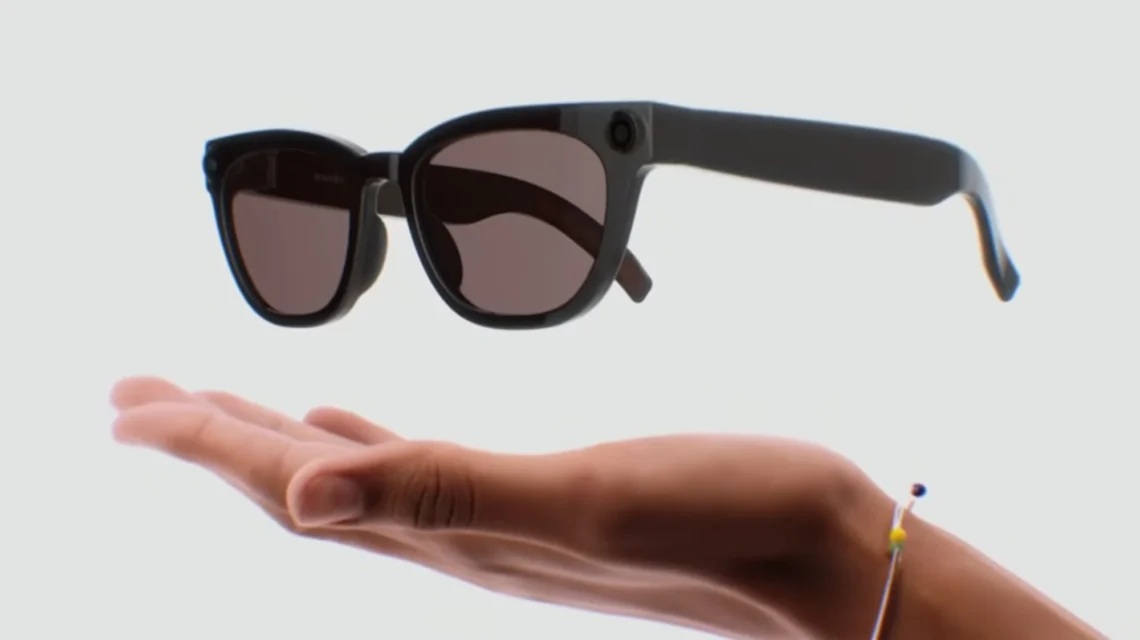
Insta360's patent takes a different approach by moving the battery outside the frame. A cable would connect the glasses to an external battery pack, potentially allowing the frame itself to become significantly lighter and thinner. In theory, the glasses could sit more comfortably on the face and look much closer to ordinary eyewear.
This could also give Insta360 more flexibility when designing the camera hardware. Without needing to reserve large amounts of space for batteries inside the temples, engineers could potentially focus on lenses, sensors, microphones and image-processing components instead.
The Cable Could Be the Biggest Compromise
Of course, removing the battery from the glasses creates another problem: the cable.
Consumer electronics have spent years moving toward wireless designs because people generally prefer not to manage wires running between devices. A battery cable hanging from a pair of glasses could feel awkward, particularly if it needs to connect to a pack carried in a pocket or clipped onto clothing.
Whether that becomes a major inconvenience would depend heavily on the implementation. A thin, lightweight cable routed discreetly behind the ear might be relatively easy to ignore, while a thicker connection could quickly undermine the convenience of the entire product.
The trade-off would essentially come down to comfort on the face versus freedom from cables.
Insta360 May Not Be Chasing the Same Smart Glasses Market as Meta
The more interesting part of Insta360's potential product may be what the company intends people to do with it.
Meta and several other companies increasingly treat smart glasses as platforms for AI assistants. Cameras and microphones observe the user's surroundings, while artificial intelligence answers questions, identifies objects, provides navigation assistance or responds to voice commands.
Insta360 may be thinking about the category differently. The company has built its reputation around cameras, particularly action cameras and 360-degree capture devices, so it would make sense for its smart glasses to focus much more heavily on photography and video.
That could give the company a clearer identity in an increasingly crowded market.
Content Creation Could Be the Main Focus
Insta360 co-founder Max Richter has suggested that if the company eventually releases smart glasses, it would not necessarily try to compete directly with rivals on intelligent assistant features. Instead, the focus could be on helping creators capture high-quality images and video from a first-person perspective.
That direction fits naturally with Insta360's existing products. A creator wearing smart glasses could capture moments without pulling out a phone, holding an action camera or mounting equipment to their body.
For travel vloggers, cyclists, content creators or anyone recording everyday experiences, having a camera built into lightweight eyewear could make spontaneous capture much easier. The device could become less of an AI assistant that happens to contain a camera and more of a wearable camera that happens to include AI.
AI Could Still Play an Important Role
Even if artificial intelligence is not the main selling point, it could still improve the camera experience significantly.
AI could help stabilise footage, improve low-light images, automatically identify interesting moments or assist with framing. It might also help users quickly search through hours of recorded footage, generate highlights or automatically edit short clips for social media.
This kind of AI would support content creation rather than become the product itself. Instead of asking the glasses questions all day, users might rely on intelligence running quietly in the background to make captured footage easier to use.
That approach could suit Insta360 particularly well because it builds on areas where the company already has considerable experience.
Lighter Frames Could Matter More Than Extra Features
Comfort remains one of the biggest barriers to smart glasses becoming something people wear for long periods. Adding cameras, processors, microphones, speakers and batteries inevitably increases weight, and even a small difference becomes noticeable when the device rests on the nose and ears for hours.
By moving the battery away from the frame, Insta360 could potentially create glasses that feel much closer to ordinary eyewear. That may turn out to be more valuable than adding another AI feature.
A device can have impressive technology, but if users want to remove it after thirty minutes because it feels heavy, the product has failed at the most basic level.
The external battery concept therefore looks strange at first, but it may be solving one of the category's hardest physical problems.
Battery Life Could Also Become Easier to Upgrade
An external battery has another potential advantage: capacity could become more flexible.
Smart glasses with internal batteries are constrained by the amount of space available inside the frame. If users want longer battery life, manufacturers usually need to make the glasses larger or heavier.
A separate battery pack could potentially be offered in different capacities, allowing users to choose between something smaller for casual use and a larger pack for extended recording sessions. Replacing a depleted battery could also be easier if the pack is detachable.
That would be especially useful for creators who may want to record for several hours rather than simply use the glasses occasionally throughout the day.
Nothing Has Been Confirmed for Consumers Yet
It is important to remember that this remains a patent and reported development, not a confirmed commercial product. Technology companies regularly patent concepts that never reach production, either because the design proves impractical or because priorities change.
Insta360 has not announced a launch date, price or specifications for smart glasses, and it is still unclear whether the concept will ever become something customers can actually buy.
The patent simply shows that the company has explored the idea seriously enough to protect elements of the design.
That makes it interesting, but not yet a product announcement.
Insta360 Is Also Expanding Beyond Action Cameras
The reports around the smart glasses arrive while Insta360 is also working on two mirrorless cameras, suggesting the company is interested in expanding its imaging business beyond the action and 360-camera categories where it is already well known.
That broader strategy makes wearable cameras easier to imagine. Insta360 appears increasingly interested in providing creators with different ways to capture content, from traditional cameras to devices that are much more integrated into everyday life.
Smart glasses could eventually become another piece of that ecosystem.
If the company can combine comfortable eyewear with the image quality and stabilisation technology associated with its existing cameras, it could bring something genuinely different to the market.
Final Thoughts
Insta360's reported smart glasses concept stands out because it appears to tackle the category from a camera-first perspective rather than an AI-assistant-first perspective. Moving the battery into an external pack could reduce the weight of the frame, while the company's imaging expertise could make high-quality first-person capture the main attraction.
The cable will undoubtedly be controversial. After years of technology becoming increasingly wireless, asking users to reconnect a wearable to a battery pack may feel like a step backwards. But if that compromise results in significantly lighter glasses, longer recording times and better camera hardware, some creators may happily accept it.
For now, the product remains speculative, and there is no guarantee the patent will turn into something consumers can buy.
Still, the idea shows that smart glasses do not necessarily need to follow the same path as Meta, Samsung or Apple. Instead of becoming another AI assistant sitting on your face, Insta360 may be exploring something closer to a high-quality camera you simply happen to wear.











Comments 0