

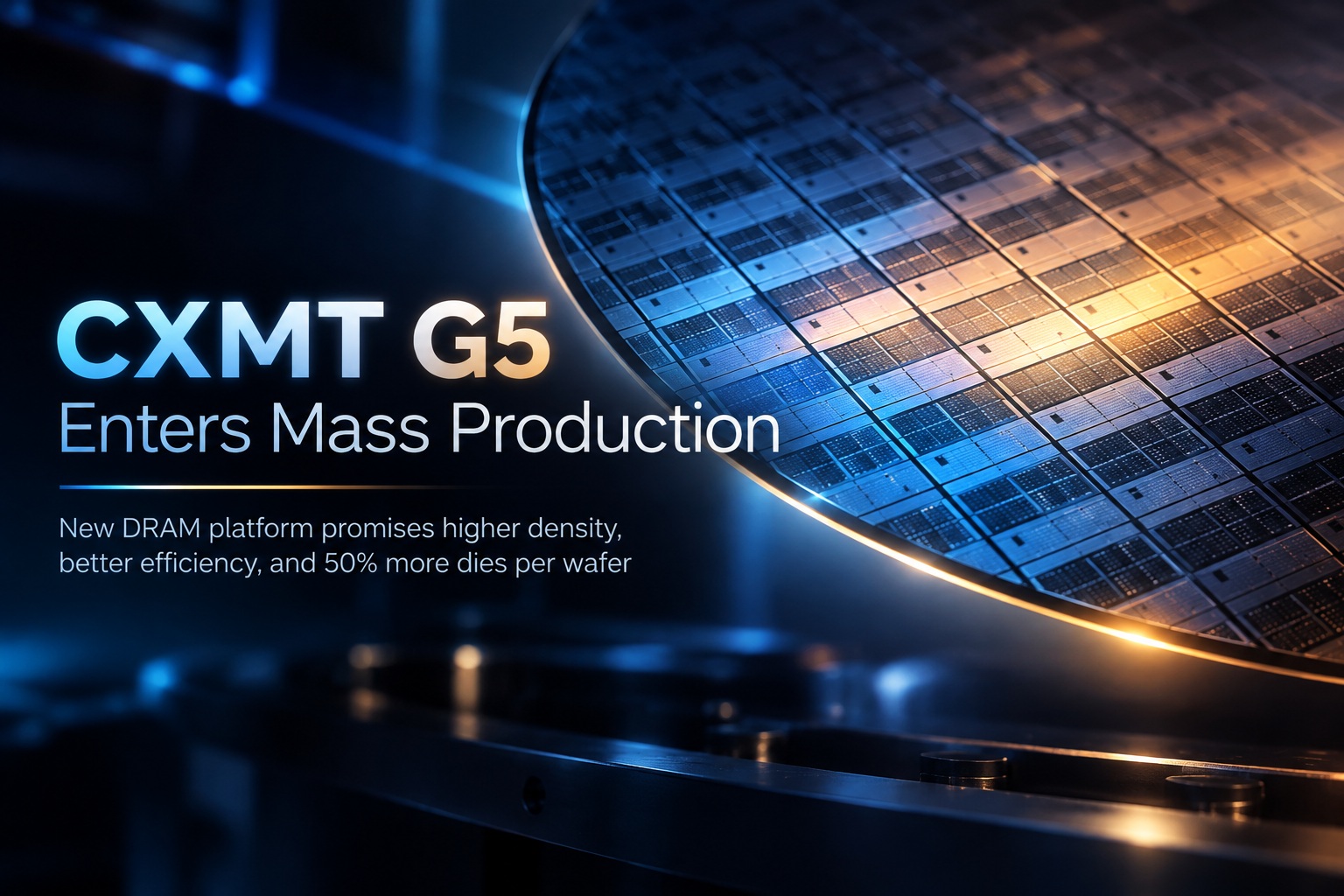
China's semiconductor industry is continuing its push into advanced memory production, and ChangXin Memory Technologies, better known as CXMT, has announced a significant step forward with its new fifth-generation DRAM platform. The company says its G5 technology platform has now entered mass production, bringing higher storage density, improved power efficiency, and lower manufacturing costs. Most notably, CXMT claims the platform can produce at least 50% more gross dies per wafer than its previous generation, potentially improving both manufacturing efficiency and competitiveness.
For years, the global DRAM market has been dominated by Samsung, SK Hynix, and Micron, which supply memory for smartphones, PCs, servers, and other electronics. CXMT's latest announcement does not suddenly overturn that balance, but it does show how quickly China's domestic memory industry is advancing. If the company can sustain yield, scale, and product quality at mass-production levels, G5 could strengthen CXMT's position as one of the most serious challengers to the established memory giants.
Why More Dies Per Wafer Matters
The 50% increase in gross die output per wafer is one of the most important claims behind G5 because wafer efficiency directly affects semiconductor economics. A single wafer contains many individual memory dies, so increasing the number produced from the same wafer can significantly reduce the manufacturing cost of each chip, provided yields remain healthy.
Higher density also allows memory makers to produce larger-capacity products without increasing die size as aggressively. For a company trying to compete against manufacturers with decades of experience and enormous fabrication capacity, squeezing more usable memory from every wafer can improve cost competitiveness and help support larger production volumes.
CXMT describes the density improvement as a major generational leap rather than a minor process refinement. The company also says G5 provides better power efficiency, which is particularly important for mobile devices where memory must balance speed with battery life and heat generation.
CXMT Is Moving Closer to Advanced DRAM Process Technology
Samsung and SK Hynix are already manufacturing DRAM using 10nm-class process technologies, putting them among the most advanced memory producers in the world. CXMT says its G5 platform has achieved an 11.95nm active-area half-pitch within its memory arrays, bringing the company closer to the process density used by leading global manufacturers.
To reach that level, CXMT says it uses quadruple patterning, a lithography technique that enables much finer structures than a single exposure would normally allow. Multiple patterning has long been used in semiconductor manufacturing when conventional lithography cannot directly produce the desired feature size, although it adds process complexity and cost.
The achievement is significant because shrinking DRAM structures is increasingly difficult. Unlike logic chips, memory devices must maintain highly reliable cell behaviour across billions of repeated structures, so reducing dimensions without hurting yield or retention becomes progressively harder with every generation.
24Gb LPDDR5X Chips Are Already in Mass Production
Alongside the G5 manufacturing platform, CXMT also introduced two new LPDDR5X products with 24-gigabit capacity per die. The chips were unveiled at the 2026 World Manufacturing Convention in Hefei and are already in mass production, according to the company.
CXMT says the 24Gb capacity represents a 50% increase over the equivalent products from its previous generation. Larger-capacity dies allow smartphone manufacturers to reach higher total memory configurations with fewer chips, which can help reduce motherboard space, package complexity, and potentially power consumption.
That is particularly useful for modern smartphones that increasingly need more memory for demanding applications, multitasking, gaming, computational photography, and on-device AI. High-end phones now routinely ship with memory capacities that would have been associated with laptops only a few years ago.
The Initial Target Is Premium Mobile Devices
CXMT says the new LPDDR5X products are intended primarily for mid-to-high-end smartphones and portable consumer electronics. That positioning suggests the company is no longer concentrating only on value-oriented memory products and is instead trying to compete in segments where performance and power efficiency matter much more.
LPDDR5X has become an important standard for flagship mobile devices because it combines high bandwidth with lower operating power than conventional desktop memory. Faster mobile DRAM can improve everything from application responsiveness and gaming to AI inference and image processing, particularly when other components are capable of using that extra bandwidth.
Competing successfully in this segment would give CXMT greater credibility with device manufacturers. Premium smartphones also provide an important showcase because memory performance becomes more visible when paired with high-end processors and increasingly advanced AI workloads.
Chinese Smartphone Brands Are Already Using CXMT Memory
CXMT has reportedly been gaining traction among Chinese handset manufacturers, with some of its higher-end LPDDR5X memory already appearing inside flagship devices. One example cited is the Nubia NaviX Ultra, which recently went on sale and includes ByteDance's Doubao AI assistant.
Domestic adoption matters because Chinese smartphone manufacturers represent a substantial global market and can provide CXMT with both scale and real-world validation. If local brands increasingly choose domestic DRAM instead of relying entirely on foreign suppliers, that could gradually strengthen China's semiconductor supply chain.
This is especially relevant as geopolitical tensions and technology restrictions continue influencing procurement decisions. Greater domestic memory capability reduces dependence on overseas suppliers and gives Chinese hardware companies more options when planning future devices.
AI Is Increasing the Importance of High-Capacity Mobile Memory
The rise of on-device AI is also making mobile DRAM more strategically important. Large language models, image-generation tools, voice processing, and other AI features can require considerable memory capacity and bandwidth, even when models are optimised for smartphones.
That means memory manufacturers are no longer competing only on traditional metrics such as app loading and multitasking. The ability to support larger AI models locally may become one of the main reasons smartphone makers adopt higher-capacity and faster memory in future flagship products.
A 24Gb LPDDR5X die gives manufacturers more flexibility when designing devices with large memory pools. Depending on packaging and configuration, fewer high-capacity dies can achieve substantial total RAM without consuming excessive board space.
CXMT Still Faces a Difficult Competitive Landscape
Despite the progress, CXMT is still competing against some of the most experienced semiconductor companies in the world. Samsung, SK Hynix, and Micron operate enormous manufacturing networks, established supply relationships, and highly refined process technologies built through decades of development.
Memory manufacturing is also heavily dependent on yield. Producing more dies per wafer looks impressive, but the economic advantage only becomes meaningful if a high percentage of those dies meet specification. Process stability, performance consistency, reliability, and long-term production volume will therefore matter just as much as headline density.
The established manufacturers are also continuing to advance their own DRAM technologies. By the time one competitor closes a process gap, the market leaders may already be moving to another generation, making memory development a constantly moving target.
Lower Cost Could Become One of CXMT's Biggest Advantages
If G5 delivers the manufacturing efficiencies CXMT claims, cost could become one of the platform's strongest competitive advantages. Producing more dies from each wafer while improving power efficiency could allow CXMT to offer attractive pricing without necessarily positioning its products as low-end memory.
That combination would be particularly appealing to smartphone manufacturers trying to increase RAM capacity while controlling bill-of-materials costs. Memory has historically been one of the components whose price can fluctuate significantly depending on supply and demand, so another large-scale supplier could also influence broader market competition.
For Chinese manufacturers, local supply may offer additional advantages in logistics, procurement, and strategic security. Over time, that could help CXMT secure more design wins even before it matches the global leaders in every technical category.
China's Memory Industry Is Becoming Harder to Ignore
CXMT's G5 announcement also fits into China's broader effort to build greater semiconductor independence. Logic processors often attract the most attention, but memory is equally fundamental because virtually every computing device depends on DRAM and storage.
China has already invested heavily in semiconductor manufacturing, equipment, materials, packaging, and domestic supply chains. Progress in advanced DRAM helps fill another major piece of that ecosystem and potentially reduces reliance on imported memory for smartphones, computers, and future AI devices.
The significance is not that CXMT has suddenly displaced Samsung, SK Hynix, or Micron. It is that the technological distance appears to be narrowing enough that Chinese memory can increasingly compete in higher-value product categories.
Final Thoughts
CXMT's G5 DRAM platform entering mass production is an important milestone for China's memory industry. The company's claim of at least 50% more gross dies per wafer, improved power efficiency, and an 11.95nm active-area half-pitch suggests substantial progress compared with its previous generation.
The accompanying 24Gb LPDDR5X products are equally significant because they show G5 is not merely a laboratory technology. CXMT says the chips are already being produced at scale and are aimed at mid-to-high-end smartphones and portable electronics, placing them directly into markets traditionally dominated by the major South Korean and American suppliers.
There are still major questions around yield, performance consistency, long-term reliability, and production scale. Those factors will determine whether G5 becomes a genuine competitive threat or simply another step in CXMT's development.
Even so, the direction is clear. China is no longer satisfied with competing only at the lower end of the memory market, and CXMT is steadily moving toward more advanced DRAM. If G5 performs as advertised in mass production, Samsung, SK Hynix, and Micron may increasingly find that the global memory market has another serious player to watch.











Comments 0