

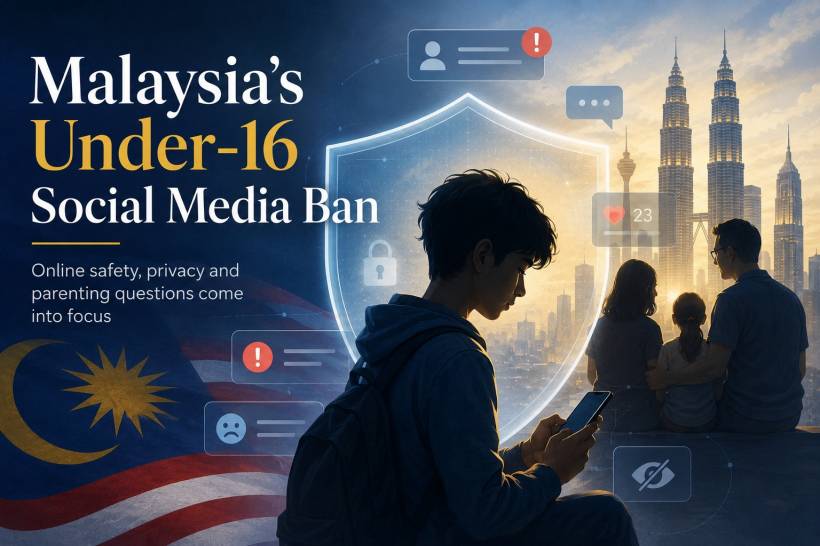
Malaysia has officially begun enforcing new rules that prevent children under the age of 16 from having social media accounts, marking one of the country's most significant moves yet in regulating how young people use online platforms. On paper, the idea is simple: children should be better protected from harmful content, cyberbullying, addictive platform design and the emotional pressure that often comes with growing up online.
But as with many digital rules, the real-world situation is far more complicated. The policy may be framed as a child safety measure, but it also opens up wider questions about privacy, enforcement, parental responsibility, digital education and how much control governments and technology companies should have over young people's online lives.
The rule places Malaysia among a growing number of countries trying to rethink children's access to social media. Around the world, governments are facing the same difficult question: how do you protect young users from genuine online harms without pushing them into less visible, less regulated corners of the internet?
What The New Rule Means
Under the new requirement, large social media platforms with at least 8 million users in Malaysia must introduce age-verification systems and stop users under 16 from creating accounts. This includes major platforms such as Facebook, Instagram, TikTok and YouTube, which have become part of everyday life for entertainment, communication, learning and self-expression.
For new users, the message is straightforward: those below 16 should not be allowed to register. For existing users, the process will happen in stages. Age verification for current account holders is expected to roll out over several months, giving platforms time to identify users who may fall below the minimum age.
Children who are found to be under 16 will reportedly be given a period to download or transfer their personal data, including photos and videos, before restrictions are applied to their accounts. This part is important because social media accounts are not just casual apps for many young users. They may contain years of memories, school-related content, creative projects, messages and personal media.
The penalties are aimed at the platforms, not parents. Companies that fail to comply may face heavy fines, while parents whose children manage to bypass the rule will not be punished. That difference reveals the government's approach: the responsibility is being pushed mainly toward technology companies rather than families.
Why The Government Is Taking This Step
The government's argument is built around child protection. Social media can expose young users to a wide range of risks, from cyberbullying and harmful content to scams, grooming, unrealistic beauty standards, toxic comparison and endless scrolling habits that can affect sleep, focus and emotional wellbeing.
For many parents, these concerns are not abstract. They are already happening at home. Children can spend hours switching between short videos, chats, gaming communities and influencer content. What looks like harmless entertainment can slowly become a daily routine that shapes attention span, self-esteem and behaviour.
There is also the issue of platform design. Social media is not neutral. Apps are built to keep people engaged for as long as possible, using notifications, recommendations, autoplay, likes and algorithmic feeds. Adults already struggle with this. For children and teenagers, who are still developing emotionally and psychologically, the effect can be even stronger.
That is why some families welcome the rule. To them, it gives parents a stronger reason to set boundaries and say no. Instead of each household fighting the battle alone, the restriction creates a national baseline.
Why Some Parents Support The Ban
For parents who already limit screen time, the new rule may feel like a long-overdue step. Some believe children below 16 are simply not ready to handle the pressures of social media. Their concern is not only about inappropriate content, but also about emotional maturity.
A child may understand how to use an app, but that does not mean they are ready to process everything they see on it. Social comparison, online arguments, viral trends and public comments can affect young minds in ways that are not always obvious at first.
Supportive parents also argue that boredom is not automatically a bad thing. When children are not constantly entertained by a screen, they may read, build things, cook, play outside, talk to family members or develop hobbies that require patience. In that sense, less social media does not necessarily mean less growth. It may actually create more room for offline development.
This is where the debate becomes more personal. For some families, keeping children away from social media is not about being old-fashioned. It is about protecting childhood from becoming too public, too fast and too dependent on online validation.
Why Other Parents Think It Goes Too Far
At the same time, not all parents agree with a blanket restriction. Some see social media as a useful tool when properly supervised. YouTube, for example, is used by many students for tutorials, revision videos, language learning, cooking guides, music lessons and general knowledge. For teenagers preparing for exams, online platforms can be more than entertainment.
There is also a practical concern. If teenagers feel suddenly cut off from spaces where their friends communicate, they may not simply accept the rule quietly. They may look for workarounds, create accounts using someone else's details, move to lesser-known platforms or use unregulated spaces where safety protections are weaker.
That is one of the biggest risks with strict age bans. A rule can remove children from mainstream platforms, but it cannot remove curiosity, peer pressure or the desire to belong. If enforcement is too heavy-handed, it may push the problem underground rather than solve it.
This is why some parents prefer a guided approach instead of a hard cutoff. They argue that children need digital literacy, not just digital restriction. In other words, young people should be taught how to recognise scams, manage screen time, avoid toxic content, protect their privacy and respond to online harassment.
The Privacy Question Cannot Be Ignored
One of the most serious concerns is age verification itself. To prove someone is old enough, platforms may need to check official documents or use identity-based systems. That immediately raises questions about data protection.
Who stores the information? How long is it kept? Can it be misused? What happens if a platform suffers a data breach? Will children, teenagers and adults all be required to hand over more personal information simply to access services they previously used with an email address or phone number?
These are not small issues. Malaysia has seen enough cybersecurity incidents over the years for the public to be cautious whenever more identity data is collected and stored. Even when the intention is child safety, the mechanism must be carefully designed. A weak verification system could create a different kind of risk.
There is also concern that mandatory identity checks may reduce online anonymity. For many people, anonymity is not always about hiding wrongdoing. Some users rely on it for safety, especially those from vulnerable communities, whistleblowers, abuse survivors or individuals who do not feel safe expressing themselves openly.
That is why the privacy safeguards around this policy matter just as much as the policy itself.
The Enforcement Challenge
Another major question is whether the rule can actually work. Children are often more digitally resourceful than adults expect. If there are no penalties for parents and the burden falls mainly on platforms, enforcement may become uneven.
Some platforms may build stronger systems. Others may rely on basic checks. Some users may bypass verification by using a parent's account, a sibling's information, a VPN, alternative apps or different registration methods. The more complicated the system becomes, the more likely users will look for loopholes.
This does not mean the rule is pointless. It can still reduce casual underage sign-ups and force platforms to take child safety more seriously. But it should not be treated as a complete solution. At best, it is one layer of protection.
The bigger work still needs to happen at home, in schools, inside platform design teams and through public education. A ban may limit access, but it cannot replace conversations about online behaviour, emotional resilience and responsible technology use.
A Global Trend, But Not A Simple One
Malaysia is not alone in taking this path. Several countries have introduced, proposed or studied age-based restrictions for children's social media access. The growing concern is understandable. Parents, teachers, doctors and policymakers are all seeing the effects of digital life on young people.
But every country faces the same balancing act. Too little regulation leaves children exposed to real harms. Too much regulation can limit access to useful learning tools, reduce privacy and create enforcement problems.
The challenge is to avoid treating all online activity as equally harmful. Watching an educational video is not the same as being trapped in endless algorithmic content. Messaging classmates is not the same as being exposed to cyberbullying. Posting creative work is not the same as being pressured into public comparison.
A good digital safety policy needs to recognise these differences. Otherwise, it risks becoming too broad for a very complex problem.
What Should Happen Next
The next few months will be important. Technology companies need to explain clearly how they plan to verify age, what data they will collect, how they will protect it and whether users will have options that do not require unnecessary exposure of personal information.
The government also needs to be transparent about oversight. If age verification involves official identity records, the public deserves strong assurance that the system will not become a tool for excessive monitoring.
Parents, meanwhile, should not treat the rule as a substitute for guidance. Even if children under 16 are blocked from having accounts, they will still use the internet. They will still watch videos, play games, join chats, search for information and interact online in other ways.
That means digital parenting remains essential. Screen-time limits, open conversations, privacy awareness, family rules and trust-building are still needed. The law may set a boundary, but families still shape the daily habits.
Final Thoughts
Malaysia's under-16 social media ban is a bold move, and it comes from a concern many people can understand. Children today are growing up in an online environment that is fast, persuasive and often difficult even for adults to manage. Wanting to protect them is not unreasonable.
However, the policy should not be seen as a magic fix. The real test will be in how it is implemented. If age verification is handled poorly, it could create new privacy risks. If enforcement is inconsistent, teenagers may simply find ways around it. If the focus stays only on blocking access, Malaysia may miss the bigger opportunity to teach healthier digital habits.
A safer internet for children cannot depend on one rule alone. It needs better platform accountability, stronger privacy safeguards, more digital literacy, active parenting and a more honest conversation about how technology now shapes childhood.
The ban may be the beginning of that conversation, but it should not be the end of it.











Comments 0