

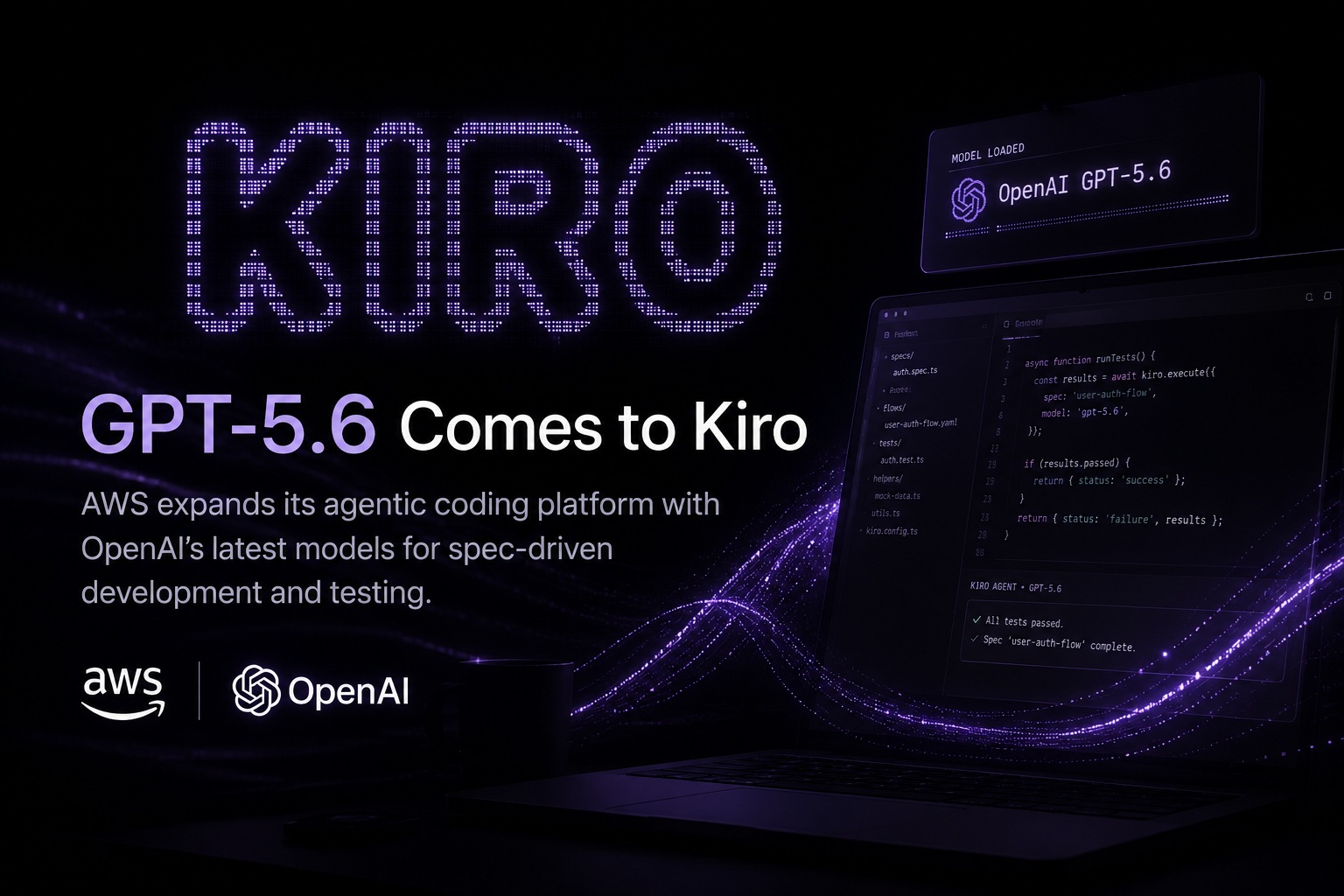
AWS has expanded the model choices available inside Kiro, its agentic coding platform, by adding OpenAI's latest GPT-5.6 family. Developers can now use GPT-5.6 Sol, Terra and Luna directly within Kiro's spec-driven development workflow, giving teams more flexibility to balance reasoning capability, speed and cost depending on the task.
AWS and OpenAI say the integration is intended to help developers complete complex coding work with fewer iterations while improving cost efficiency.
Swami Sivasubramanian, AWS Vice President of Agentic AI, said the company wants Kiro users to have access to the latest foundation models for increasingly complex and long-running development tasks.
Kiro Starts With a Specification, Not Just a Prompt
One of the main differences between Kiro and a conventional AI coding assistant is its emphasis on spec-driven development.
Instead of simply giving the AI an open-ended request such as "build this feature," Kiro first converts product ideas and requirements into a more structured implementation plan.
That plan can include requirements, technical design information and individual development tasks.
The agent then works through those steps while drawing context from the organisation's existing codebase and engineering standards.
This gives the model a clearer understanding of what it is expected to build before it starts modifying code.
For larger software projects, that grounding can be particularly important.
A coding agent may be technically capable of producing working code, but without enough context it can still make incorrect assumptions about architecture, naming conventions, dependencies or expected behaviour.
Kiro attempts to reduce those mistakes by placing specifications at the beginning of the workflow rather than treating them as something the AI has to infer.
GPT-5.6 Sol, Terra and Luna Give Developers More Choice
The addition brings three GPT-5.6 variants into Kiro.
This gives developers more flexibility to choose the appropriate model depending on how demanding the development task is.
Some stages of software development may require deeper reasoning and longer-running analysis.
Others may benefit more from faster responses or lower cost.
OpenAI and AWS describe the GPT-5.6 family as giving development teams more room to balance intelligence, speed and cost throughout the software development lifecycle.
That flexibility becomes increasingly important as AI coding agents move beyond simple autocomplete or isolated code generation.
An agent working through a large refactoring project, analysing a complex repository or implementing a multi-step feature may consume significantly more tokens than an assistant answering a short programming question.
Choosing the right model for each task can therefore have a direct impact on development costs.
Developers Still Review the Agent's Work
Kiro does not simply allow the AI to make changes without oversight.
The workflow includes review checkpoints where developers can inspect what the agent proposes before changes are implemented.
At these checkpoints, developers can approve the proposed approach, make adjustments or reject it entirely.
This preserves an important human control point.
AI coding tools can work quickly, but software changes can affect security, performance, compatibility and business logic in ways that may not be obvious from the generated code alone.
Providing review stages helps prevent the agent from becoming an uncontrolled automation layer inside the development process.
It also means teams can use AI for larger tasks without necessarily surrendering ownership of engineering decisions.
Property-Based Testing Adds Automated Verification
After implementation, Kiro also performs property-based testing to check whether the generated code behaves correctly.
Traditional software tests often use specific examples.
For instance, a developer may provide an input and verify that the function returns one expected result.
Property-based testing approaches the problem differently.
Instead of checking only a handful of predefined examples, developers describe properties or behaviours that should remain true across a wider range of generated inputs.
Kiro can then test whether the code continues satisfying those rules under many different conditions.
This can help expose edge cases that may not appear in manually written example tests.
The combination creates two different controls around AI-generated code:
That is important because generating code quickly is useful only if the resulting software actually behaves as expected.
AWS and OpenAI Say Kiro Was Optimised for GPT-5.6
The two companies say they have worked to optimise the Kiro environment specifically for OpenAI's models.
One benchmark highlighted in the announcement is Terminal-Bench 2.1, which measures whether an AI agent can correctly complete assigned tasks through a terminal environment.
In testing, GPT-5.6 Terra reportedly completed successful tasks in Kiro with around an 82% reduction in cost.
AWS and OpenAI attribute part of that improvement to Kiro's structured context.
Because the model begins with explicit requirements, technical designs and task information, it may be less likely to take unnecessary paths before finding a working solution.
Fewer failed attempts can translate directly into fewer tokens consumed.
For organisations running large numbers of AI-assisted development tasks, that difference can become financially significant.
Benchmark Savings Still Need Real-World Validation
The benchmark result is impressive, but it is important to understand what it actually measures.
Terminal-Bench 2.1 evaluates whether agents successfully complete specific terminal-based tasks under controlled testing conditions.
An 82% cost reduction in that benchmark does not automatically mean every development team will reduce its AI coding costs by the same amount.
Real software projects can be considerably more complicated.
Enterprise codebases may contain years of technical debt, incomplete documentation, unusual dependencies and organisation-specific business rules.
The announcement also does not provide production data covering areas such as:
Those metrics will ultimately be more important for organisations deciding whether agentic coding genuinely improves engineering productivity.
Generating a feature more cheaply matters.
Generating it correctly and safely matters even more.
Manual Review Remains an Important Safeguard
Kiro's checkpoint system is therefore one of the more important parts of the workflow.
Developers are able to inspect proposed changes before they become part of the codebase.
This prevents the development process from becoming completely autonomous.
AI coding systems can occasionally generate solutions that look convincing but misunderstand a requirement or introduce subtle problems elsewhere.
A human engineer who understands the broader system can catch issues that an automated test may overlook.
The review stage also allows teams to maintain architectural consistency.
An AI agent may find several technically valid ways to solve a problem, but only one may fit the organisation's long-term engineering strategy.
Human oversight provides that additional judgement.
Agentic Coding Is Moving Beyond Autocomplete
The integration also reflects how quickly AI-assisted software development is evolving.
Early coding assistants were largely focused on autocomplete.
They predicted the next few lines of code based on what the developer was already writing.
Modern agentic coding systems are attempting something much broader.
An agent can potentially:
That makes the AI much more useful for complex engineering tasks.
It also increases the amount of trust being placed in the system.
Once an AI begins changing several parts of a project instead of suggesting a few lines of code, validation becomes considerably more important.
This is why workflows involving specifications, review gates and automated testing are becoming central to agentic development platforms.
Different GPT-5.6 Models Can Fit Different Development Stages
OpenAI's Colleen Kapase, Vice President of Strategic Global Partnerships and Ecosystems, said the integration allows developers to choose between intelligence, speed and cost depending on where they are in the development lifecycle.
That idea makes practical sense.
A team might use a stronger reasoning model to analyse a complicated architectural change.
A faster or more economical model could then handle routine implementation work or smaller updates.
Different stages of software engineering do not necessarily require the same level of AI capability.
Allowing developers to switch between models can therefore help prevent organisations from using the most expensive option for every task.
As agentic development becomes more widespread, model routing and cost optimisation may become nearly as important as model quality itself.
Spec-Driven Development Could Reduce AI Guesswork
One of the biggest challenges with AI coding is ambiguity.
A developer may understand exactly what they mean when they type:
"Add user account export."
The AI may not.
Should the export contain JSON or CSV?
Does it include audit logs?
What permissions are required?
Where should the button appear?
Should the operation be asynchronous?
What happens if the dataset is enormous?
When those details are not specified, the model must make assumptions.
Some assumptions will be wrong.
By creating specifications first, Kiro attempts to make those decisions explicit before implementation begins.
That can reduce the amount of back-and-forth required between developer and agent.
It can also create documentation that remains useful after the AI finishes its work.
AWS and OpenAI Plan Further Improvements
The companies say their collaboration will continue beyond the initial GPT-5.6 integration.
Future work is expected to focus on improving how OpenAI models perform within Kiro and helping developers obtain greater value from AI throughout the software development lifecycle.
The GPT-5.6 family is already available to Kiro users.
For AWS, adding OpenAI models also expands the range of AI choices available to developers rather than locking the platform around a single model provider.
For OpenAI, the integration places GPT-5.6 inside another enterprise-focused development workflow where agentic coding is becoming increasingly important.
Final Thoughts
Bringing GPT-5.6 Sol, Terra and Luna into AWS Kiro gives developers another powerful set of models for agentic software development.
The more interesting part, however, is not simply which models Kiro now supports.
It is the structure surrounding them.
Kiro begins with specifications, provides codebase context, introduces developer review checkpoints and finishes with property-based testing.
That represents a more controlled approach to AI-assisted software engineering than simply asking a chatbot to generate code and copying the result into production.
AWS and OpenAI's benchmark results suggest the combination can also reduce the cost of completing certain development tasks, particularly when better upfront context prevents unnecessary iterations.
But benchmark efficiency is only one part of the story.
The real test will be whether teams using GPT-5.6 inside Kiro produce better software with fewer defects, less rework and faster delivery in real production environments.
AI can already write code quickly.
The next challenge is ensuring that the code it writes is something developers can actually trust.











Comments 0