

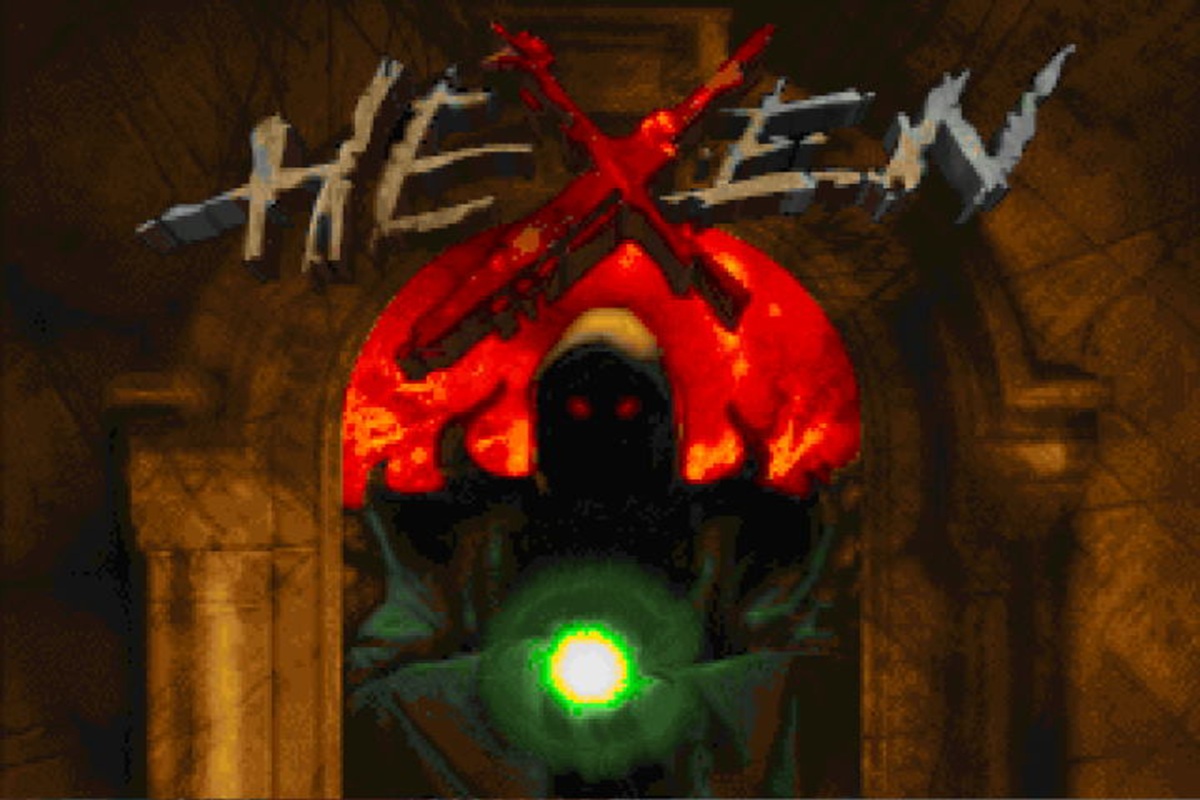
Hexen: Beyond Heretic takes the dark fantasy foundations of Heretic and expands them into a much more adventurous first-person experience built around character classes, interconnected hubs, environmental puzzles, magical weapons, inventory artifacts, and large areas that often require repeated exploration. Instead of controlling a single hero with one fixed arsenal, players choose between the Fighter, Cleric, and Mage, with each class offering completely different weapons and combat strengths. The result feels less like a traditional sequence of shooter levels and more like a fantasy journey through castles, temples, swamps, dungeons, ruined settlements, and corrupted landscapes. Fast combat remains important, but understanding the world becomes just as essential as surviving the enemies inside it.
The story takes place in the world of Cronos, which has fallen under the influence of Korax, the second of the mysterious Serpent Riders. Players become one of three surviving heroes attempting to break his control and ultimately confront him, but reaching Korax requires far more than simply fighting through corridors. Switches can change distant areas, portals connect multiple locations, keys may be needed several maps away from where they are discovered, and important puzzles can span an entire hub. Hexen therefore asks players to remember locations, recognize environmental changes, and think about how separate areas fit together.
Now playable online through Lemon Web Games, Hexen: Beyond Heretic can be experienced directly in your web browser as part of a growing collection of classic, retro, dark fantasy, first-person shooter, action, adventure, and browser-playable games. Its browser-based format makes it easy to revisit one of the more ambitious fantasy shooters of the 1990s while preserving the class-based combat, mana management, hub exploration, inventory artifacts, secret hunting, and environmental puzzle solving that define the experience. For players who enjoy classic FPS action but want something considerably more exploratory than a straightforward level-by-level shooter, Hexen remains a fascinating and distinctive adventure.
Three Character Classes Change the Entire Game
One of Hexen's defining features is the ability to choose between three different heroes before the journey begins. The Fighter, Cleric, and Mage do not simply have different statistics; they use completely different weapon sets and therefore approach enemies in noticeably different ways. This means replaying the campaign with another class can change the feeling of combat even when the environments remain familiar. Weapon range, attack style, mana efficiency, and preferred positioning all depend heavily on the chosen character.
The class system gives Hexen a light role-playing flavor without introducing complicated character sheets or large amounts of statistical management. Players immediately understand the difference through the way each hero fights. The Fighter is strongest at direct physical combat, the Mage specializes in long-range magical attacks, and the Cleric sits between them with a mixture of offensive magic and versatile weapons. Choosing a class therefore becomes the first major strategic decision of the entire game.
The Fighter Is Built for Direct Combat
The Fighter is the most physical of the three heroes and works especially well for players who enjoy aggressive close-range combat. His starting weapon relies heavily on melee attacks, encouraging players to move directly toward weaker enemies rather than keeping their distance. As stronger weapons are discovered, the Fighter gains much more powerful ways to control the battlefield while still maintaining his identity as the toughest frontline character. His greater durability also makes mistakes slightly more forgiving compared with the more fragile Mage.
Playing as the Fighter changes the way many encounters are approached because range becomes an important consideration. Enemies that seem simple for the Mage can become much more dangerous when the Fighter needs to close the distance before dealing strong damage. This encourages fast movement, careful use of corners, and smart positioning around groups of monsters. The result feels almost like combining a traditional FPS with a brutal fantasy melee game.
The Cleric Offers a Balanced Approach
The Cleric provides a more balanced style that sits between the Fighter's physical strength and the Mage's long-range magic. His weapons combine magical and physical themes, allowing players to handle different types of encounters without leaning entirely toward one extreme. This makes him a strong choice for players who want flexibility rather than specializing completely in melee or ranged combat. His arsenal also contains some of the strangest and most memorable weapon effects in the game.
Because the Cleric is adaptable, players can often change tactics more easily when entering unfamiliar areas. Close-range enemies can be handled with powerful direct attacks, while more distant threats can be pressured through magical weapons. This flexibility becomes especially useful during complicated hub exploration where the next encounter may be difficult to predict. The Cleric feels like a versatile adventurer capable of responding to a wide variety of situations.
The Mage Specializes in Ranged Magic
The Mage begins with a major advantage in range because even his starting attacks can strike enemies from a safe distance. This makes early encounters feel very different from the Fighter's experience, allowing players to carefully eliminate threats before they become dangerous. The trade-off is reduced physical durability, meaning mistakes can be much more costly when enemies manage to close the distance. Good movement and awareness therefore become extremely important.
As the Mage discovers additional weapons, his magical arsenal becomes increasingly impressive. Long-range attacks allow him to control corridors and open spaces effectively, while stronger spells can handle larger groups or tougher enemies. Playing the Mage encourages a more cautious and tactical approach where positioning matters constantly. For players who enjoy magical combat and keeping enemies at a distance, he offers one of the most distinctive ways to experience Hexen.
Class-Specific Weapons Create Strong Replay Value
Because each hero uses an entirely different weapon set, completing the game once does not reveal everything Hexen has to offer. A weapon pickup that becomes one object for the Fighter can transform into something completely different for the Cleric or Mage. This means familiar areas can produce new combat possibilities on another playthrough. The same enemy encounter may require an entirely different strategy depending on which class is being used.
This system adds significant replay value without requiring changes to the actual campaign structure. Players who remember every switch and puzzle can still experience fresh combat by selecting another character. Differences in weapon range, speed, and power can completely change which enemies feel dangerous. Hexen therefore rewards both environmental mastery and class experimentation.
Mana Replaces Traditional Ammunition
Hexen uses blue and green mana as the primary ammunition resources for most class weapons. Different weapons consume different mana types, while the most powerful attacks may require both. This creates a familiar resource-management system but presents it through a magical fantasy theme rather than conventional ammunition boxes. Players constantly need to consider which resource is more plentiful before selecting a weapon.
Mana management becomes increasingly important during long sections of exploration because several battles may occur before another large supply appears. Using a powerful weapon against weak enemies can quickly drain resources needed for a much tougher encounter later. Efficient players learn which attacks provide the best balance between damage and mana consumption. This keeps weaker weapons useful even after stronger options have been discovered.
Hub-Based Levels Completely Change Exploration
One of the biggest differences between Hexen and earlier shooters is its hub system. Instead of completing one map and permanently moving to the next, players frequently travel between several interconnected areas through portals. A switch activated in one location may open a door or raise a platform somewhere else, requiring the player to remember how the different maps connect. This creates a much stronger sense of exploring an actual world rather than progressing through isolated stages.
The hubs can initially feel confusing because the game does not constantly explain what has changed. A message may indicate that something happened elsewhere, leaving the player to work out where that change occurred. This encourages careful observation and memory instead of relying on objective markers. Once a hub is understood, navigating it becomes extremely satisfying because previously disconnected locations begin fitting together like parts of a larger puzzle.
Switches Can Affect Distant Areas
Hexen frequently uses switches as part of larger environmental puzzles rather than simply opening the nearest door. Activating something in a temple may change machinery in another map, while pressing a switch deep inside a dungeon can unlock progress back near the beginning of the hub. These interactions force players to pay attention to messages and remember places that previously seemed inaccessible. The world feels interconnected because actions can have consequences far beyond the current room.
This design can make progression more challenging than in a conventional shooter. When something changes elsewhere, players need to decide which portal or previously explored route should be revisited. The automap becomes useful, but memory and environmental awareness remain extremely important. Solving one of these multi-map puzzles provides a stronger sense of accomplishment than simply finding another exit switch.
Environmental Puzzles Become Part of the Adventure
Puzzle solving is a major part of Hexen's identity and goes far beyond searching for colored keys. Players may need to activate several mechanisms in the correct areas, manipulate platforms, find hidden switches, or understand how different parts of a hub influence one another. Some puzzles are straightforward once the relevant objects are found, while others can require extensive exploration. This gives the game a much more adventurous feeling than a standard action shooter.
The puzzles also create natural breaks between combat encounters. Instead of fighting continuously, players sometimes spend time investigating architecture, examining suspicious areas, and thinking about where to travel next. When combat eventually resumes, the change in pace makes the action feel more intense. This alternation between fighting and exploration is central to Hexen's atmosphere.
Doors and Keys Still Matter
Traditional key hunting remains part of the experience, but Hexen integrates keys into its larger hub structure. A key found in one map may be required somewhere completely different, and players may carry several important items while travelling between areas. This makes each discovery feel like part of a broader progression system rather than a simple local objective. Remembering where locked doors were located becomes extremely useful.
The design encourages players to mentally build a map of the entire hub. A locked gate discovered early may only become relevant much later after several other objectives have been completed. Returning with the correct key can reveal an entirely new branch of the adventure. This creates a satisfying sense of gradually unlocking the world.
Destructible Objects Make the World More Interactive
Hexen includes environmental objects that can be smashed, broken, or otherwise interacted with. Pots, windows, decorations, and other scenery can hide items or simply react to attacks, making the world feel more physical than many earlier shooters. Players quickly learn that suspicious objects may be worth destroying because useful resources can sometimes be hidden nearby. This encourages experimentation during exploration.
Destructible scenery also makes melee combat feel more satisfying, particularly when using the Fighter. Smashing through objects while exploring a dungeon reinforces the sense of controlling a powerful fantasy hero rather than a detached camera with weapons. Small interactions like these add personality to the environments. The world feels less static because it responds to the player's actions.
Inventory Artifacts Expand Your Options
Like Heretic, Hexen allows players to carry useful artifacts and activate them when needed. Healing items, defensive tools, teleportation devices, and other magical objects can be saved for dangerous moments rather than triggering automatically when collected. This adds strategic flexibility because players decide exactly when each resource is worth using. A difficult boss fight can become much easier if several powerful artifacts were conserved beforehand.
Inventory management remains simple enough that it does not slow down the FPS pacing. Players can cycle through available objects quickly while continuing to move and fight. The important part is remembering what is available and recognizing when the situation justifies using it. This creates another layer of decision-making without overwhelming the core action.
The Flechette Behaves Differently for Each Class
One of Hexen's more interesting artifacts is the Flechette because its effect changes depending on the selected character class. The Fighter, Cleric, and Mage each use it differently, reinforcing the idea that the three heroes interact with the world in unique ways. This makes even shared inventory items part of the class system rather than universal tools with identical behavior. Experimenting with them becomes part of learning a character.
The class-dependent artifact also strengthens replay value because players can discover new uses for familiar pickups. Something that served one purpose during a Fighter playthrough may become a completely different tactical tool when controlling the Mage. These subtle differences help the classes feel more distinct beyond their primary weapons. Hexen continually reinforces the idea that character choice matters.
Disc of Repulsion Creates Tactical Space
The Disc of Repulsion can push nearby enemies and projectiles away, making it extremely useful during crowded encounters. Rather than dealing direct damage, the artifact changes positioning and can create valuable breathing room when monsters have surrounded the player. In areas with dangerous ledges or environmental hazards, pushing an enemy away can be even more effective than attacking normally. The item rewards creative thinking.
It also demonstrates how Hexen's inventory system provides solutions beyond simply healing or increasing damage. Players can control the battlefield through movement and displacement instead of relying entirely on weapons. Saving a Disc for the right moment can prevent a dangerous situation from becoming fatal. These utility artifacts give combat more variety.
Chaos Devices Offer an Emergency Escape
The Chaos Device provides a way to escape from dangerous situations by teleporting the player away. This can be extremely useful when trapped by multiple enemies or when health is critically low. Instead of forcing every encounter to be fought to the end, Hexen gives players the option to retreat and reconsider their strategy. That flexibility fits well with the larger hub-based structure.
Using an emergency escape still involves trade-offs because the player may need to travel back through previously explored areas. However, surviving is often more important than maintainingimmediate progress. The item rewards players who remember their inventory rather than panicking when surrounded. It is another example of how artifacts provide tactical choices beyond raw damage.
Centaur Enemies Become a Familiar Challenge
Centaurs are among the more recognizable enemies in Hexen and can be surprisingly durable compared with basic monsters. Their defensive behavior can interrupt the player's attacks and make them frustrating if approached without patience. Fighting several at once can consume significant mana unless the player chooses the correct weapon. Their presence teaches players that not every enemy should be attacked in exactly the same way.
Different classes handle them differently because their weapon characteristics vary so much. The Fighter may rely on aggressive close-range pressure, while the Mage can attack from safer distances. This reinforces the class system during ordinary enemy encounters rather than only during major battles. Familiar monsters become new tactical problems depending on who the player controls.
Ettins Provide Early Melee Pressure
Ettins are common enemies that primarily rely on close-range attacks. Individually they are usually manageable, but groups can become dangerous when they restrict movement in narrow corridors or rooms. Their straightforward behavior makes them useful as frontline enemies alongside more dangerous ranged threats. Players often need to clear them quickly before focusing on larger monsters.
They also work especially well with Hexen's melee-heavy Fighter gameplay. Engaging an Ettin directly feels natural for that class, while the Mage usually prefers maintaining distance. This simple enemy therefore helps highlight class differences from the very beginning. Even basic encounters reinforce the broader design of the game.
Afrits Attack From the Air
Afrits introduce flying threats that can attack from angles unavailable to ground-based enemies. They can move through open spaces, cross environmental obstacles, and harass players who are already dealing with creatures on the floor. Their mobility becomes particularly troublesome in vertical areas where several levels of architecture are visible at once. Players need to watch above and around themselves rather than only straight ahead.
Flying enemies also interact strongly with the hub environments because open courtyards and large chambers give them plenty of movement space. Their attacks can pressure the player while stronger monsters control the ground. This layered combat helps make encounters feel less predictable. Hexen frequently mixes enemy types to create pressure from several directions simultaneously.
Stalkers Use Water and Terrain
Stalkers are unusual enemies because they can hide within water and emerge to attack. Their behavior makes seemingly empty pools or waterways feel dangerous, adding tension to environmental exploration. Players learn quickly that water is not always simply decorative scenery. The environment itself can conceal threats.
This reinforces Hexen's emphasis on atmosphere and interaction. Instead of enemies always waiting visibly in corridors, some use the terrain to surprise the player. These encounters encourage caution when entering unfamiliar spaces. Small design choices like this make the world feel much more hostile and alive.
Dark Bishops Bring Magical Ranged Combat
Dark Bishops are dangerous magical enemies capable of attacking from a distance while moving unpredictably. Their projectiles can create constant pressure, particularly when several appear in open areas. They also fit naturally within the corrupted fantasy setting, visually reinforcing Korax's influence over the world. Their presence often signals that the player has entered a more dangerous stage of the campaign.
Because they can attack while maintaining distance, players may need to use stronger ranged weapons or close the gap carefully. The effectiveness of each approach depends heavily on the selected class. Mage players can engage them from afar, while Fighters may need to use terrain to approach safely. Again, class choice fundamentally changes the combat experience.
Korax's Forces Become Increasingly Dangerous
As players progress deeper into Cronos, enemy combinations become more demanding and environments more hostile. Early creatures that were manageable individually begin appearing alongside ranged monsters, flying enemies, and magical threats. This creates increasingly complicated battles without needing to introduce completely new mechanics every few minutes. The difficulty grows by combining familiar systems more intelligently.
The campaign also uses environmental hazards to increase pressure. Narrow bridges, lava, crushing mechanisms, and dangerous architecture can become part of combat situations. Players need to watch both enemies and terrain simultaneously. Hexen becomes increasingly about controlling space rather than simply dealing damage.
Boss Encounters Test Class Mastery
Major encounters become opportunities to test how well players understand the strengths of their chosen class. Fighters need to use durability and powerful close-range attacks effectively, while Mages rely more heavily on distance and movement. Clerics can adapt between different approaches depending on the available weapons and mana. The same boss can therefore feel significantly different across separate playthroughs.
Inventory preparation also matters during these encounters. Healing items, defensive artifacts, and saved mana can provide a major advantage against difficult opponents. Entering a boss fight poorly supplied can make the battle considerably harder. Hexen rewards players who manage resources throughout the entire hub rather than thinking only about the current room.
Korax Provides the Ultimate Goal
Korax is the second Serpent Rider and the central antagonist controlling the world of Cronos. Reaching him requires surviving every major hub, solving complicated environmental puzzles, defeating powerful guardians, and gradually breaking his influence over the world. His presence is felt throughout the journey even when he is not directly visible. This gives the campaign a clear destination despite the complexity of the hub structure.
The final confrontation acts as the culmination of everything learned throughout the game. Movement, class-specific weapons, inventory management, mana conservation, and situational awareness all become important. Players who have mastered their chosen character are much better prepared for the encounter. Defeating Korax provides a satisfying conclusion to the long journey through Cronos.
The World Feels More Like an Adventure Than a Shooter Campaign
Hexen's hub system gives its locations a stronger sense of continuity than traditional FPS maps. Players repeatedly return to earlier areas, unlock new routes, and discover how separate locations influence one another. This creates the feeling of exploring a connected fantasy world rather than completing isolated levels. The structure is closer to an adventure game while still retaining fast first-person combat.
That design makes the environment itself one of the main challenges. Players need to understand where they are, what has changed, and which unexplored route might now be accessible. Progress feels earned because it depends on both combat and discovery. Hexen continually asks players to think about the world rather than simply move toward the next exit.
The Atmosphere Is Darker Than Heretic
Heretic already established a dark fantasy setting, but Hexen pushes the tone further into grim castles, corrupted temples, ruined villages, underground crypts, and oppressive landscapes. The architecture often feels heavier and more imposing, while environmental sounds and darker lighting create a stronger sense of isolation. The world of Cronos feels like a place that has already suffered under Korax for a long time. Every area reinforces that atmosphere.
The slower exploratory sections also allow players more time to absorb the surroundings. Walking through an abandoned settlement or searching a temple for hidden switches creates a different kind of tension from constant combat. When enemies finally appear, the sudden shift back into action feels more dramatic. This balance between atmosphere and fighting is one of Hexen's strongest qualities.
Sound Design Supports the Fantasy World
Weapons produce distinctive magical and physical sounds that help communicate their power, while enemies often reveal themselves through recognizable audio cues before becoming visible. Environmental sounds also contribute heavily to the atmosphere, especially in larger spaces where the source may not be immediately obvious. This creates tension during exploration because players frequently hear danger before they understand where it is coming from. Sound becomes an important part of situational awareness.
The music complements this darker approach with tracks that support exploration and combat without overwhelming the environment. Some areas feel ominous and slow, while others become more energetic during intense sections. The soundtrack helps each hub develop its own identity. Together with the architecture, it reinforces the sense of travelling through a corrupted fantasy world.
The Automap Is Essential for Large Hubs
Because Hexen's areas can be large and interconnected, the automap becomes one of the most useful tools available. It helps players understand which corridors have already been explored, where doors remain unopened, and how different sections of the current map connect. During complicated hubs, checking it regularly can prevent unnecessary wandering. It does not solve the puzzles, but it provides valuable context.
The automap can also help identify suspicious spaces that may contain secrets or unexplored routes. Players who study the shape of a level can sometimes recognize that a hidden room must exist behind a particular wall. This gives exploration another layer beyond simply walking through visible doors. Map knowledge becomes an important part of mastering Hexen.
Secrets Reward Careful Exploration
Hidden passages, secret rooms, and concealed items are scattered throughout the campaign. Some provide extra mana, health, or artifacts, while others may reveal valuable shortcuts or useful equipment. Because the hubs are already designed around exploration, secret hunting fits naturally into the overall experience. Players who investigate suspicious walls and unusual architecture are often rewarded.
Secrets also improve replay value because many are easy to miss during a first playthrough. Returning with better knowledge of the hub canreveal new areas and resources that make later encounters easier. Finding everything becomes an additional challenge beyond simply completing the game. Hexen strongly rewards curiosity.
Why Hexen Still Feels Different
Hexen remains distinctive because very few classic first-person shooters combined action, character classes, persistent hub exploration, inventory artifacts, environmental puzzles, and dark fantasy atmosphere in quite the same way. The game expects players to think about where they have been and how different areas connect, while still demanding quick reactions during combat. This combination gives it a slower and more deliberate structure than DOOM or Heretic without abandoning their responsive movement. It occupies an unusual space between shooter, action RPG, and adventure game.
The three classes strengthen that identity even further. Players do not simply choose a character model; they choose an entirely different combat experience. Replaying as another class can make familiar enemies and encounters feel new. Few shooters from the same era offered that degree of variation within one campaign.
Why Hexen Still Feels Fun
Hexen remains enjoyable because the game continually alternates between action, discovery, and problem solving. One moment may involve fighting through a room of monsters, while the next requires finding a hidden switch or returning through a portal to see what changed elsewhere. This variety prevents the experience from becoming a repetitive sequence of firefights. The environment becomes part of the gameplay rather than merely a backdrop.
The game also rewards knowledge extremely well. Players who initially become lost in a hub gradually learn every portal, switch, locked door, and important route. Combat improves at the same time as they become more comfortable with class-specific weapons and mana management. What begins as a confusing and dangerous world eventually becomes something the player understands deeply.
Playing Hexen: Beyond Heretic Online Today
Through Lemon Web Games, Hexen: Beyond Heretic can now be played directly in your web browser with no downloads or setup required. Features of the web-based version include:
• Browser-based play for quick access
• No installation required
• Three playable classes including Fighter, Cleric, and Mage
• Class-specific magical and physical weapon sets with blue and green mana systems
• Interconnected hub-based levels containing portals, switches, keys, environmental puzzles, and hidden secrets
• Inventory artifacts, destructible scenery, dark fantasy enemies, and atmospheric exploration
• Accessible play through Lemon Web Games
Playing Hexen online today provides an easy way to experience one of the more ambitious fantasy shooters of the classic PC era. The browser format allows players to begin exploring Cronos quickly while retaining the class system, hub progression, inventory management, magical weapons, and environmental puzzles that make the game unique. Whether you complete one area at a time or spend a longer session solving an entire hub, the campaign offers a much deeper style of exploration than a typical corridor-based FPS.
Who Should Play Hexen: Beyond Heretic
• Players who enjoy classic first-person shooters with deeper exploration
• Fans of dark fantasy worlds, magical weapons, castles, dungeons, temples, and corrupted landscapes
• Players who enjoy choosing between Fighter, Cleric, and Mage classes with completely different combat styles
• Fans of hub-based level design, environmental puzzles, switches, portals, keys, and secret hunting
• Players who enjoy inventory artifacts, mana management, and light action-RPG elements
• Anyone looking for a browser-playable classic FPS that feels more like a fantasy adventure than a straightforward shooter
Hexen is particularly suitable for players who enjoy figuring out environments rather than simply following a linear sequence of rooms. Its hubs can demand patience, memory, and observation, especially when one switch changes something in another location. Players who enjoy exploration and puzzle solving alongside fast combat will likely appreciate the structure much more than those looking only for continuous shooting. The three classes also make it an excellent choice for anyone who enjoys replaying the same campaign with completely different combat abilities.
Play Hexen: Beyond Heretic Online Now
Hexen: Beyond Heretic is now available to play online through Lemon Web Games, giving players an easy way to experience the corrupted world of Cronos directly in the browser. Its web-based format makes it possible to begin the adventure without complicated setup while preserving the three character classes, class-specific weapons, mana systems, inventory artifacts, interconnected hubs, environmental puzzles, and dark fantasy atmosphere that define the game. Every portal can lead to another part of a larger puzzle, and every newly activated switch can potentially change somewhere you explored much earlier.
For players exploring the Lemon Web Games library, Hexen offers something noticeably deeper than a traditional retro FPS. Combat remains fast and responsive, but understanding the world is equally important, with progress often depending on remembering locked doors, recognizing environmental changes, and travelling between several connected locations. Whether you choose the raw strength of the Fighter, the balanced versatility of the Cleric, or the long-range magical power of the Mage, the journey toward Korax provides a distinctive adventure that rewards both combat skill and careful exploration.
Final Thoughts
Hexen: Beyond Heretic remains one of the most ambitious dark fantasy shooters of the 1990s because it was willing to expand the familiar FPS structure in several directions at once. Fighter, Cleric, and Mage classes provide dramatically different weapon sets, mana replaces traditional ammunition, inventory artifacts introduce tactical options, and interconnected hubs turn entire groups of maps into large environmental puzzles. Instead of simply finding the exit and moving forward, players repeatedly revisit areas, activate distant mechanisms, unlock new pathways, and gradually understand how the world fits together. That structure gives Hexen a depth that remains unusual even among later shooters.
Its greatest strength is the way these systems reinforce the feeling of being on a genuine fantasy adventure. Dark castles, ruined settlements, temples, swamps, underground chambers, magical enemies, and class-specific weapons all contribute to the same world rather than feeling like unrelated mechanics. Combat can be intense, but quiet exploration and puzzle solving are equally important parts of the experience. The result is a game that demands patience and observation while still delivering the responsive action expected from a classic first-person shooter.
Through Lemon Web Games, Hexen: Beyond Heretic can be enjoyed directly in the browser as a distinctive piece of classic PC gaming history. It remains a strong choice for retro FPS fans, dark fantasy players, and anyone who enjoys games where exploration and environmental puzzles matter just as much as combat. For players ready to choose a Fighter, Cleric, or Mage, explore the interconnected world of Cronos, master magical weapons and artifacts, and eventually challenge the Serpent Rider Korax, Hexen remains an adventure well worth experiencing.











Comments 0