

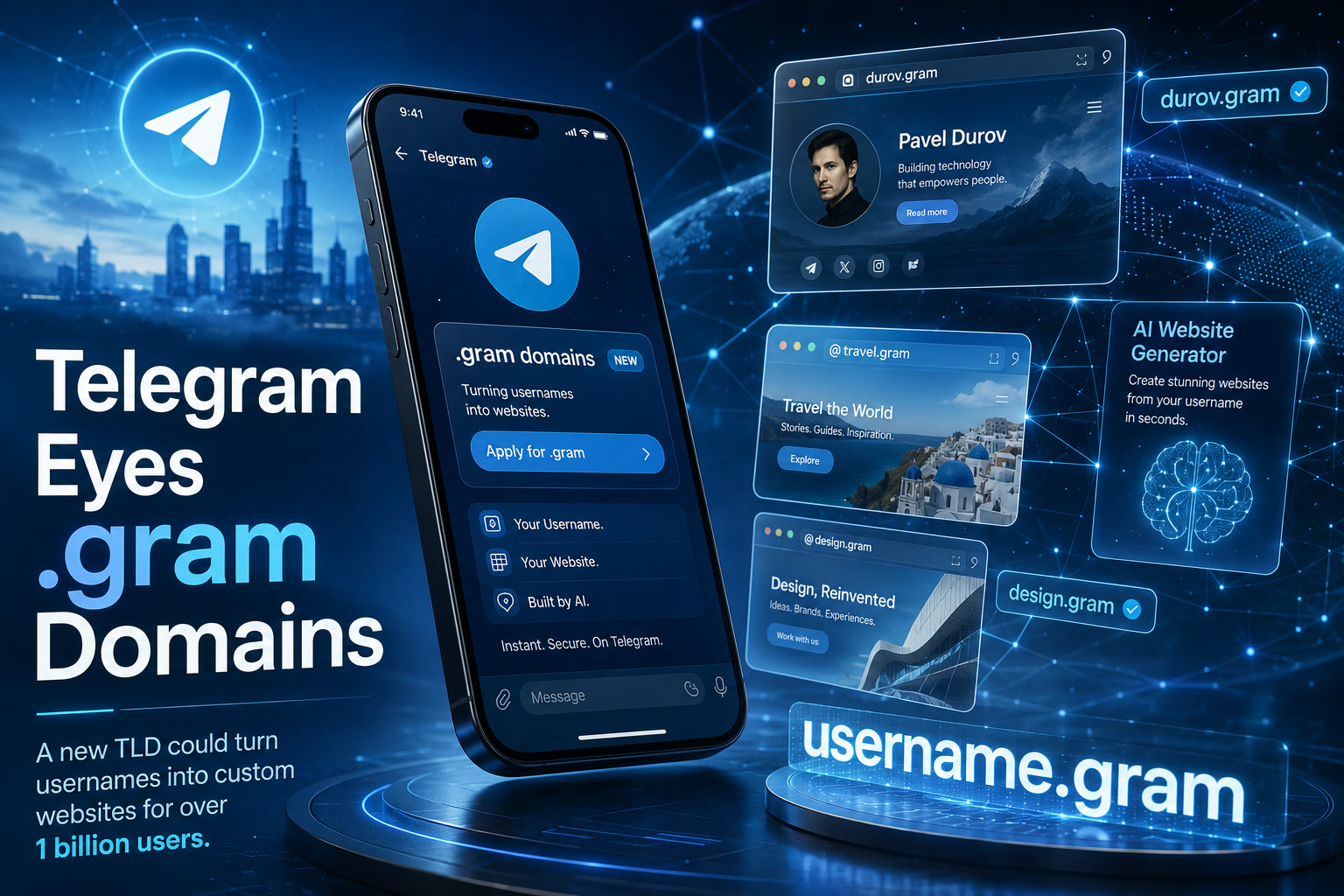
Telegram may be preparing one of its most ambitious expansions yet — and this time, it isn't about messaging, bots or cryptocurrency. The company has officially applied for control of the .gram top-level domain, potentially giving more than one billion Telegram users their own personalised web addresses such as yourname.gram.
Telegram founder Pavel Durov revealed that the company submitted the application as part of ICANN's 2026 round for new generic top-level domains. If approved, Telegram wouldn't simply use .gram for a handful of corporate websites. The much bigger idea is to connect it directly to Telegram usernames and let users build their own websites inside the Telegram ecosystem.
And perhaps the most interesting part? Durov says those websites could potentially be created with a single prompt.
That immediately suggests Telegram has something much bigger in mind than another fancy domain extension.
First, What Exactly Is a .gram Domain?
Most of us interact with top-level domains every day without really thinking about them.
They're the final part of a web address:
Over the years, ICANN has dramatically expanded the number of generic top-level domains available, introducing everything from .app and .cloud to more unusual choices such as .pizza and .guru.
Telegram now wants .gram added to that list — with Telegram operating the registry behind it.
So instead of someone's Telegram presence existing primarily at something like:
t.me/username
The same identity could eventually become:
username.gram
That's a much more interesting proposition because a .gram address could behave like a proper standalone website rather than simply redirecting someone into Telegram.
Telegram Wants to Turn Usernames Into Web Addresses
According to Durov, approval of the application could give Telegram's enormous user base access to their own second-level .gram domains.
In practical terms, a Telegram username could potentially become a web identity almost automatically.
For example:
@alex → alex.gram
@lemonweb → lemonweb.gram
Instead of buying a domain from a registrar, configuring DNS, finding web hosting and then installing a content management system, Telegram appears to be imagining a much simpler experience.
Pick your Telegram identity, create your page and publish it through Telegram's infrastructure.
For ordinary users who have never built a website before, that could dramatically lower the barrier to having a personal presence on the open web.
And These Wouldn't Necessarily Be Simple Profile Pages
This is where Telegram's proposal becomes much more interesting.
Durov says users could create interactive websites hosted by Telegram, potentially using just one prompt.
That wording strongly points towards some form of AI-powered website generation.
You could imagine typing something along the lines of:
"Create a portfolio website showing my photography, biography and links to my Telegram channel."
Telegram could then theoretically generate the layout, content structure and interactive elements automatically before publishing everything at:
yourname.gram
Nothing about the final implementation has been detailed yet, so it's worth avoiding assumptions about exactly how sophisticated the website builder would be.
But if Telegram really delivers on the "one prompt" idea, .gram could become less like conventional domain registration and more like an AI website publishing platform built directly into Telegram.
It Could Be Telegram's Answer to Link-in-Bio Services
There's another obvious use case here.
Millions of creators currently rely on services such as Linktree and similar platforms to create a simple landing page containing their social accounts, stores, videos and other links.
Telegram already has creators, public channels, businesses, bots, communities and Mini Apps living inside its ecosystem.
A .gram website could potentially pull all of those things together.
A creator's page might eventually include:
All under a memorable domain attached directly to their Telegram identity.
That would give Telegram another way of expanding beyond the boundaries of its messaging app.
Owning .gram Could Also Solve a Very Real Problem for Telegram
There is another reason Telegram may want greater control over its own domain infrastructure — and the timing is difficult to ignore.
In July 2026, Telegram's widely used t.me short-link domain temporarily stopped resolving worldwide after the .ME registry placed it under a serverHold status. The disruption broke browser links to Telegram profiles, groups, channels, bots and posts, although Telegram's core messaging service continued operating.
The incident was related to OFAC compliance after a Telegram URL associated with a sanctioned VPN service appeared in a sanctions listing. The .ME registry later restored the domain after the issue was addressed.
The episode demonstrated an uncomfortable reality:
Telegram does not control the .me top-level domain.
Telegram owns the t.me registration, but .me itself is operated externally. A registry-level action can therefore affect Telegram's domain regardless of whether Telegram's own servers are running normally.
If Telegram eventually operates .gram, it would have substantially greater control over that namespace and the infrastructure associated with it.
That doesn't mean .gram could never experience technical, regulatory or policy-related issues, but Telegram would no longer be relying on another company's top-level domain simply to operate its primary public-link system.
Could .gram Eventually Replace t.me?
That's one of the obvious questions, although Telegram hasn't announced anything suggesting that t.me is going away.
The two could easily coexist.
t.me is extremely short and already recognised globally. It's ideal for sharing Telegram links.
.gram, on the other hand, could be positioned as something much broader — an identity and publishing layer for users, creators and businesses.
We could theoretically end up with something like:
t.me/lemonweb → opens the Telegram account.
lemonweb.gram → opens a complete website associated with that account.
That would give Telegram both a short-link system and a proper web ecosystem.
This Isn't Like Simply Buying a Normal Domain
There's an important distinction here.
Telegram isn't trying to register gram.com or another conventional web address.
It wants to become the registry operator for an entirely new top-level domain.
That means .gram would effectively sit alongside extensions such as .com, .net or .app within the global Domain Name System.
ICANN's application process for something like this is considerably more involved than purchasing a regular domain name. Applicants are assessed on technical, operational and financial requirements before a new TLD can eventually be delegated.
The 2026 application window opened on 30 April 2026 and closed on 12 August 2026, making this the first major ICANN new-gTLD application round since 2012.
So Telegram has submitted its application, but that is only the beginning of the process.
There's Also No Guarantee Telegram Will Get .gram
Here's where things could get complicated.
More than one organisation can apply for the same or confusingly similar domain extension.
When that happens, ICANN places competing applications into what it calls a contention set. Only one application for an identical string can ultimately proceed, meaning the competing applicants must eventually resolve the situation through the processes defined by ICANN.
Reports have suggested that Telegram may not be the only party interested in .gram.
Link Freedom Group, a domain infrastructure company, has confirmed that it submitted more than 300 TLD applications during the 2026 ICANN round, representing tens of millions of dollars in application fees.
Whether .gram is officially among competing applications won't be fully confirmed until ICANN publishes the applications that pass its initial administrative checks.
We Should Know More Within the Next Few Months
ICANN refers to the publication of the submitted applications as Reveal Day.
On that day, ICANN will publish:
Reveal Day is expected to occur no later than nine weeks after the application window closed, although ICANN will determine the precise date based on the volume of applications received.
Since the window closed on 12 August, we should therefore get a much clearer picture of the .gram situation later this year.
And if several organisations really have applied for it, Telegram could face a much longer road before anything becomes operational.
Why Would Telegram Want to Become Part of the Web Infrastructure?
Looking at Telegram today, the move actually makes quite a lot of sense.
The platform has gradually moved far beyond simple messaging.
Telegram now encompasses:
Adding domains and hosted websites would give Telegram another layer.
Instead of being somewhere users visit after clicking a web link, Telegram could increasingly become the platform creating and hosting the web destination itself.
That's a subtle but important shift.
A Billion Potential Websites Is a Huge Proposition
The scale is also worth considering.
Most website-building companies spend years trying to convince people to sign up, purchase hosting and create their first site.
Telegram already has an enormous installed user base.
If it simply places a "Create Website" button beside Telegram usernames and automatically offers something like username.gram, millions of users could potentially experiment with website creation without ever dealing with conventional hosting.
Combine that with AI-generated pages and the process could become remarkably simple:
Choose username → Describe website → Generate → Publish
For individuals and small businesses, that could be extremely appealing.
It could also make .gram addresses widely recognisable very quickly if Telegram integrates them deeply into profiles, channels and messaging.
There Are Still Plenty of Questions
The concept sounds impressive, but Telegram hasn't explained many of the practical details yet.
Among the bigger unanswered questions are:
Those details could determine whether .gram becomes a serious web-publishing platform or simply another convenient Telegram profile feature.
Security and Impersonation Could Become a Major Challenge
There's also another side to making website creation extremely easy.
If Telegram suddenly allows enormous numbers of people to create websites using AI prompts, the company would need strong protections against phishing, impersonation, malicious downloads and fraudulent pages.
A domain like:
support-company.gram
could look surprisingly convincing to an inexperienced user if the site itself is professionally generated by AI.
Telegram would therefore need robust moderation, identity verification and abuse-reporting mechanisms if .gram becomes widely available.
The easier it becomes to create legitimate websites, unfortunately, the easier it can become to create convincing malicious ones too.
Final Thoughts
Telegram's .gram application could initially sound like little more than another technology company trying to secure a branded domain extension.
But the bigger vision is much more interesting.
If Telegram successfully obtains .gram and delivers what Pavel Durov has described, Telegram usernames could essentially become web identities, complete with interactive websites hosted directly by the platform and potentially generated through AI prompts.
That would push Telegram another step beyond messaging and closer towards becoming an all-in-one digital ecosystem encompassing communication, communities, applications, payments, publishing and now potentially web hosting.
It would also give the company greater control over its domain infrastructure after the recent t.me disruption highlighted the risks of depending on a third-party top-level domain.
Still, we're a long way from typing yourname.gram into a browser.
Telegram first needs to survive ICANN's evaluation process, resolve any competition for the .gram string and then actually build the infrastructure and tools Durov is promising.
But if everything falls into place, creating a personal website could eventually become almost as easy as choosing a Telegram username and describing what you want it to look like.











Comments 0