

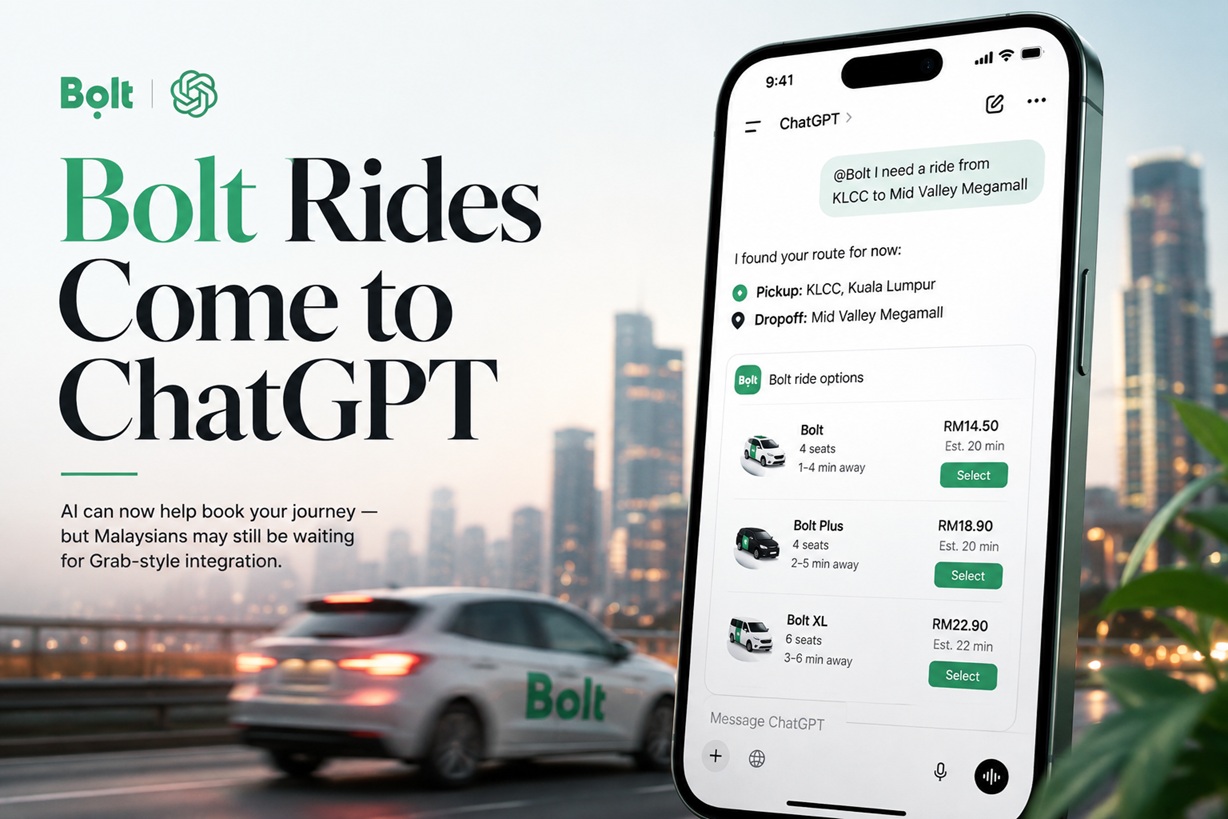
Generative AI is steadily moving beyond answering questions and writing content. It is now beginning to perform practical everyday tasks, from planning journeys and making reservations to helping users interact with services without constantly switching between different applications. Bolt is taking advantage of that shift by allowing users to begin booking an e-hailing ride directly through ChatGPT.
The integration is designed to make requesting transport feel more conversational. Instead of opening an e-hailing application, entering a destination and manually comparing several ride options, users can describe where they want to go through ChatGPT and view the available Bolt choices from there.
How Booking a Bolt Ride Through ChatGPT Works
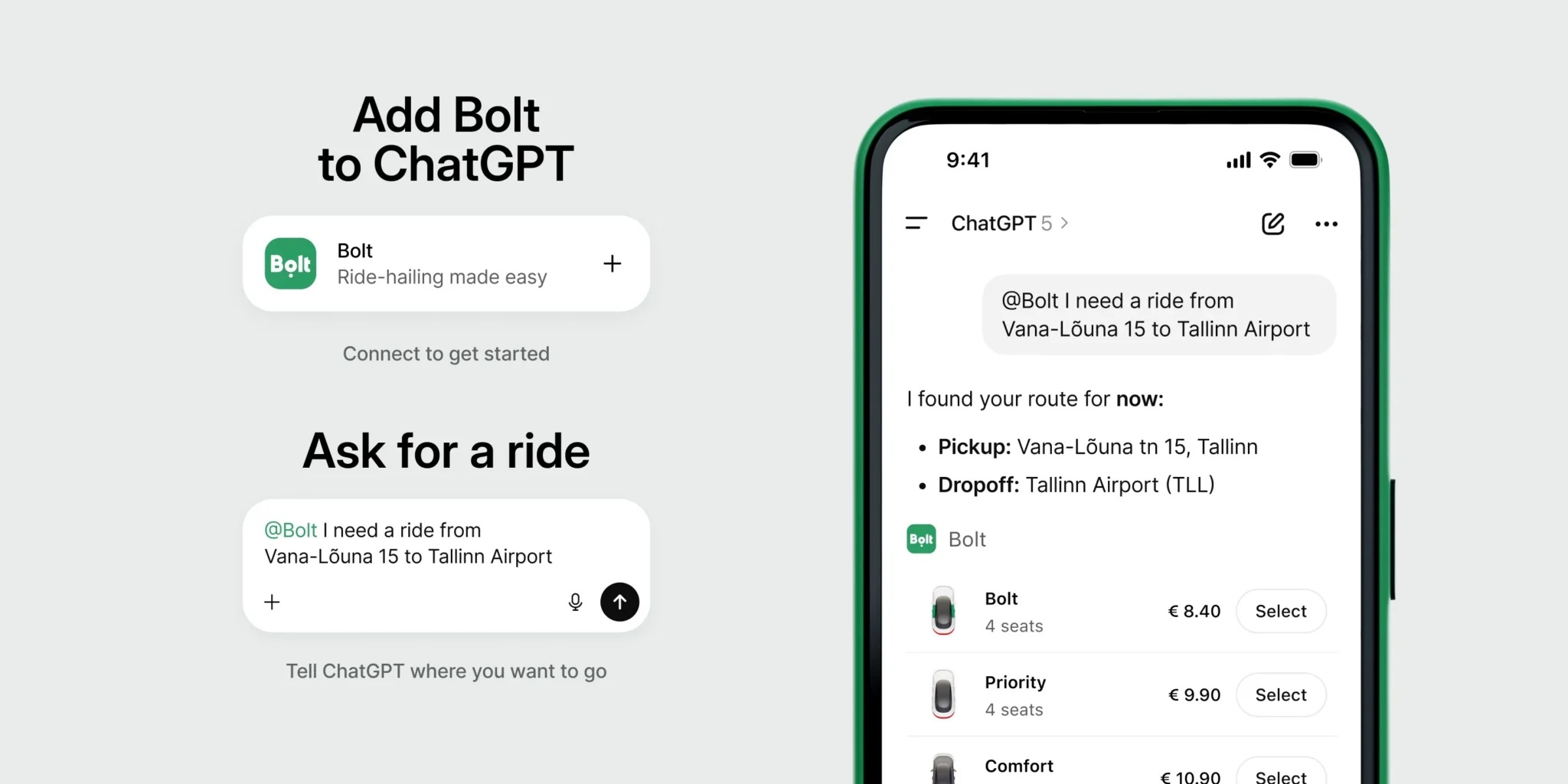
Before using the feature, users must connect their Bolt account with ChatGPT. Once the two services are linked, they can ask ChatGPT to arrange a ride by providing the necessary pickup point and destination.
ChatGPT will then display relevant ride options, including the available vehicle categories, estimated fares and expected driver arrival times. The service may also suggest a more suitable pickup location nearby, which could help reduce waiting time or make it easier for the driver to reach the passenger.
After the user selects a preferred option, the booking information is transferred to the Bolt application. The final confirmation and payment are currently completed through Bolt itself.
This means ChatGPT does not yet handle the entire journey from request to payment. However, it acts as the starting point, simplifying the process of searching for a ride and comparing the available choices.
Payments Could Eventually Stay Inside ChatGPT
Bolt intends to expand the integration by allowing passengers to pay for their rides without leaving ChatGPT. The company expects this capability to arrive later, although it has not provided a firm launch date.
Once direct payment becomes available, the experience could become much more seamless. A user might simply tell ChatGPT where they need to go, review the available fares, select a vehicle and confirm payment—all within the same conversation.
That is likely the broader direction of AI assistants. Rather than simply providing instructions on how to complete a task, they will increasingly connect with external services and carry out portions of the process on the user's behalf.
Bolt Malaysia General Manager Afzan Lutfi explained that people no longer want to plan a single evening across several separate applications. The company's idea is that requesting a ride should eventually become as easy as asking for one, checking the price and confirming the trip.
A Global Rollout Instead of Making Malaysia Wait
One encouraging aspect of the announcement is that Bolt is introducing the ChatGPT integration across all the markets in which it operates. The company is not limiting the initial release to a few major countries before gradually expanding it elsewhere.
Malaysian users are often required to wait for new application features, AI tools and digital services that appear much earlier in the United States or Europe. A simultaneous rollout gives local users the opportunity to test the feature without being placed at the end of a lengthy regional release schedule.
However, simply making the integration available does not guarantee that it will gain widespread attention in Malaysia. The usefulness of the feature will depend heavily on how many people already use Bolt, how easily they can find drivers and whether the fares are competitive with other local options.
Personally, I Have Never Used Bolt
On a personal level, I have never used Bolt. The service appears to be relatively unpopular in Malaysia compared with Grab, which has become the default e-hailing application for many people.
Grab benefits from being deeply established in the local market. It is not only used for transport but also for food delivery, digital payments, shopping and several other everyday services. For many Malaysians, opening Grab when they need a ride has already become a habit.
That makes Bolt's ChatGPT integration technically interesting, but perhaps less immediately relevant to the average Malaysian user. A useful AI feature can encourage people to try a new service, but it may not be enough to overcome limited familiarity, smaller driver availability or an existing preference for a competing platform.
The integration may be more attractive in countries where Bolt already has a stronger presence and a larger customer base. In Malaysia, it could instead serve as an introduction to users who may not have previously considered the platform.
I Would Rather See Grab Integrated with ChatGPT
Personally, I would be more interested in seeing Grab—or another widely used local service—integrated with ChatGPT in a similar way.
Imagine asking ChatGPT to find a ride to a hospital, shopping centre or airport and immediately receiving GrabCar options, estimated arrival times and current fares. The assistant could potentially consider traffic conditions, recommend the most convenient pickup point and help determine what time the user should leave.
The integration could become even more useful if it extended beyond transport. A user might ask ChatGPT to plan dinner, compare nearby restaurants, arrange a Grab ride and prepare a food delivery order for later—all through one connected conversation.
Grab has previously offered ChatGPT Plus access as a benefit for selected subscribers, showing that there has already been some connection between the two brands. However, integrating Grab's actual services into ChatGPT would be a much more meaningful development for users.
Other e-hailing and transport providers could benefit from doing the same. The main value is not necessarily the novelty of booking through an AI chatbot. It is the ability to reduce the number of steps required to complete a familiar task.
Convenience Comes with Privacy Considerations
Connecting an e-hailing service to an AI assistant will naturally require users to share certain information between platforms. This could include pickup locations, destinations, account details and booking preferences.
Users should therefore pay attention to what information is being shared, how account connections can be removed and whether location history is retained. The convenience of completing more tasks through a single assistant should not mean giving that assistant unlimited access to every connected service.
Clear permissions will become increasingly important as ChatGPT and other AI platforms evolve into central hubs for transport, shopping, travel and payments.
AI Assistants Are Becoming Service Platforms
Bolt's integration represents a wider change in how technology companies view AI assistants. Chatbots are no longer being treated purely as tools for generating text or answering questions. They are gradually becoming interfaces through which people can access other digital services.
In the future, users may spend less time navigating individual applications. Instead, they could tell an AI assistant what they need and allow it to communicate with the appropriate service.
That could make everyday digital tasks faster, especially for people who find complex application menus frustrating. At the same time, service providers must ensure that users remain in control of important decisions such as prices, payments, cancellations and personal information.
Final Thoughts
Bolt's ChatGPT integration is an interesting step towards a future where booking transport feels more like having a conversation than completing a form. Users can request a ride, compare vehicles and prices, receive pickup suggestions and then continue the booking through the Bolt application. Direct payment within ChatGPT is also expected to arrive later.
The feature demonstrates how generative AI can become genuinely useful when connected to real services. Nevertheless, its impact in Malaysia may be limited because Bolt is still much less prominent than Grab.
Since I have personally never used Bolt, this integration alone is unlikely to make it my first choice for transport. I would be far more excited to see Grab or another widely used Malaysian platform offer the same capability. That would make ChatGPT integration feel less like an interesting experiment and more like a practical feature that people could use every day.











Comments 0