

For many years, graphic design was an important part of the services offered by Lemon Web Solutions. Businesses needed logos, banners, posters, social media artwork, website graphics, promotional materials and countless other visual assets. Even smaller design assignments helped keep the business moving because there was always someone who needed professional artwork but did not have the skills or software to create it themselves.
That situation began changing very quickly with the rise of artificial intelligence.
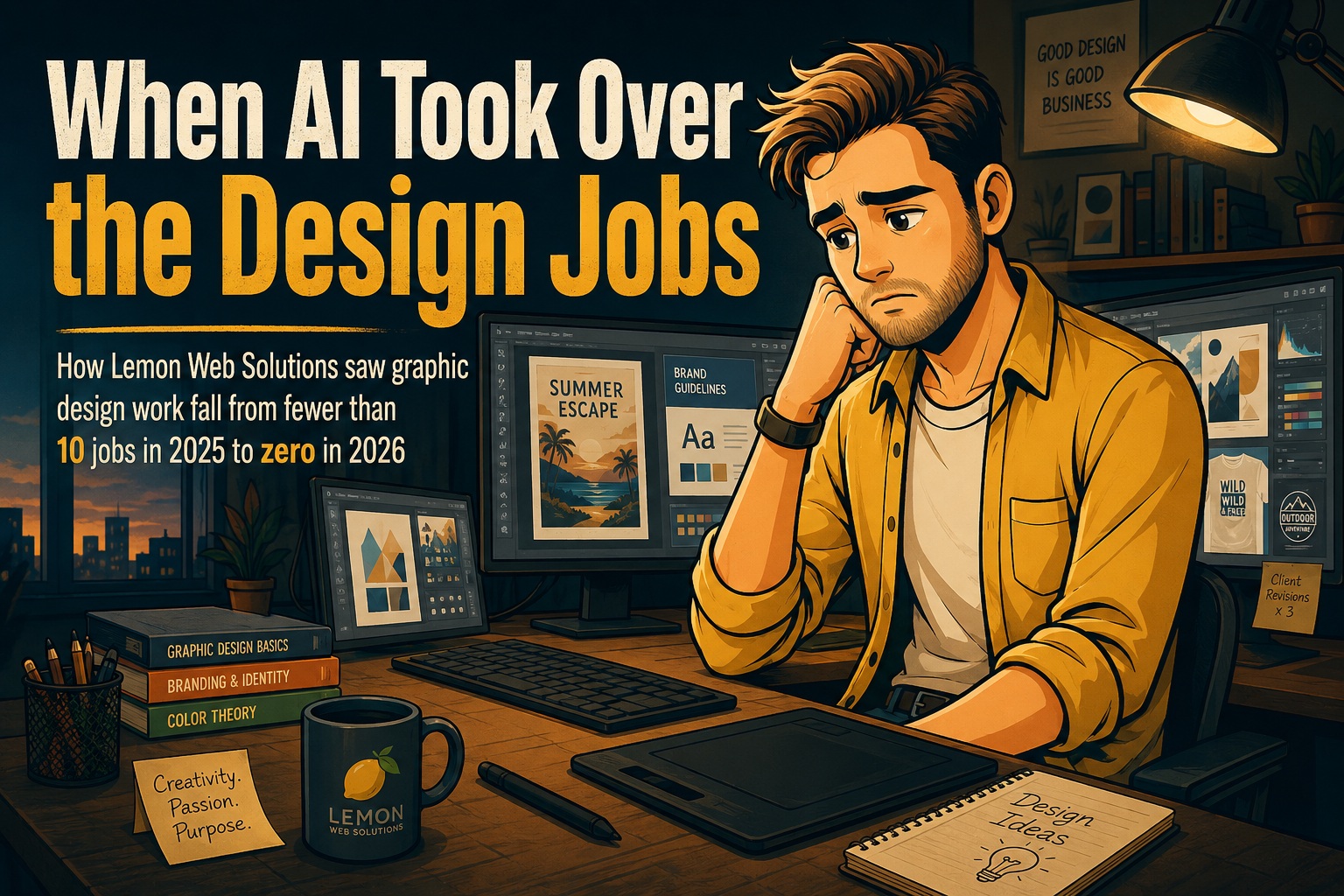
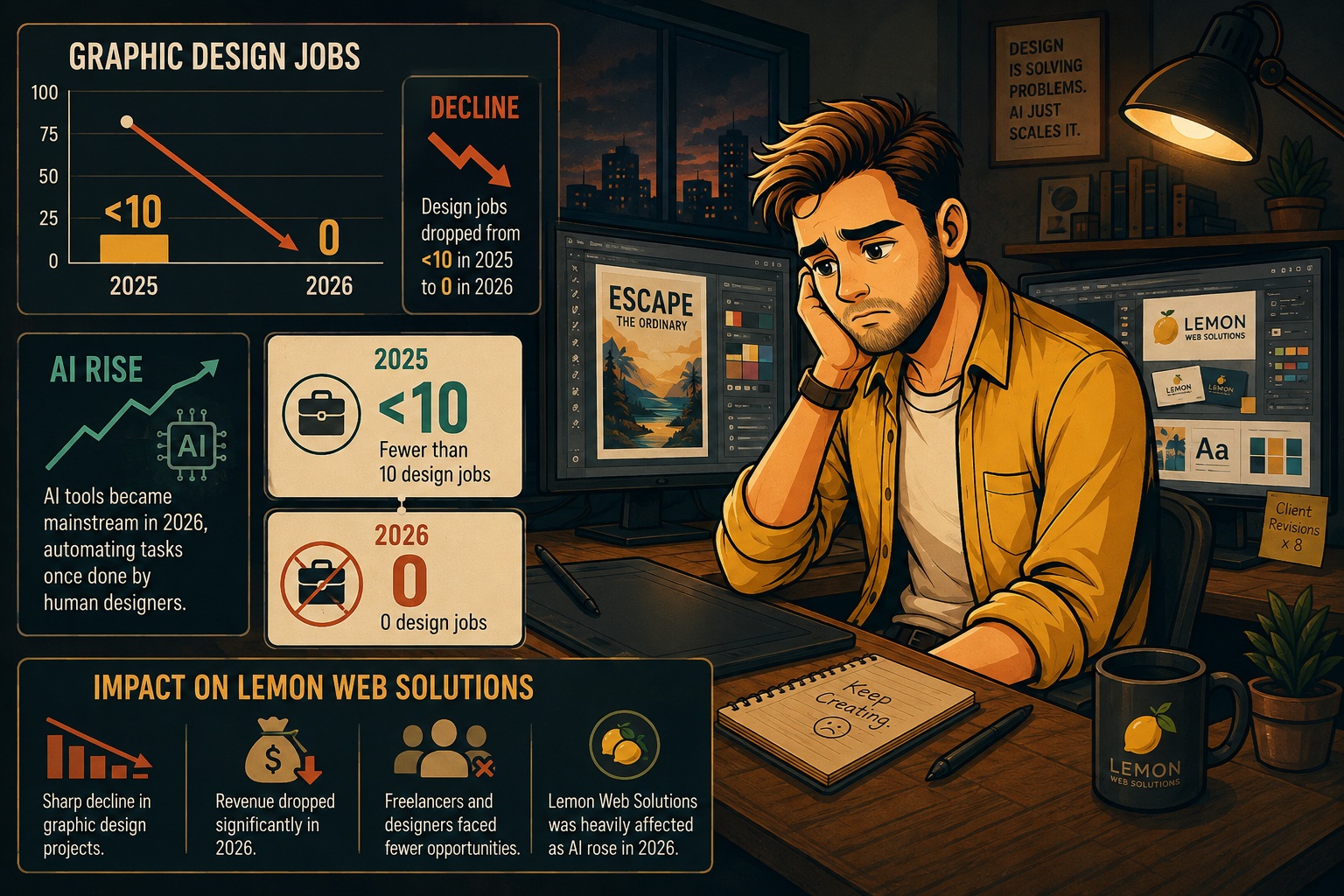
By 2025, I could already feel the decline. Throughout the entire year, Lemon Web Solutions received fewer than ten graphic design jobs. That was already worrying, especially when compared with previous years when design work arrived much more regularly. However, 2026 made the situation even clearer: the number of graphic design jobs dropped to zero.
Not fewer jobs. Not one or two small projects.
Completely zero.
The Change Happened Faster Than Expected
Technology has always affected the creative industry. Before AI, designers already had to deal with cheaper design marketplaces, editable templates, Canva and clients trying to create their own artwork. However, those tools still required some level of effort, creativity and understanding.
Generative AI changed the situation because it removed many of those barriers.
Today, someone can type a few sentences describing a logo, poster, background or promotional image and receive several results within seconds. They may not always be perfect, but for many people, they are considered "good enough." A small business owner who previously paid a designer may now generate an image, add some text and publish it immediately.
The quality does not even have to match professional design work. For many clients, speed and cost are now more important than originality, consistency or long-term brand value.
That shift has had a serious effect on businesses such as Lemon Web Solutions. Graphic design was not merely a creative hobby. It was a real service that generated income, supported other projects and helped build relationships with customers.
From Paying a Designer to Writing a Prompt
In the past, a client would contact a designer, explain what they wanted and provide information about their business. The designer would study the requirements, choose suitable colours, plan the composition, prepare drafts and make revisions based on the client's feedback.
Now, many potential clients simply open an AI application and enter a prompt.
They can ask for a modern business logo, a festive greeting poster, a gaming thumbnail or an advertisement for a product. Within moments, they have something they can use. They may encounter distorted text, inconsistent details or artwork that looks similar to thousands of other AI-generated images, but these problems are often accepted because the result was fast and inexpensive.
This has created a difficult question for professional designers: how do you convince someone to pay for thoughtful design when they can generate an acceptable-looking image almost instantly?
The answer is not easy, especially for smaller design jobs. A large company may still understand the importance of brand guidelines, licensing, consistency and original creative direction. Smaller clients often just need something attractive enough to post on Facebook, WhatsApp or Instagram. AI is increasingly fulfilling that basic requirement.
The Financial Impact Is Real
When people discuss AI, the conversation often focuses on convenience, productivity and innovation. We hear about how AI helps people work faster, generate ideas and reduce costs. Those benefits are real, and I use AI myself in many areas.
However, there is another side to the story.
Every task that becomes automated may also represent income that someone previously depended on. When ten people decide to generate their own artwork rather than hiring a designer, that is not merely a technological change. It is ten missing jobs for the creative industry.
For Lemon Web Solutions, the decline was visible in actual numbers. Fewer than ten graphic design jobs in 2025 was already a dramatic reduction. Reaching zero jobs in 2026 showed that this was no longer a temporary slowdown. The market itself had changed.
A business can prepare for competition, economic downturns or seasonal demand. It is much harder to prepare when an entire category of work almost disappears within a very short period.
Design Has Not Disappeared, but Its Value Has Changed
Graphic design itself is not dead. Visual communication is still everywhere. In fact, people are probably producing and consuming more visual content than ever before.
What has changed is who creates it, how quickly it is created and how much people are willing to pay for it.
AI has made visual production widely accessible, but it has also reduced the perceived value of individual pieces of artwork. When hundreds of images can be generated in a few minutes, clients may no longer see a single design as something that deserves hours of work and professional fees.
This can be frustrating for experienced designers because good design is not only about producing something attractive. It involves understanding the audience, maintaining brand consistency, controlling visual hierarchy, selecting suitable typography and communicating the correct message.
AI can generate impressive images, but it does not automatically understand a company's history, reputation, customers or long-term direction. A human still needs to guide those decisions. Unfortunately, many clients only notice this difference when something goes wrong.
Competing on Price Is No Longer Realistic
One possible response would be to lower design prices, but there is a limit to how far any professional can go.
A human designer requires time to communicate with the client, develop ideas, make revisions and prepare the final files. AI tools can produce results almost immediately, sometimes as part of a subscription the client already pays for. Competing purely on price and speed therefore becomes nearly impossible.
This means design businesses must compete on something AI cannot easily provide: understanding, accountability, consistency and the ability to connect design with a wider business objective.
Instead of selling only a logo, designers may need to offer a complete branding system. Instead of creating only a banner, they may need to connect the artwork with a website, campaign or digital marketing strategy. Instead of being seen as someone who operates design software, they must become a creative partner who understands the client's business.
That transition is necessary, but it is not painless. It does not immediately replace the income lost from all the small design jobs that have disappeared.
AI Is Also Becoming Part of the Workflow
The strange reality is that the same technology responsible for reducing design work can also help designers and digital businesses become more productive.
AI can assist with early concepts, background generation, image enhancement, resizing, copywriting and repetitive production tasks. Work that previously required several hours may now be completed much faster. For projects that still require professional direction, this can improve efficiency and allow more time to focus on the final quality.
The challenge is finding clients who value that direction.
Using AI does not automatically remove the role of a designer. A person still needs to judge whether an image fits the brand, whether the message is clear and whether the final artwork looks professional. AI can generate options, but someone must decide which option actually works.
The problem is that many potential clients now believe the generation process and the design process are the same thing.
They are not.
Lemon Web Solutions Must Continue Adapting
For Lemon Web Solutions, the disappearance of graphic design jobs is disappointing, but it is also a clear signal that the business must continue evolving.
Web development, application services, digital platforms, gaming projects and technical solutions may offer areas where human experience remains more difficult to replace. Even within those fields, AI will continue changing the way work is performed, so adaptation cannot stop.
Graphic design may become less of a standalone service and more of a supporting part of larger projects. A client may no longer pay only for an individual image, but visual design will still be needed when creating a complete website, application, online campaign or branded digital experience.
The skills are still valuable. The way they are packaged and sold must change.
Final Thoughts
The rise of AI in 2026 has brought many useful possibilities, but it has also caused genuine disruption to creative professionals and small digital businesses. For Lemon Web Solutions, the decline in graphic design work is not theoretical. It can be measured clearly: fewer than ten jobs in 2025, followed by no graphic design jobs at all in 2026.
That is a painful change for a service that once contributed meaningfully to the business.
I do not believe the answer is to reject AI or pretend that it will disappear. The technology is already here, and it will continue improving. The only realistic option is to understand it, use it where appropriate and focus on services where human judgement, technical knowledge and long-term responsibility still matter.
AI can generate a picture in seconds. What it cannot automatically provide is a genuine understanding of a client, a business relationship built over time or the responsibility of making sure the final result actually achieves its purpose.
The graphic design industry may never return to what it was before 2025. For Lemon Web Solutions, this means accepting a difficult reality while continuing to search for new ways to provide value in a world where creativity, technology and automation are becoming increasingly connected.











Comments 0