

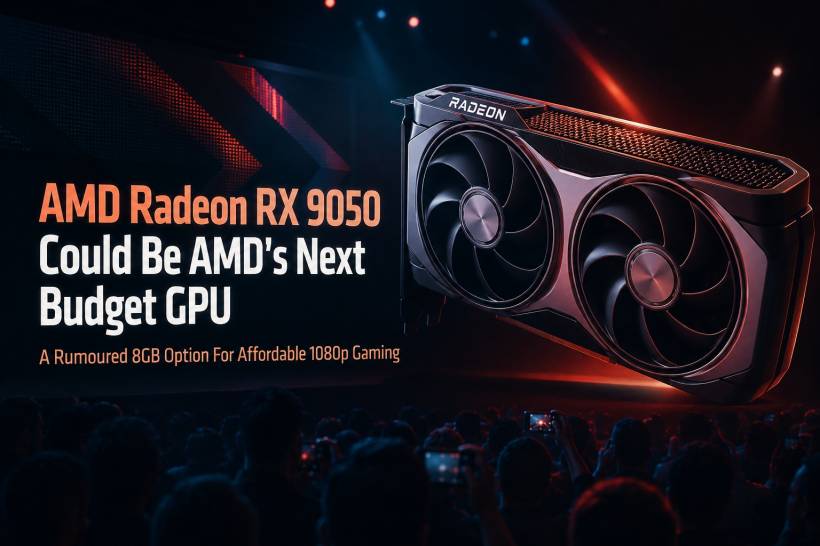
AMD may be getting ready to expand its Radeon RX 9000 Series lineup with a more affordable graphics card aimed at budget-conscious gamers. The reported card, known as the Radeon RX 9050, appears to be positioned below the Radeon RX 9060 Series and could become AMD's entry-level option for users who want modern GPU features without paying mid-range prices.
At this stage, the Radeon RX 9050 has not been officially announced by AMD, so the details should still be treated as early information. However, based on the reported specifications, the card seems designed for one very clear purpose: to offer a more accessible 1080p gaming option for players who do not need the fastest GPU, but still want something capable, modern, and reasonably efficient.
A New Entry Point Into The Radeon RX 9000 Series
The Radeon RX 9050 is reportedly based on AMD's Navi 44 GPU architecture, which is also used in the Radeon RX 9060 Series. That alone makes it interesting because it suggests AMD may be using the same general architecture but tuning the card differently to fit a lower price segment.
According to the reported specifications, the RX 9050 may come with 2,048 Stream Processors. On paper, that matches the Radeon RX 9060 XT, which sounds surprisingly strong for an entry-level model. However, raw Stream Processor count is only one part of the story. Clock speeds, power limits, memory configuration, and overall tuning all play a major role in real-world gaming performance.
This is where AMD appears to be separating the RX 9050 from the higher-positioned RX 9060 XT. The new card is expected to run at lower clock speeds, making it a more modest performer despite sharing some similarities on paper.
Lower Clock Speeds To Match Its Budget Positioning
The Radeon RX 9050 is reportedly expected to feature a game clock of around 1,920MHz and a boost clock of around 2,600MHz. For comparison, the Radeon RX 9060 XT runs at a much higher 2,530MHz game clock and 3,130MHz boost clock.
That difference is important because it gives us a better idea of where AMD may be positioning this card. Based on clock speed alone, the RX 9050 could be noticeably slower than the RX 9060 XT, possibly by around 24% when compared directly in terms of frequency.
Of course, actual gaming performance will depend on more than just clock speed. Driver optimisation, memory bandwidth, game engine behaviour, cooling design, and power limits will all affect the final result. Still, the reduced clocks strongly suggest that the RX 9050 is not meant to compete with the RX 9060 XT directly. Instead, it is likely being prepared as a lower-cost alternative for gamers who mainly play at 1080p.
8GB VRAM Still Makes Sense For Entry-Level Gaming
The Radeon RX 9050 is expected to come with 8GB of GDDR6 memory running on a 128-bit memory bus. Its reported memory bandwidth is 288GB/s, which is said to be similar to the non-XT Radeon RX 9060.
For an entry-level graphics card, 8GB of VRAM is still a sensible starting point. It should be enough for many 1080p games, especially esports titles, older AAA games, indie releases, and well-optimised modern games. However, it is also fair to say that 8GB is no longer a generous amount of VRAM in today's gaming landscape.
Many newer AAA titles are becoming more demanding, especially when high-resolution textures, ray tracing, and ultra-quality presets are enabled. For this reason, the RX 9050 should probably be viewed as a practical 1080p card rather than something designed for maximum settings in every modern game.
For budget-minded gamers, that may not be a major issue. Many users in this segment are not chasing ultra settings or high refresh rates in every title. They simply want games to run smoothly at sensible settings, and that is where a card like the RX 9050 could still be useful.
PCIe 5.0 Support Could Help Keep The Card Modern
One of the more positive details surrounding the Radeon RX 9050 is its expected PCIe 5.0 compatibility. While this may not sound exciting for every user, it does help keep the card aligned with newer platforms and modern motherboard standards.
That said, budget GPUs are often paired with older systems. Many users buying an affordable graphics card may still be using PCIe 3.0 or PCIe 4.0 motherboards. If the RX 9050 uses a reduced PCIe lane configuration, performance on older PCIe systems could become an important point to watch once reviews are available.
This is especially relevant for budget cards because manufacturers sometimes limit lower-end GPUs to fewer PCIe lanes to reduce cost. On newer PCIe 5.0 systems, that may not be much of a problem. On older systems, however, the performance difference can become more noticeable in certain games or workloads.
Power Requirements Should Be Manageable
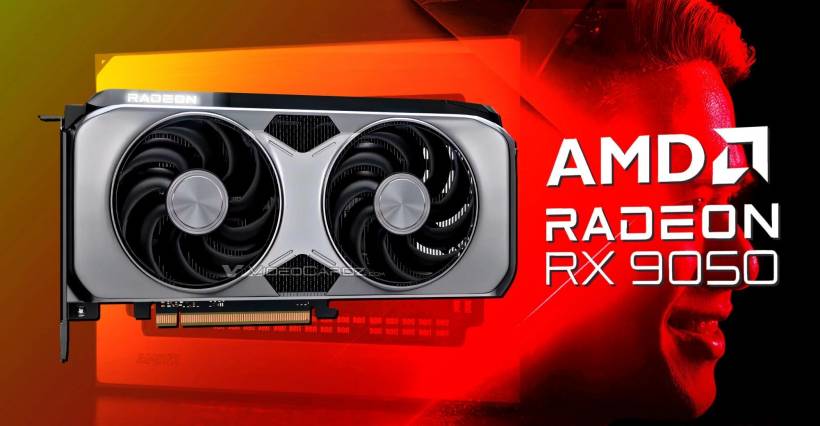
The card's total board power has not been clearly confirmed yet. However, the reported recommended power supply is 450W, which suggests that the RX 9050 should not be a particularly power-hungry GPU.
For comparison, the Radeon RX 9060 XT reportedly has a total board power of around 160W. If AMD keeps the RX 9050 at a similar or lower power level, it could become a practical upgrade for users with existing entry-level or mid-range power supplies.
This matters because budget GPU buyers often want a simple upgrade. They may not want to replace their power supply, change their casing, or deal with complicated cooling requirements. A lower-power card would make the RX 9050 easier to recommend for older desktops, compact builds, and affordable gaming PCs.
The Price Will Decide Everything
The most important factor for the Radeon RX 9050 will be pricing. A budget graphics card only makes sense if it is actually priced like one. If AMD places it too close to the RX 9060 XT or NVIDIA's competing entry-level options, the RX 9050 may struggle to stand out.
In Malaysia, the cheapest Radeon RX 9060 XT models are said to average around RM1,500, while NVIDIA's GeForce RTX 5050 is also expected to sit around a similar price range. If the Radeon RX 9050 is truly meant to target entry-level gamers, then a price below RM1,000 would make far more sense.
That sub-RM1,000 range would be important for many local PC gamers. It would make the card more attractive to students, casual gamers, office PC upgraders, and users who simply want to build or refresh a 1080p gaming system without overspending.
If AMD can hit that price point while offering decent performance, 8GB of VRAM, modern architecture, and reasonable power consumption, the RX 9050 could become a very appealing option in the Malaysian market.
Who The Radeon RX 9050 Is Really For
The Radeon RX 9050 does not appear to be aimed at enthusiasts or gamers who want to play every new title at ultra settings. Instead, it seems more suited for users who are upgrading from older hardware and want a practical, affordable improvement.
This could include gamers still using older Radeon RX 500 Series cards, NVIDIA GTX 1000 Series cards, entry-level GTX 1650-class GPUs, or integrated graphics. For these users, even a modest modern GPU could feel like a meaningful upgrade.
It could also appeal to gamers who mostly play titles such as esports games, racing games, older AAA releases, platformers, browser-based games, and lighter modern titles. Not every player needs a high-end graphics card, and that is exactly why budget GPUs still matter.
Final Thoughts
The reported Radeon RX 9050 could be an interesting addition to AMD's Radeon RX 9000 Series, especially if AMD positions it correctly. The specifications suggest a card that is not trying to be powerful for the sake of headlines, but practical enough for gamers who want reliable 1080p performance at a lower price.
The 8GB VRAM, 128-bit memory bus, PCIe 5.0 support, and expected low power requirements all point toward a card that could work well in affordable gaming PCs. However, the final verdict will depend heavily on actual performance, retail pricing, and how close it sits to the RX 9060 Series and NVIDIA's entry-level alternatives.
If AMD can keep the Radeon RX 9050 below RM1,000, it could become a strong option for budget-minded gamers in Malaysia. But if the price climbs too close to stronger cards, it may lose the value advantage that a product like this needs. For now, the RX 9050 is worth watching because it could fill a gap that still matters: affordable, modern graphics performance for everyday 1080p gaming.











Comments 0