

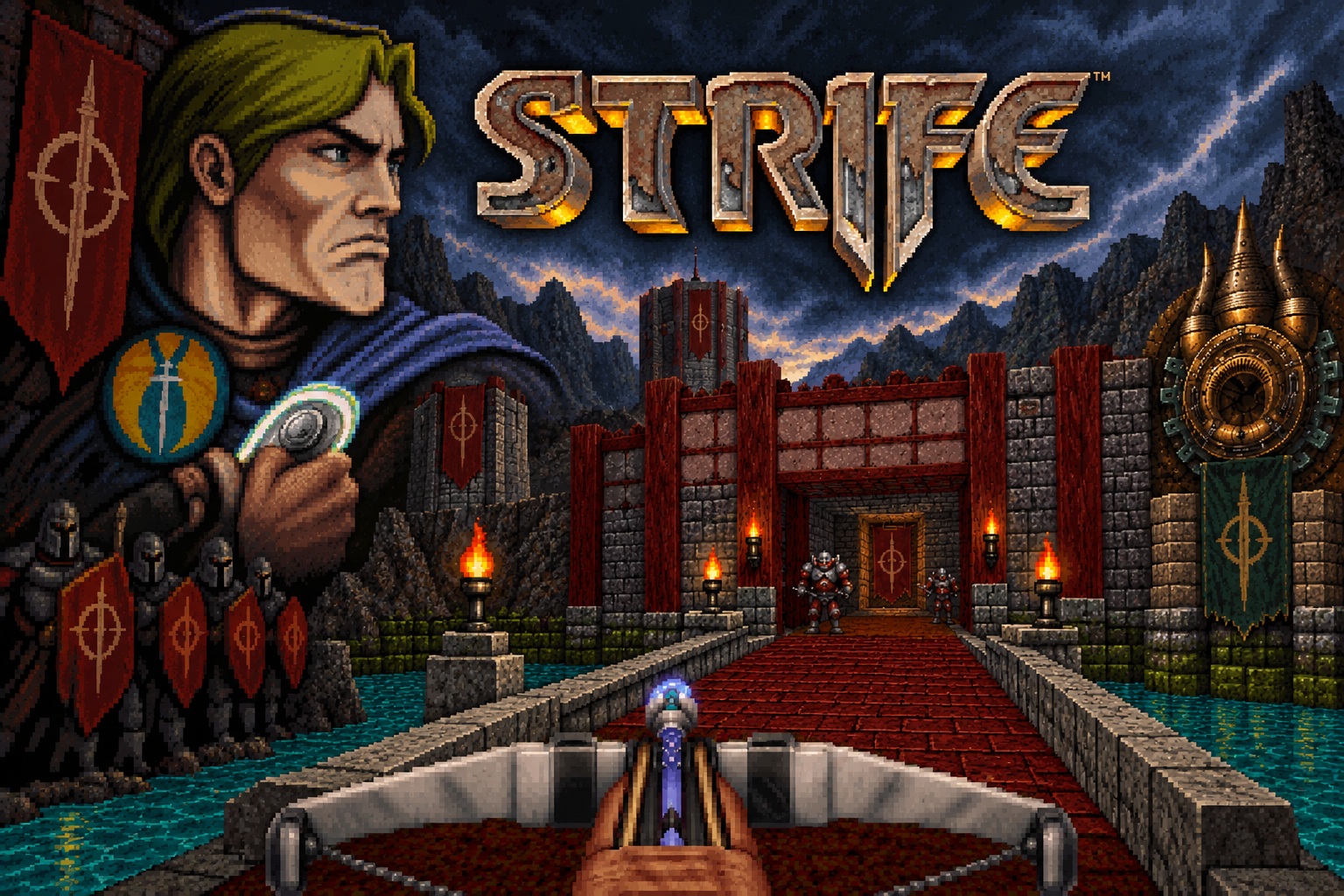
Strife is a distinctive 1996 first-person shooter that combines fast DOOM-style combat with role-playing mechanics, dialogue, quests, shops, stealth, inventory management, character progression, and a story that changes according to some of the player's decisions. Instead of moving through a simple sequence of isolated combat maps, players explore connected locations populated by civilians, merchants, rebels, guards, and other characters who can be spoken to directly. The player takes the role of an unnamed wandering mercenary who becomes involved with an underground resistance movement known as the Front, eventually taking part in a much larger conflict against the oppressive Order. This unusual mixture makes Strife feel closer to an FPS adventure than a conventional corridor shooter.
What makes Strife especially interesting is how naturally it combines combat and exploration. One moment may involve quietly walking through the town of Tarnhill, speaking with characters and buying supplies, while the next can become a firefight inside a heavily guarded industrial facility. Missions often send players back through familiar areas with new objectives, while character upgrades, money, equipment, and story decisions gradually change what becomes possible. The result was remarkably ambitious for its era and remains one of the most unusual games built around classic 1990s first-person shooter technology.
Now playable online through Lemon Web Games, Strife can be experienced directly in your web browser as part of a growing collection of classic, retro, first-person shooter, RPG, adventure, stealth, and browser-playable games. Its web-based format makes it easy to revisit this unusual hybrid while preserving the conversations, quests, weapon progression, character upgrades, hub exploration, stealth opportunities, and branching story elements that separate it from more straightforward shooters. For players who enjoy classic FPS combat but also want a world filled with characters, objectives, choices, and places worth revisiting, Strife remains a fascinating experience.
A Shooter With Genuine RPG Ambitions
Strife was unusual because it treated the first-person shooter as more than a sequence of combat arenas. Players can talk to characters, receive missions, purchase equipment, collect money, improve important character attributes, and make decisions that influence later parts of the story. These mechanics were much closer to traditional role-playing games than to most shooters of the mid-1990s. The combination gave Strife an identity that remains distinctive even when compared with many later FPS titles.
The RPG systems are deliberately lightweight enough that they never completely replace the action. Players still spend plenty of time fighting guards, robots, mutants, and other enemies with a growing arsenal of weapons. However, combat exists within a larger structure of exploration and mission progression rather than being the only activity. This makes the world feel more purposeful because most firefights happen for a reason connected to the current objective.
Tarnhill Acts as a Living Hub
The town of Tarnhill functions as one of Strife's central locations and immediately demonstrates how different the game is from DOOM. Instead of entering a map filled entirely with enemies, players encounter civilians, merchants, guards, members of the resistance, and other characters who occupy the world for different reasons. Some provide useful information, while others sell ammunition, armor, healing supplies, or equipment. Returning to the town between missions gives the campaign a sense of continuity.
The hub structure also allows locations to become familiar over time. Players gradually learn where important shops, characters, doors, and routes are located, making later navigation faster and more confident. Areas that initially seem ordinary may become relevant during future objectives, while previously inaccessible locations can eventually open. This creates the feeling of inhabiting a place rather than simply clearing one level after another.
The Front Draws You Into the Rebellion
The Front is the resistance movement fighting against the Order, and much of the player's early progression involves carrying out missions on its behalf. The mercenary begins as an outsider motivated largely by survival and reward, but gradually becomes involved in events with consequences far beyond a simple paid job. Members of the Front provide objectives, information, and access to resources needed to challenge the Order. This gives the campaign a clear political conflict without constantly interrupting gameplay with lengthy exposition.
Working with the resistance also gives missions more context than the usual "find the exit" structure of classic shooters. Players may be asked to infiltrate installations, eliminate important targets, recover equipment, sabotage infrastructure, or investigate suspicious locations. Each assignment moves the broader story forward while opening additional areas of the world. The objectives make exploration feel directed without turning Strife into a completely linear experience.
The Order Controls the World Through Fear
The Order is the dominant oppressive force within Strife's dystopian world. Its soldiers and officials maintain control over towns and facilities while ordinary people live under constant surveillance and pressure. The player regularly encounters guards patrolling public spaces, making open violence potentially dangerous because attacking one soldier can alert others nearby. This creates tension even in areas that are not initially hostile.
The Order also provides much of the game's distinctive atmosphere. Industrial machinery, religious symbolism, authoritarian architecture, heavily armed troops, and mysterious technology blend together into a strange mixture of science fiction and dark fantasy. The world feels damaged and unstable rather than cleanly futuristic. That visual identity helps Strife stand apart from more traditional military or demonic shooters.
Dialogue Is a Core Gameplay Mechanic
Talking to characters is essential because conversations provide objectives, hints, story information, and sometimes choices. Instead of relying entirely on text screens between levels, Strife allows much of its narrative to unfold while the player remains inside the world. Characters can respond differently depending on circumstances, and some conversations reveal information that makes later objectives easier to understand. This gives exploration a conversational dimension rarely seen in FPS games from the same era.
Dialogue also encourages players to slow down occasionally rather than treating every figure on screen as an enemy. Walking into a room and immediately attacking everything can create serious problems because some characters may be useful or connected to the current mission. The game therefore asks players to interpret situations before reacting. This small change dramatically alters the tone compared with shooters built entirely around combat.
Voice Acting Adds Personality
Strife also uses extensive voice acting to give its characters additional personality. Important figures speak directly to the player, helping missions and story developments feel more immediate than simple text descriptions. The voices make characters easier to remember, particularly when returning to the same people across multiple objectives. For a mid-1990s action game, this helped make the world feel unusually character-driven.
The spoken dialogue is especially effective because the story involves competing factions, hidden motives, and characters whose advice may not always be completely trustworthy. Hearing them speak makes those relationships more memorable. It also strengthens the sense that the player is navigating a real conflict rather than simply following mission instructions. The narrative presentation remains simple by modern standards but was highly ambitious for its time.
BlackBird Becomes Your Constant Companion
BlackBird communicates with the player throughout much of the campaign, providing guidance, commentary, and important information. Her presence gives the protagonist someone to interact with even while exploring dangerous areas alone. She can warn about threats, explain objectives, and react to developments as the story progresses. This creates a stronger sense of companionship than most classic shooters provide.
The relationship also helps maintain narrative continuity between missions. Rather than disappearing entirely into isolated levels, the player regularly receives information connecting current actions to the broader rebellion. BlackBird effectively becomes the voice accompanying the mercenary through the conflict. Her role makes the adventure feel more personal.
Stealth Is Actually Useful
Strife allows some encounters to be approached quietly rather than forcing every mission into immediate open combat. Certain weapons and tactics can eliminate enemies without automatically alerting an entire installation, allowing careful players to reduce the number of opponents before a major firefight begins. This creates an additional layer of strategy beyond simply carrying the strongest gun available. Understanding when stealth is possible can conserve both health and ammunition.
The system is relatively simple compared with dedicated stealth games, but its presence was unusual for an FPS of the period. Guards can react to alarms and nearby combat, meaning a poorly planned attack may turn a manageable situation into a much larger battle. Players who move cautiously can sometimes prevent that escalation. This makes infiltration missions feel noticeably different from straightforward assault sections.
The Dagger Encourages Silent Takedowns
The dagger provides a close-range option that can be useful when trying to remain quiet. Moving close enough to use it is naturally risky, but successfully eliminating an isolated enemy without creating a loud firefight can make infiltration much easier. This gives even a basic melee weapon a tactical role beyond simply saving ammunition. Its usefulness depends heavily on the environment and enemy positioning.
The dagger also reinforces the player's identity as a resourceful mercenary rather than an unstoppable super-soldier. Sometimes the smartest solution is not firing the largest weapon available. Quiet approaches can preserve resources and prevent additional guards from joining the battle. Strife continually rewards players who think about the consequences of each attack.
The Crossbow Supports Stealth
The crossbow is one of Strife's most recognizable weapons because it provides a quieter ranged alternative to conventional firearms. Different ammunition types allow it to serve several purposes, including silently dealing with vulnerable enemies from a distance. This makes it extremely useful during missions where triggering an alarm would create unnecessary trouble. Accurate shots can allow players to clear important positions before moving deeper into enemy territory.
The crossbow also demonstrates how Strife gives weapons roles beyond raw damage. A louder firearm may kill an enemy faster, but the resulting attention could make the overall mission more difficult. Choosing the quieter weapon can therefore be strategically superior despite lower immediate firepower. This kind of decision supports the game's hybrid RPG and stealth design.
Conventional Weapons Still Deliver Strong FPS Combat
Despite the RPG and stealth mechanics, Strife never abandons traditional first-person shooter action. Automatic firearms, explosive weapons, energy-based attacks, and increasingly powerful equipment become available as the campaign progresses. Once a facility enters full alert, the game can quickly turn into a fast and chaotic firefight. Movement, positioning, ammunition management, and target selection become just as important as they are in other classic shooters.
This balance is important because the game never forces one style exclusively. Players who enjoy exploration and dialogue have plenty to do, while those who prefer action still receive substantial combat. Missions often transition naturally between both styles, beginning quietly before eventually becoming much louder. The variety keeps the campaign from settling into a repetitive rhythm.
The Assault Gun Becomes a Reliable Workhorse
The assault gun provides sustained automatic fire and becomes useful against many common enemies. It works particularly well once stealth is no longer necessary and the player needs to deal with several threats quickly. Its rate of fire makes it effective for controlling corridors or interrupting weaker opponents before they can respond. Ammunition management remains important because extended firing can consume resources rapidly.
As with many Strife weapons, the assault gun is most useful when chosen for the correct situation. Using it against every minor target can waste ammunition better saved for difficult missions. The crossbow or dagger may be more efficient during quiet sections, while explosives become preferable against stronger groups. Learning to switch naturally between weapons is part of mastering the game.
Explosives Handle Heavier Resistance
As enemy strength increases, explosive weapons become increasingly useful. Mini-missiles and grenade-style attacks can deal heavy damage against groups or armored targets that would consume large amounts of conventional ammunition. These weapons are particularly valuable in open spaces where splash damage can affect multiple enemies without endangering the player. Tight rooms require much more caution because explosions can become dangerous at close range.
Heavy weapons also change the tone of an encounter immediately. A mission that began as careful infiltration can turn into complete chaos once explosives start flying. The player needs to recognize when subtlety is no longer useful and commit to stronger firepower. Strife handles this transition extremely well.
The Mauler Brings Powerful Energy Combat
The Mauler represents some of the heavier energy-based firepower available later in the game. It can deal major damage and becomes valuable against powerful enemies that would otherwise require sustained conventional attacks. Access to stronger technology reinforces the sense that the mercenary is becoming increasingly capable as the rebellion progresses. The player's arsenal gradually evolves alongside the story.
Powerful weapons also increase the importance of resource management. Energy ammunition should not be wasted casually if a difficult encounter may be approaching. Experienced players learn which enemies justify the expense and which can be handled with simpler weapons. This keeps the complete arsenal relevant.
The Sigil Is More Than a Story Object
The mysterious Sigil plays an important role in both the narrative and combat. As the player acquires additional pieces, its power increases and it becomes a weapon capable of unleashing increasingly destructive energy. This ties character progression directly to the central story because important narrative discoveries also expand the player's offensive capabilities. Few items in the game represent the combination of plot and mechanics as clearly.
Using the Sigil can be extremely powerful, but its effects come with their own considerations and risks. Players gradually learn when its abilities are appropriate and how the different stages change what it can do. Acquiring each additional piece feels meaningful because the player immediately gains something tangible from the story's progression. The weapon becomes one of Strife's defining elements.
Character Upgrades Provide Long-Term Progression
Strife allows the player to improve important attributes over the course of the campaign. Health-related upgrades increase survivability, while accuracy improvements make ranged weapons more reliable and effective. These enhancements provide a noticeable sense of progression beyond simply collecting larger guns. The mercenary genuinely becomes more capable as missions are completed.
This system adds another RPG element without introducing complicated character statistics. Players do not need to spend long periods managing menus or distributing dozens of points. Improvements are straightforward and immediately useful during combat. The simplicity keeps progression compatible with the game's fast FPS foundation.
Money Gives Exploration Practical Value
Gold and other forms of currency can be collected and spent in shops throughout the world. This means searching rooms, completing objectives, and gathering resources have value beyond finding ammunition directly. Merchants can provide equipment, health supplies, armor, or other useful items depending on the player's needs. The economy gives Tarnhill and other populated areas a practical function within the campaign.
Having money also encourages planning before difficult missions. Spending everything immediately may leave the player unable to purchase something important later, while saving excessively could make the current objective unnecessarily difficult. The system is simple but adds another meaningful decision. Shops help the world feel more interactive and believable.
Inventory Management Adds Flexibility
Strife allows players to carry useful items rather than consuming every resource automatically. Healing supplies and other equipment can be kept until they are genuinely needed, giving players more control over survival during long missions. This works especially well with hub-based exploration because important resources may need to last through several connected areas. Prepared players enter dangerous facilities with much more confidence.
Inventory management remains lightweight enough that it does not interrupt combat constantly. Players still spend most of their time exploring and fighting rather than navigating menus. The system simply provides another layer of preparation. It contributes to the game's overall feeling of being an action RPG rather than a pure shooter.
Quests Give Every Location a Purpose
Many areas in Strife are connected to specific objectives rather than existing only as combat spaces. A facility may contain machinery that must be sabotaged, an important character may need to be found, or a restricted building may contain information required by the resistance. These objectives give locations a narrative purpose and make the world feel more coherent. Entering a new area usually means there is something meaningful to accomplish there.
The mission structure also encourages revisiting locations after the story changes. A building that seemed irrelevant earlier may become central to a later quest. Previously friendly or neutral areas can change depending on events. This dynamic use of space makes the world feel more persistent than a series of disposable maps.
Objectives Can Require More Than Shooting
Strife frequently asks players to interact with switches, machinery, doors, characters, and environmental objects rather than simply eliminating enemies. Understanding the mission can therefore be just as important as surviving the guards protecting it. Some objectives require investigating before the correct course of action becomes obvious. This creates a slower and more thoughtful rhythm between firefights.
The game rarely becomes a full puzzle adventure, but these interactions add welcome variety. Players need to pay attention to dialogue because characters may provide clues about what to do next. Ignoring conversations can make an objective more confusing than necessary. The narrative and gameplay therefore support one another.
Hub-Based Exploration Makes the World Feel Connected
Strife uses connected locations that can be revisited repeatedly as the campaign progresses. Tarnhill acts as a recognizable center, while surrounding facilities, sewers, castles, industrial zones, and other areas gradually become accessible. Returning through familiar spaces strengthens the sense that everything exists within one broader world. Players begin understanding geography rather than memorizing isolated level layouts.
This approach also makes story changes more noticeable. Returning to an area after a major event can reveal different characters, altered security, or new objectives. The world appears to respond to progress rather than resetting after every level. That persistence was unusually ambitious for a shooter of its era.
Choices Can Influence the Story
Strife contains branching decisions that can alter how portions of the campaign unfold. Certain characters offer competing explanations or instructions, and the player may eventually need to decide who to trust. These choices can influence later events and contribute toward different outcomes. The presence of branching progression gives conversations much greater importance.
The game does not constantly present obvious modern-style choice menus. Instead, decisions often emerge naturally through dialogue and mission actions. Players therefore need to think about the information they have received rather than simply selecting a clearly labeled good or bad option. This makes the story feel more interactive and encourages additional playthroughs.
Not Everyone Tells the Complete Truth
Competing factions and individuals can provide conflicting information, making trust an important part of the narrative. The player is not always given an objective narrator explaining exactly who is correct. Instead, information must be interpreted through conversations and discoveries made during missions. This creates a sense of uncertainty that fits the dystopian setting extremely well.
That ambiguity also makes the world more interesting. Characters have their own agendas, and following one person's instructions can affect how another responds later. The mercenary is therefore navigating a political conflict as well as a physical one. Strife's story becomes more engaging because information itself can be a resource.
Stealth and Open Combat Can Exist in the Same Mission
Some of Strife's best moments come from missions that begin quietly before escalating into open warfare. Players might enter an installation using silent weapons and carefully remove isolated guards, only for an alarm or objective to trigger a much larger battle later. The change in intensity feels natural because the environment remains the same while the tactical situation transforms. This variety prevents missions from becoming predictable.
Players can also influence when that transition happens. A careful approach can keep the facility quiet for longer, while reckless gunfire may immediately bring additional guards. This gives players some control over the pace. The simple stealth mechanics become meaningful because they affect how difficult the later combat may become.
Guards React to Trouble
Enemies are not simply isolated targets waiting passively inside individual rooms. Loud combat can alert nearby guards, creating larger encounters than the player originally intended. This makes weapon selection and positioning more important during infiltration. A quiet takedown may remove one opponent, while a gunshot can bring several more.
The resulting alarm behavior makes populated environments feel more coherent. Guards appear to belong to the same organization rather than existing independently. Once trouble begins, the area can become noticeably more hostile. This contributes strongly to Strife's sense of place.
Secret Areas Reward Traditional FPS Exploration
Despite all of its RPG systems, Strife retains the classic tradition of hiding useful resources behind secret doors and suspicious architectural details. Careful exploration can reveal ammunition, health, money, equipment, or alternate routes. Players familiar with classic shooters will naturally begin testing unusual walls and examining areas that seem slightly different. These secrets provide another reward for curiosity.
Hidden areas can be particularly useful because resources purchased in shops cost money. Finding supplies for free means more currency can be saved for other equipment. Secrets therefore connect naturally with the game's economy. Exploration benefits both immediate survival and long-term progression.
The Automap Helps Navigate a Larger World
Because many areas contain branching corridors and interconnected routes, the automap becomes extremely useful. Players can see where they have already explored and identify sections that may still contain objectives or hidden paths. This is especially valuable during missions that require returning through familiar facilities. The map reduces unnecessary wandering without completely removing the need to understand the environment.
Learning the layout of Tarnhill and surrounding regions gradually becomes part of the experience. Areas that initially seem confusing eventually become easy to navigate. This reinforces the feeling that the player is learning a persistent world. Familiarity itself becomes a form of progression.
Industrial Science Fiction Meets Medieval Dystopia
Strife's visual identity is difficult to categorize neatly because it combines several different influences. Technological installations, guns, robots, and energy weapons exist alongside castles, religious imagery, medieval-looking streets, and supernatural artifacts. This mixture creates a world that feels both futuristic and ancient at the same time. The unusual combination suits the mysterious nature of the Order and the Sigil.
The environments become especially memorable because they do not look like conventional military science fiction. Tarnhill feels like a damaged medieval settlement living under advanced authoritarian control, while industrial areas suggest a much larger technological system operating behind the scenes. The contrast creates constant curiosity about how the world reached this state. Atmosphere becomes part of the storytelling.
The Sound and Voice Work Support the World
Voice acting gives major characters recognizable personalities, while environmental sounds help distinguish populated locations from hostile facilities. Guards, machinery, doors, weapons, and ambient effects all contribute to making each area feel active. Important dialogue also becomes easier to remember when connected with a particular voice. This was especially valuable in a game where conversations could influence objectives.
Music supports both quieter exploration and intense combat without overwhelming the dialogue. The audio presentation helps the world feel like more than a set of connected shooter maps. Even when the technology is clearly rooted in the 1990s, the ambition remains easy to appreciate. Strife was attempting to create a believable interactive setting rather than merely another action backdrop.
Bosses and Major Enemies Test Your Preparation
As the campaign progresses, stronger enemies and major encounters begin requiring more than basic weapons. Players need to manage ammunition, health, armor, and powerful equipment carefully before committing to these battles. Character upgrades become increasingly valuable because additional durability and accuracy improve the player's chances against tougher opponents. Preparation matters just as much as reflexes.
The larger arsenal also gives players several possible approaches. Explosives may work well against groups, while energy weapons can provide overwhelming damage against important targets. Saving enough ammunition for these moments is part of the challenge. Strife rewards players who think beyond the current room.
The Sigil Connects Combat and Narrative Progression
Few games integrate their central story artifact as directly into combat as Strife does with the Sigil. Each additional piece represents progress toward understanding the larger mystery while simultaneously increasing the player's power. The weapon therefore becomes a physical representation of how far the campaign has advanced. Players can feel the narrative progression directly through gameplay.
This connection also makes acquiring each piece more memorable than finding a normal weapon upgrade. The story changes as knowledge about the Sigil grows, and the player's capabilities change alongside it. By the later stages, the artifact becomes central to both survival and the larger conflict. This is one of Strife's most successful blends of RPG storytelling and FPS mechanics.
Multiple Outcomes Encourage Replay
Because some decisions influence the story, completing Strife once does not necessarily reveal every possible development. Different choices can lead to alternate sequences and outcomes, encouraging players to return and see how another path changes events. Knowledge from the first playthrough also makes navigation and combat significantly smoother. Repeat runs can therefore focus more heavily on experimentation with choices.
The branching design was particularly ambitious for a shooter released in 1996. Most contemporary FPS campaigns moved toward one fixed ending regardless of player behavior. Strife instead asks players to take some responsibility for how events unfold. That gives the story additional replay value beyond simply increasing the difficulty.
Why Strife Still Feels Unusual
Strife remains distinctive because it combines systems that were rarely found together in mid-1990s shooters. Fast first-person combat exists alongside conversations, shops, quests, character upgrades, stealth, money, inventory items, hub exploration, and branching decisions. None of those systems individually matches the depth of a dedicated RPG or stealth game, but together they create an experience unlike most of its contemporaries. The ambition is more important than the complexity of any one feature.
The game also avoids becoming completely overwhelmed by its RPG ideas. Players can still understand the basic controls quickly and begin exploring almost immediately. The additional systems gradually reveal themselves as the story expands. This keeps Strife accessible to FPS fans while providing considerably more depth than a straightforward shooter.
Why Strife Still Feels Fun
Strife remains enjoyable because its world gives context to everything the player does. Fighting through a facility matters because there is a mission behind it, returning to Tarnhill matters because useful characters and shops are located there, and finding money matters because equipment can be purchased. The systems reinforce one another rather than feeling like unrelated features. This cohesion makes exploration much more rewarding.
The combat also retains the responsive pace expected from classic shooters. Movement is fast, weapons have clear purposes, and firefights can become extremely intense once alarms are triggered. Players therefore receive the satisfaction of traditional FPS action without giving up dialogue and exploration. The balance remains unusual even today.
Playing Strife Online Today
Through Lemon Web Games, Strife can now be played directly in your web browser with no downloads or setup required. Features of the web-based version include:
• Browser-based play for quick access
• No installation required
• Classic first-person shooter combat combined with RPG-style progression
• Dialogue, quests, shops, money, inventory items, and character upgrades
• Hub-based exploration across Tarnhill and surrounding locations
• Stealth options, secret areas, branching decisions, and multiple story outcomes
• Accessible play through Lemon Web Games
Playing Strife online today provides an easy way to experience one of the most ambitious hybrid shooters of the 1990s. The browser format allows players to jump directly into the world while retaining the conversations, missions, equipment management, stealth mechanics, and connected environments that make it distinctive. It works well for short individual missions, but the persistent world and evolving story also encourage much longer sessions.
Who Should Play Strife
• Players who enjoy classic first-person shooters
• Fans of FPS games with RPG mechanics and character progression
• Players who enjoy dialogue, quests, shops, money, and inventory management
• Fans of stealth, infiltration, and alternative approaches to combat
• Players who enjoy hub-based exploration and interconnected game worlds
• Anyone looking for a browser-playable retro shooter with branching story choices
Strife is particularly suitable for players who want more narrative and exploration than a conventional classic FPS provides. Its combat remains fast enough for shooter fans, while dialogue, quests, upgrades, and decisions offer additional depth between firefights. Players who enjoy games where the world changes as the story progresses should find the hub structure especially appealing. It is also an interesting historical experience for anyone curious about the early development of FPS-RPG hybrids.
Play Strife Online Now
Strife is now available to play online through Lemon Web Games, giving players an easy way to explore Tarnhill, join the struggle against the Order, and uncover the mystery of the Sigil directly in the browser. Its combination of first-person combat, stealth, dialogue, quests, shops, character upgrades, and persistent locations creates a much more adventurous experience than a typical shooter from the same era. The player is constantly moving between conversation, preparation, exploration, and intense firefights.
For players exploring the Lemon Web Games library, Strife offers a fascinating alternative to conventional retro FPS games. The world contains civilians worth speaking to, merchants worth visiting, factions with competing agendas, and missions that can influence later events. Whether you choose to quietly infiltrate an installation with the crossbow or trigger an alarm and fight your way through with heavier weapons, the game provides considerably more flexibility than its classic engine might initially suggest.
Final Thoughts
Strife remains one of the most ambitious first-person shooters of the 1990s because it attempted to combine action, role-playing, stealth, adventure, and interactive storytelling within one connected experience. Dialogue and quests give purpose to exploration, money and shops create an economy, upgrades make the protagonist stronger, and stealth provides alternatives to immediate open combat. Branching decisions and multiple outcomes add another layer by allowing certain choices to influence how the story develops. These ideas make the game feel surprisingly forward-looking.
Its greatest strength is the way the world feels persistent. Tarnhill is not discarded after one mission, characters can remain relevant across multiple objectives, and previously visited locations gain new importance as the rebellion develops. The player gradually learns both the physical layout of the world and the motivations of the people living within it. That sense of continuity makes Strife feel more like an adventure than a sequence of levels.
Through Lemon Web Games, Strife can be enjoyed directly in the browser as an important and unusual piece of classic PC gaming history. It remains a strong choice for players who enjoy retro shooters but want dialogue, quests, stealth, exploration, progression, and meaningful story decisions alongside the combat. For anyone curious about what happens when classic FPS action is combined with the structure of a role-playing adventure, Strife remains one of the most interesting examples to revisit.











Comments 0