

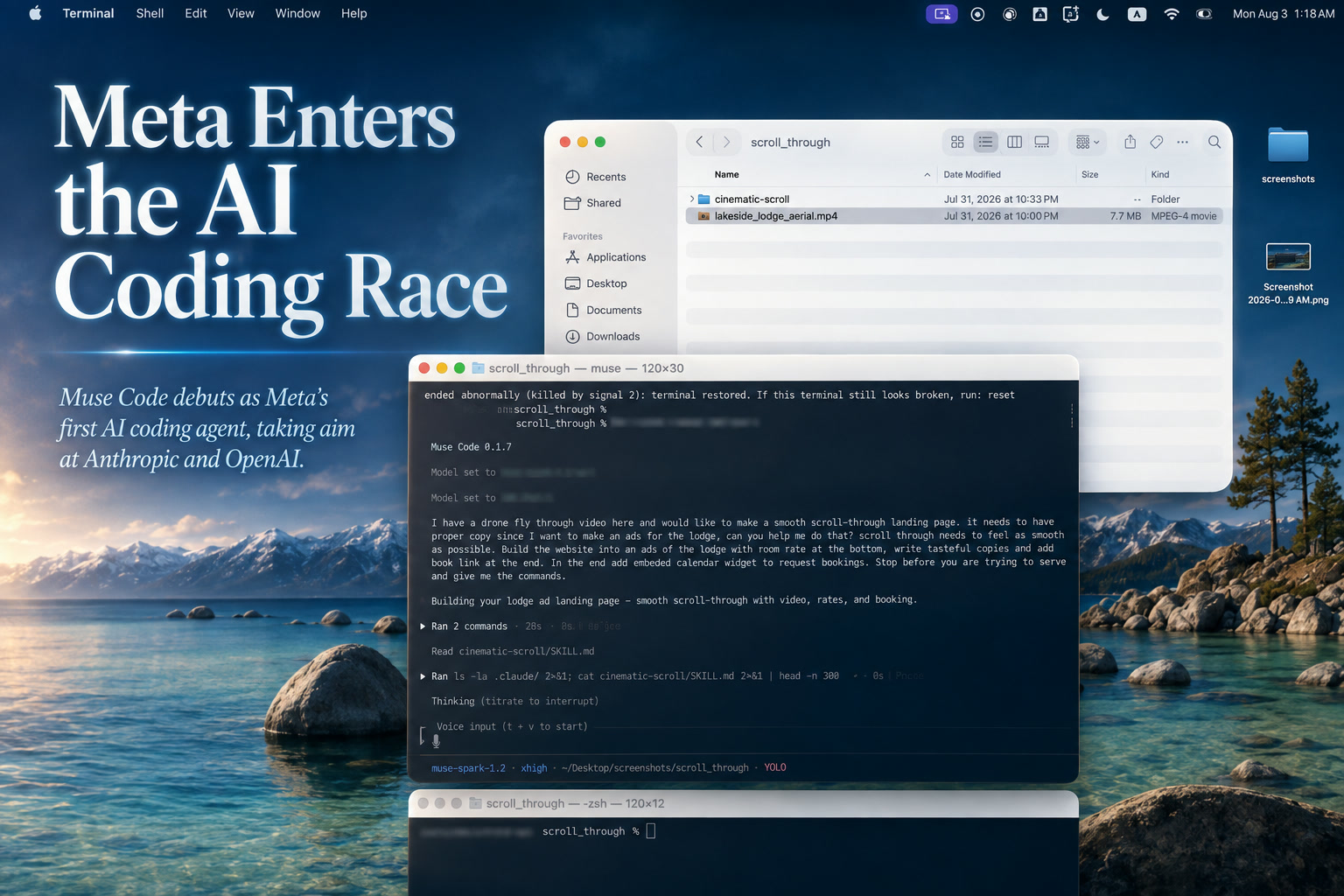
Developers are certainly not short of AI coding tools these days. Anthropic has Claude Code, OpenAI offers Codex, and a growing number of platforms are building agents that can inspect repositories, write features, fix bugs and run tests with minimal supervision.
Meta has now decided it wants a place in that market too.
The company has introduced Muse Code, its first dedicated AI coding agent. Released in beta, the new tool operates through the terminal and is designed to handle more than simple code suggestions. Meta is positioning it as an agent capable of taking on complete software engineering assignments across large and complicated repositories.
More Than an AI Autocomplete Tool
Traditional AI coding assistants mainly focused on completing individual lines, generating small functions or explaining unfamiliar code. Coding agents such as Muse Code are meant to operate at a much broader level.
Instead of asking the tool to write one function, a developer could give it a larger objective, such as adding an authentication system, investigating a performance problem or migrating part of an application to a new framework.
Muse Code can then examine the repository, plan the required changes, write or modify the relevant files and validate whether the result works as intended. Meta says the agent is specifically designed for complex engineering work involving large codebases rather than isolated coding questions.
This distinction is important. The appeal of modern coding agents is not simply that they can produce code quickly. It is that they can follow a task through several stages, from understanding the problem to checking whether the implementation actually works.
Powered by the New Muse Spark 1.2 Model
Behind Muse Code is Muse Spark 1.2, Meta's latest coding-focused AI model.
The new version builds on Muse Spark 1.1, which Meta introduced in July 2026 as a multimodal reasoning model for agentic workflows, computer use and software development. Muse Spark 1.2 places greater emphasis on code generation, complicated debugging, repository understanding and end-to-end developer tasks.
Meta says it significantly increased the amount of computing resources used to train the model on coding tasks while also exposing it to a wider variety of development environments.
The model was trained on what Meta describes as long-horizon coding tasks. These include generating entire repositories, completing large projects from beginning to end and carrying out automated research over extended sessions. It also uses planning, goal tracking and context management to stay focused during longer assignments.
In practical terms, this is meant to reduce one of the biggest weaknesses of AI coding tools: losing track of the original objective after making several changes across many files.
A Team of AI Agents Working Together
One of Muse Code's more interesting features is its use of multiple specialised agents.
The main agent does not necessarily handle every part of a project by itself. It can coordinate several background agents that remain active throughout the development session. These agents can investigate different parts of the codebase, prepare changes or perform supporting tasks before reporting their findings to the main agent.
Because the background agents remain available instead of being created again for every request, they can retain useful context and avoid repeatedly analysing the same information. Meta says this should reduce delays and require less manual guidance from the developer.
For larger assignments, the main agent can also delegate work to several sub-agents simultaneously. This parallel approach could be particularly useful when a project contains separate frontend, backend, database and testing components that can be examined independently.
However, more agents do not automatically guarantee better software. Parallel work still needs to be coordinated carefully, particularly when several agents modify related parts of an application. Human review remains essential before AI-generated changes are merged into a production system.
Designed to Survive Long-Running Tasks
Long coding sessions create another problem for AI agents: interruptions.
A terminal may close, a process may crash or the connection may be disrupted halfway through a complicated assignment. Restarting the task from the beginning can waste both time and tokens.
Muse Code attempts to solve this through a local event log. Every model request, tool operation, approval and file edit is recorded. If the agent crashes, it can use that history to resume from the point where it stopped instead of repeating the entire workflow.
This may sound like a small technical detail, but it could be one of the tool's more practical advantages. An agent intended to work on projects lasting several hours needs a reliable way to recover from failures.
Built-In Skills for Planning and Validation
Muse Code also ships with several predefined skills intended to structure how it approaches development tasks.
The /plan skill creates a proposed implementation plan that requires approval before changes are made. The /grill skill challenges that plan and searches for weaknesses, while /goal directs the agent to continue working toward a clearly defined result.
These features reflect a wider shift in AI-assisted development. The focus is gradually moving away from simply generating more code and toward improving how the agent reasons about requirements, risks and validation.
For developers, an agent that questions a weak plan may ultimately be more valuable than one that immediately produces hundreds of lines of code.
Pricing Could Be Meta's Biggest Advantage
Meta appears to be using price as one of its main weapons against established competitors.
The standard pay-as-you-go tier costs US$1.25 per million input tokens and US$4.25 per million output tokens. Cached input is priced separately at a lower rate. Unlike subscription-based tools, developers are charged according to how much information the model processes and generates.
That structure may appeal to developers who use coding agents occasionally or businesses that want to monitor costs at a more detailed level.
However, low token prices do not always mean a lower final bill. A coding agent may inspect thousands of files, repeatedly run tools and generate large amounts of internal output while completing one task. The real comparison will depend on the total cost of successfully completing a project, not merely the advertised price per million tokens.
Meta is also offering a heavily discounted contributor tier. That option can reduce costs substantially, but it requires users to permit their activity or feedback to be used to improve Meta's products. This creates an important trade-off for companies working with confidential source code, proprietary algorithms or sensitive customer systems.
A Serious New Challenger, but Still a Beta
Muse Code arrives at a time when AI coding agents are becoming one of the most competitive areas in the technology industry.
Developers are no longer judging these tools purely by whether they can generate a working function. They are looking at how well an agent understands an existing codebase, whether it can recover from errors, how safely it edits files and whether its final changes can pass real tests.
Meta's combination of persistent background agents, long-task training, crash recovery and aggressive pricing gives Muse Code a credible foundation. Its close integration with Muse Spark 1.2 may also help the model make better use of the tools and workflows provided by the agent.
Nevertheless, Muse Code is still in beta. Its performance on real production repositories, particularly older or poorly documented systems, will matter far more than controlled demonstrations or benchmark scores.
Final Thoughts
Muse Code represents a significant change in Meta's approach to developer AI.
The company is no longer limiting itself to releasing general-purpose models that other developers can build upon. It is now offering a complete coding product aimed directly at the same users considering Claude Code, Codex and similar agent-based development tools.
Its pricing will probably attract attention first, but the long-term success of Muse Code will depend on reliability. Developers may tolerate an agent that works slightly slower, but they will quickly abandon one that introduces hidden bugs, rewrites functioning code unnecessarily or misunderstands the architecture of a project.
For now, Muse Code looks like a promising and potentially affordable addition to the rapidly expanding AI coding market. Whether it can genuinely compete with Anthropic and OpenAI will become clearer once developers begin testing it against real repositories rather than carefully prepared demonstrations.











Comments 0