

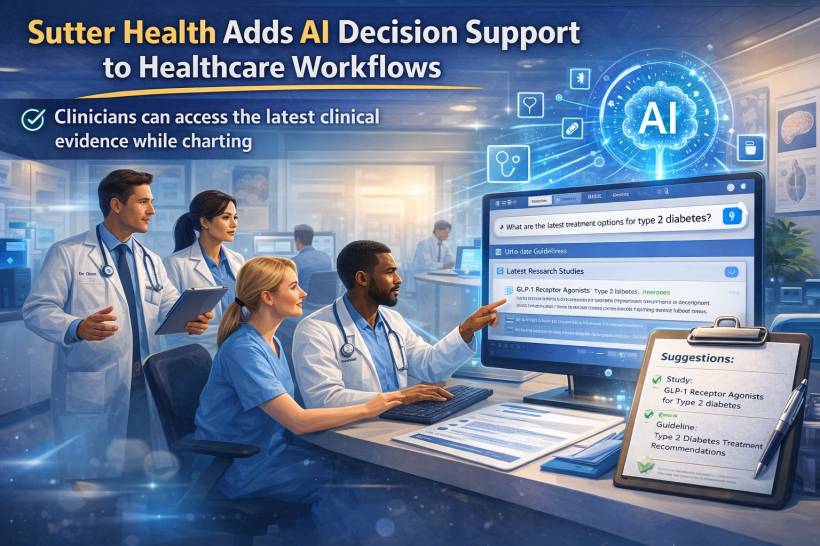
Sutter Health is rolling out an AI-powered medical search and decision support tool that sits inside everyday clinician workflows. The idea is simple: when a doctor is in the middle of documenting a visit or making a care decision, they shouldn't have to jump between tabs, websites, or separate systems just to confirm the latest guidance or evidence. Instead, the information should be available right where care happens.
What's actually being added to the workflow
The technology being introduced is described as an evidence-based medical search and decision support platform, built to let clinicians ask questions in natural language and quickly surface relevant, current clinical information. Rather than feeling like "another app," it's designed to work within Sutter Health's existing electronic health record setup, so the clinician can reference studies, guidelines, and other clinical evidence without breaking the flow of care.
Just as important, it's being framed as decision support that still respects quality and safety expectations. In other words, this isn't meant to replace clinical judgement. It's meant to make it easier for clinicians to access the right information at the right time.
Why Sutter Health thinks this matters for patient care
Sutter Health's leadership is positioning this as part of a broader push to modernize how care teams work and how patients experience care. The reasoning is pretty straightforward:
When clinicians have faster access to the most relevant evidence, decisions can be more consistent, more defensible, and more aligned with current best practices. That can reduce variation in care, lower the chance of missing a key update, and make it easier for teams to follow the same playbook across clinics and hospitals.
It's also a practical move. Clinical knowledge changes constantly, and expecting busy teams to manually keep up with every guideline update and study isn't realistic. A tool that brings the most current evidence closer to the point of care helps close that gap.
The burnout angle is part of the story too
Sutter Health has been using generative AI for about two years with a stated goal of easing clinician workload and improving sustainability. That context matters, because decision support is not just about accuracy. It's also about reducing the friction that wears people down: excessive searching, duplicative documentation, and the mental overhead of verifying everything while moving fast.
So while the headline reads like "AI for better decisions," there's also a quieter promise underneath it: less wasted time, less cognitive load, and a workflow that supports clinicians instead of adding yet another step.
Where this fits in the bigger trend in healthcare AI
Healthcare has used clinical decision support for years, and it has a long track record of improving outcomes and helping systems use resources more efficiently. What's changing now is the growing belief that newer generative AI tools can make decision support feel more natural and more usable, especially when they can interpret a clinician's question the way a colleague might.
At the same time, the industry is being careful. Generative AI can be impressive, but it can also be inconsistent if it's not tightly grounded in verified evidence and reliable processes. That's why many organisations talk about medical AI safety, quality standards, and evidence-based outputs when rolling out tools like this.
Why "hybrid" decision support is getting attention
One interesting point raised in the material you shared is that some research has found value in combining approaches rather than treating it like a competition between "traditional decision support" and "LLMs."
In one study example, a long-established diagnostic decision support system outperformed large language models on diagnostic accuracy in patient cases. But the researchers still argued that pairing the two could be stronger than either alone, because they bring different strengths:
Traditional decision support systems can be more deterministic and structured in how they reason through cases, while LLMs can be excellent at language, summarisation, and explaining complex medical text in a clinician-friendly way. Put together, you can potentially get both reliability and usability, which is exactly what frontline care teams tend to need.
What Sutter Health leaders are saying out loud
Sutter Health's messaging is consistent: digital innovation is being treated as a core lever for building a more connected, proactive, and sustainable healthcare system. They're also emphasizing a patient-centered benefit: when clinicians can incorporate the most current and relevant evidence into decision-making, patients are more likely to receive care that reflects today's standards, not last year's habits.
Final thoughts
This kind of rollout is worth watching because it reflects where healthcare AI is heading in the real world: not as flashy standalone demos, but as practical tools embedded inside the systems clinicians already use. If Sutter Health can make evidence retrieval faster, safer, and less disruptive to care workflows, the impact won't just be "cool AI." It'll show up as smoother clinician experiences, more consistent decisions, and better-supported care teams, which is usually where meaningful outcomes improvements begin.











Comments 0