

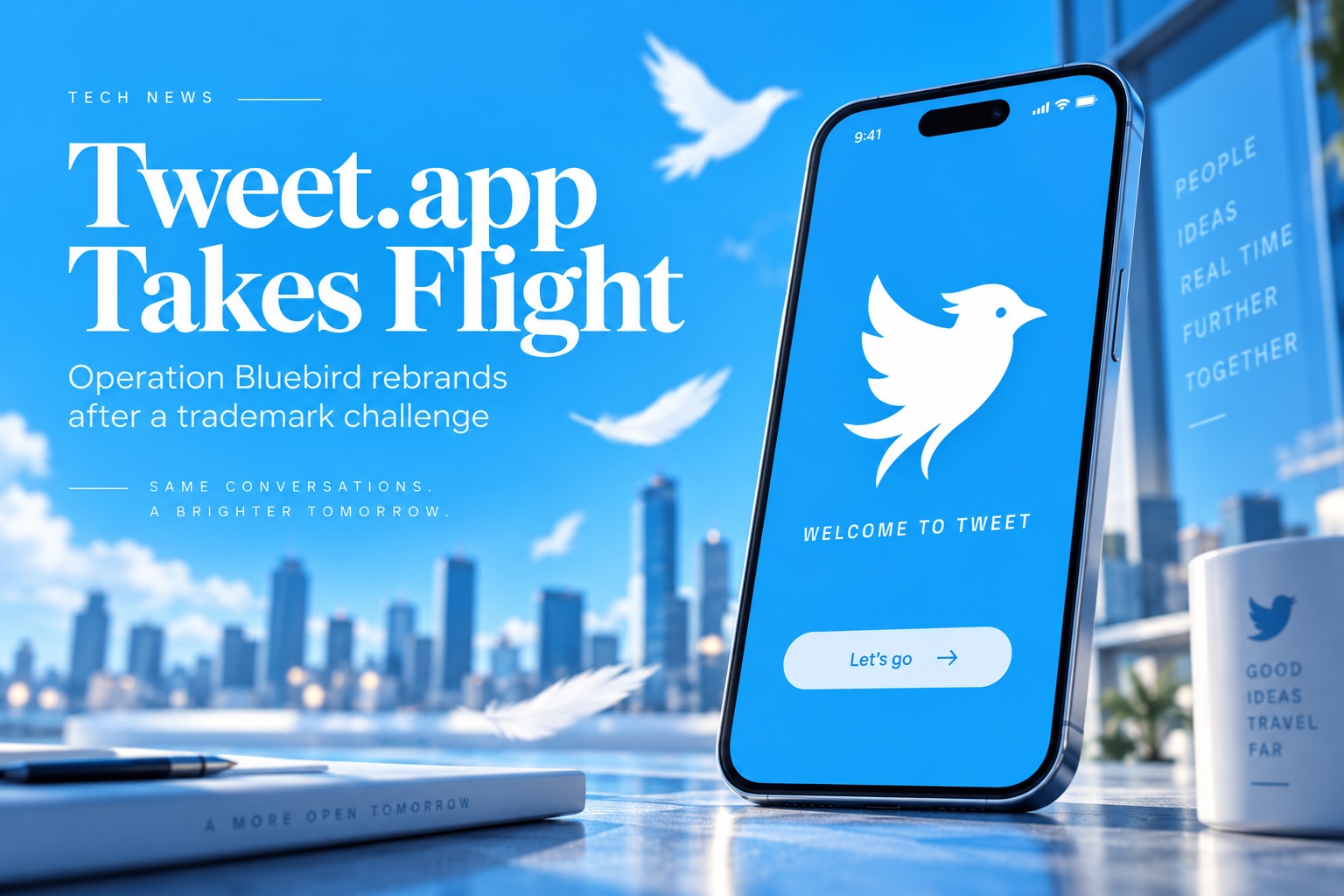
Operation Bluebird, the Virginia-based startup attempting to recreate the feel of the old Twitter experience, has changed the name of its social platform from Twitter.now to Tweet.app. The rebrand follows a legal ruling in the United States that found continued use of the word "Twitter" could create trademark confusion, even though the court apparently did not extend the same protection to the word "tweet" or the familiar blue bird imagery.
The platform itself remains largely unchanged in concept. Operation Bluebird is still positioning the service as a spiritual successor to the social network many users remember before Twitter was acquired by Elon Musk and eventually renamed X. The company has also kept its own interpretation of the blue bird logo, signalling that it still intends to lean heavily into the visual and cultural identity associated with the original platform.
Why Twitter.now Had to Change Its Name
The legal issue centres on whether consumers might mistake Operation Bluebird's service for the original Twitter platform or assume some formal connection between the two. According to reports, US District Judge Colm Connolly determined that using the name "Twitter" was likely to cause confusion, particularly because many users still casually refer to X by its former name.
That reasoning is understandable. Even years after the rebrand to X, the word "Twitter" remains deeply embedded in public vocabulary, media coverage and everyday conversation. For many people, saying "Twitter" still immediately refers to the platform now operated as X, which makes a competing service using the same name especially likely to raise trademark concerns.
The more unusual part is that the word "tweet" and the blue bird logo were apparently treated differently. Users also continue to describe posts on X as tweets, yet the court appears to have concluded that X may no longer be actively maintaining the same claim over those elements.
Tweet.app Keeps the Old-Twitter Identity Alive
Operation Bluebird has not abandoned its original branding philosophy. Instead, the company has shifted to a name that still evokes the language of the old platform without directly using the trademarked "Twitter" name.
The result is Tweet.app, a name that is arguably even more direct in communicating what the service wants to represent. It points immediately to the familiar posting format and culture associated with the original Twitter experience, while avoiding the exact brand name that triggered the legal dispute.
The company has also continued using a blue bird-style logo. That choice reinforces the idea that Operation Bluebird is not trying to create an entirely new social-media identity; it is intentionally appealing to users who miss the earlier look, language and atmosphere of Twitter.
The Company Says It Will Follow the Court Order for Now
On its updated FAQ page, Operation Bluebird says it intends to comply with the court's direction while the case continues toward trial. That suggests the current branding may not necessarily be the final word, depending on how the litigation develops.
For now, however, Tweet.app appears to be the name users should expect to see. The platform can continue operating and attracting signups without directly challenging the court's initial ruling on the use of "Twitter."
This approach also lets the company preserve momentum while the legal process continues. Rather than pausing operations, it can continue building its user base, raising funds and refining the product under the new name.
The Founder Fee Is Still US$20
The rebrand has not changed the platform's unusual early-access model. New users are still being asked to pay US$20, or roughly RM80.89, to join at this stage.
Paying that amount gives the user Founder status. The label is intended to recognise people who support the platform during its early development rather than simply joining after it becomes fully established.
It is an unconventional approach for a social platform, especially in an industry where users are generally accustomed to signing up for free. Operation Bluebird appears to be treating early participation more like a membership or crowdfunding model than a conventional open registration process.
There Is Also a More Expensive Fighter Tier
Users who want to contribute more can pay US$40 or above, equivalent to roughly RM161.78, and receive Fighter status instead. This tier includes the Founder benefits along with an additional profile badge.
The badge is described as a slingshot badge, intended to show that the user supported the project at a higher level. Operation Bluebird frames the tier in activist language, suggesting these supporters did not merely arrive early but actively backed the company's attempt to build an alternative social platform.
That messaging fits the overall tone of the project. Operation Bluebird is not presenting Tweet.app simply as another social network; it is positioning the platform around the idea of reclaiming an older style of social-media experience.
More Than 172,000 People Have Reportedly Paid to Join
The most surprising part of the project may be the level of early interest. TechCrunch reports that more than 172,000 users have already paid the Founder fee and requested a handle on the platform.
If that figure is accurate, it represents a substantial amount of early financial support for a service that is still in its formative stage. Even at the basic US$20 tier, the total would amount to several million dollars in gross contributions before accounting for higher-tier supporters, payment fees or other costs.
That level of participation suggests there is still considerable nostalgia and demand surrounding the old Twitter experience. The platform may not need to replicate X at full scale to build a meaningful community if enough users are specifically looking for something that feels closer to what Twitter used to be.
The Membership Fees May Also Help Fund the Legal Fight
TechCrunch has speculated that the early-access payments may be helping Operation Bluebird cover its legal expenses. That would make sense given the ongoing trademark dispute and the costs associated with defending a startup in federal court.
The higher-priced Fighter tier makes that interpretation even more plausible. Its framing is clearly about supporting the project rather than simply purchasing additional platform functionality.
In that sense, Tweet.app is operating partly like a technology startup and partly like a community-backed campaign. Users are not only paying for access; they are financially supporting the company's attempt to establish a new social network under legal and competitive pressure.
Recreating Old Twitter Is More Complicated Than Copying the Interface
The project also highlights how difficult it is to revive the identity of a well-known technology platform. Operation Bluebird can attempt to reproduce the feel of old Twitter, but names, logos and cultural language are all tied to intellectual property and long-established public associations.
Even if X has moved away from many of those branding elements, that does not automatically mean every part of the old identity becomes free for competitors to use. Courts may still consider whether consumers could be confused about ownership, endorsement or affiliation.
That is why the distinction between "Twitter" and "tweet" has become so interesting. One appears to remain strongly associated with the original platform as a brand, while the other may be treated more like a term that has become embedded in broader public usage.
The Blue Bird Still Carries Enormous Brand Recognition
Operation Bluebird's decision to keep the bird imagery is also strategically important. The old Twitter bird remains one of the most recognisable symbols in social media, even though the original platform no longer uses it.
That creates an opportunity for a newcomer trying to appeal directly to users who preferred the old branding. A familiar visual identity can immediately communicate what kind of experience the service is trying to recreate without requiring lengthy explanations.
At the same time, relying too heavily on nostalgia creates risks. Tweet.app will eventually need to offer a compelling product in its own right rather than surviving entirely on memories of what Twitter used to be.
Nostalgia Can Bring Users In, but It May Not Keep Them
The initial interest in Tweet.app shows that nostalgia can be a powerful acquisition tool. Many users remain dissatisfied with changes made to X and still speak fondly about earlier versions of Twitter.
But attracting users is only the first challenge. A social platform needs enough active people, conversations and communities to remain useful. It also needs moderation systems, infrastructure, mobile apps, developer tools and a sustainable business model.
A platform can look and feel like old Twitter and still struggle if the network itself does not become lively enough. Social media is unusually dependent on network effects because the value of the service comes largely from who else is using it.
Charging for Early Access Changes the Kind of Community It Builds
The US$20 entry fee may help Operation Bluebird fund development, but it also shapes the early community. People willing to pay are likely to be more committed to the project than someone casually creating a free account.
That could produce a smaller but more engaged initial user base. Early members may also feel more invested in the platform's success because they have financially supported it from the beginning.
The downside is obvious: a fee creates friction. Many potential users will not pay to try an unproven social network when numerous alternatives are available for free.
Whether the model works will depend on how effectively Operation Bluebird converts early financial support into a product that eventually attracts a much broader audience.
Tweet.app Is Entering an Already Crowded Social-Media Market
The challenge is made even greater by the number of alternatives competing for users dissatisfied with X. Platforms such as Threads, Bluesky, Mastodon and others have all attempted to attract communities looking for a different social experience.
Tweet.app's main differentiator appears to be its deliberate effort to recreate the old Twitter atmosphere rather than invent an entirely new format. That could work in its favour if users are looking specifically for familiarity rather than novelty.
However, the company will still need to compete on reliability, moderation, usability and community quality. Branding can open the door, but those fundamentals determine whether people stay.
The Legal Dispute Could Shape the Platform's Identity Long Term
The court case may ultimately force Operation Bluebird to develop a more independent identity. While the project began with extremely direct references to Twitter, the rebrand to Tweet.app already creates some distance from the original name.
That may prove beneficial. If the service succeeds, it will eventually need its own brand recognition rather than permanently being described as a copy or revival of another platform.
The challenge will be balancing that independence with the nostalgia that attracted its earliest supporters in the first place.
Final Thoughts
Operation Bluebird's move from Twitter.now to Tweet.app is more than a simple domain change. It reflects the legal difficulty of building a platform around the identity of a famous social network whose original owner has abandoned some branding elements but still retains strong trademark rights around others.
The company has chosen to comply with the court's initial ruling while continuing to use the word "tweet" and its blue bird imagery. At the same time, it is maintaining its unusual paid early-access model, with Founder memberships starting at US$20 and Fighter memberships beginning at US$40.
With more than 172,000 reported paid signups, there is clearly meaningful interest in the idea. The bigger question is whether Operation Bluebird can turn that nostalgia into a sustainable social network with its own identity.
For now, Tweet.app remains a fascinating experiment in what happens when a startup tries to revive not just the functionality of an old platform, but its language, visual culture and sense of community as well.











Comments 0