

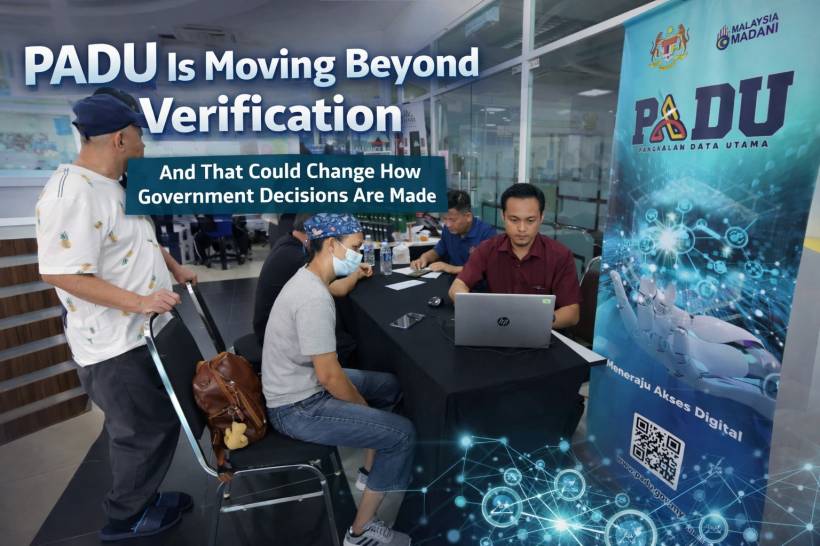
Malaysia's Central Database Hub, better known as PADU, appears to be entering a more meaningful phase. What began as a platform focused largely on data consolidation and verification is now being positioned as a tool for analytics as well. In practical terms, that means the government is no longer looking at PADU as just a place to store and check information, but as a system that can actively help shape policy decisions.
According to Economy Minister Akmal Nasrullah Mohd Nasir, the government plans to expand PADU's role beginning in May so it can provide analytics services to other government agencies. That shift matters because raw data, on its own, does not always tell decision-makers what they need to know. Numbers can sit in a database for years, but unless they are interpreted properly, they do not automatically lead to better planning or better outcomes.
Why Data Alone Is Not Enough
This is really the key point behind the latest move. Having a national database is useful, but the real value comes when the information inside it can be studied, compared, and turned into something actionable.
That is the direction the government now seems to be taking with PADU. Instead of limiting the platform to identity and eligibility checks, it wants to use the data to uncover patterns, trends, and needs across different groups of Malaysians. That kind of capability could be important for everything from subsidy planning to long-term economic and social policy.
The minister's explanation makes the intention fairly clear. Analytics can help agencies move from simply confirming facts to actually understanding what those facts mean in context. In other words, the system is being pushed toward becoming a decision-support platform rather than just an administrative reference point.
A Bigger Role in Loan Assessments and Social Policy
One example raised is the evaluation of a borrower's ability to repay government loans. That is a fairly practical use case. If an agency has access to verified socio-economic data and can analyse it properly, it may be able to make fairer and more informed decisions when reviewing applications.
Another example is broader policy planning, including issues linked to an ageing population. That is especially relevant as Malaysia, like many countries, has to think more seriously about long-term demographic shifts. Questions around healthcare access, retirement preparedness, social support, and household vulnerability become more important when a country's age profile starts to change.
This is where a platform like PADU could potentially become more than just a government back-end system. If used well, it could help policymakers identify which communities are under greater pressure, which age groups may need more targeted support, and where future resources should be focused.
Understanding People by Location and Circumstance
One of the more important aspects of the minister's remarks is the idea that PADU can identify demographic and socio-economic patterns based on location. That may sound technical, but the real-world implication is straightforward.
Different areas in Malaysia do not face the same challenges. Urban households, rural families, lower-income communities, senior-heavy neighbourhoods, and regions with different employment patterns all have different needs. A national policy can only go so far if it is designed too broadly. Better analytics could allow government agencies to see where support is genuinely needed, what kind of support makes sense, and whether a one-size-fits-all approach is actually effective.
That could be especially useful in a country where assistance programmes, subsidies, and public services often need to be delivered with more precision. The stronger the data interpretation, the better the government's chances of avoiding waste, duplication, or poorly targeted initiatives.
PADU's Scale Makes This Expansion Significant
Part of what makes this development worth paying attention to is the scale of the platform itself. PADU reportedly integrates more than 600 data points and covers around 30.7 million individuals. That is a substantial national data footprint.
When a system reaches that level of coverage, its value goes far beyond recordkeeping. It becomes an infrastructure layer for governance. That is why this latest expansion feels important. The question is no longer whether PADU can collect and verify information, but whether it can help government agencies use that information intelligently and responsibly.
The fact that other government bodies are already using it for verification requests suggests the system has already found a role inside the administrative machinery. The analytics layer is essentially the next step in making it more central to policymaking.
From Launch Ambitions to a More Defined Purpose
PADU was first launched in January 2024 as a national data repository designed to consolidate verified information from multiple government agencies. At the time, the platform was introduced with fairly broad goals. It was meant to reduce duplication, improve visibility across agencies, support near real-time insight generation, and help ensure subsidies and financial assistance reached the right recipients more accurately.
It was also once seen as a likely backbone for the RON95 petrol subsidy targeting mechanism before attention later shifted toward BUDI95. That detail is worth remembering because it shows how PADU has always been tied to the idea of targeted assistance and more efficient government delivery.
What seems to be happening now is less about changing the system's original purpose and more about sharpening it. The government appears to be refining what PADU is supposed to become in practice.
The Real Test Will Be Execution
Of course, the idea sounds promising on paper. A well-integrated data platform that helps agencies make smarter decisions is something most governments would want. But turning that vision into reliable, fair, and trusted implementation is the harder part.
The quality of analysis will depend not only on how much data PADU holds, but also on how accurate, current, and responsibly managed that data is. It also raises broader questions about governance, transparency, inter-agency coordination, and public confidence. A large database can be powerful, but it also needs clear safeguards and strong accountability if it is going to play a bigger role in public policy.
This is why the roadmap expected later this month could be quite important. It may offer a clearer view of how the government plans to expand PADU, what agencies will be able to use it for, and what kind of structure will support that growth.
Final Thoughts
PADU's next phase looks like a shift from being a national verification platform to becoming something more strategic. If the analytics expansion is rolled out well, it could give government agencies a stronger foundation for designing aid programmes, assessing needs more accurately, and responding to demographic and economic realities with more precision.
That said, the bigger the role PADU plays, the more important it becomes to get the execution right. Good policy is not created by data alone. It comes from understanding what the data means, using it responsibly, and making sure the system serves the public in a fair and practical way. PADU may now be moving closer to that role.











Comments 0