

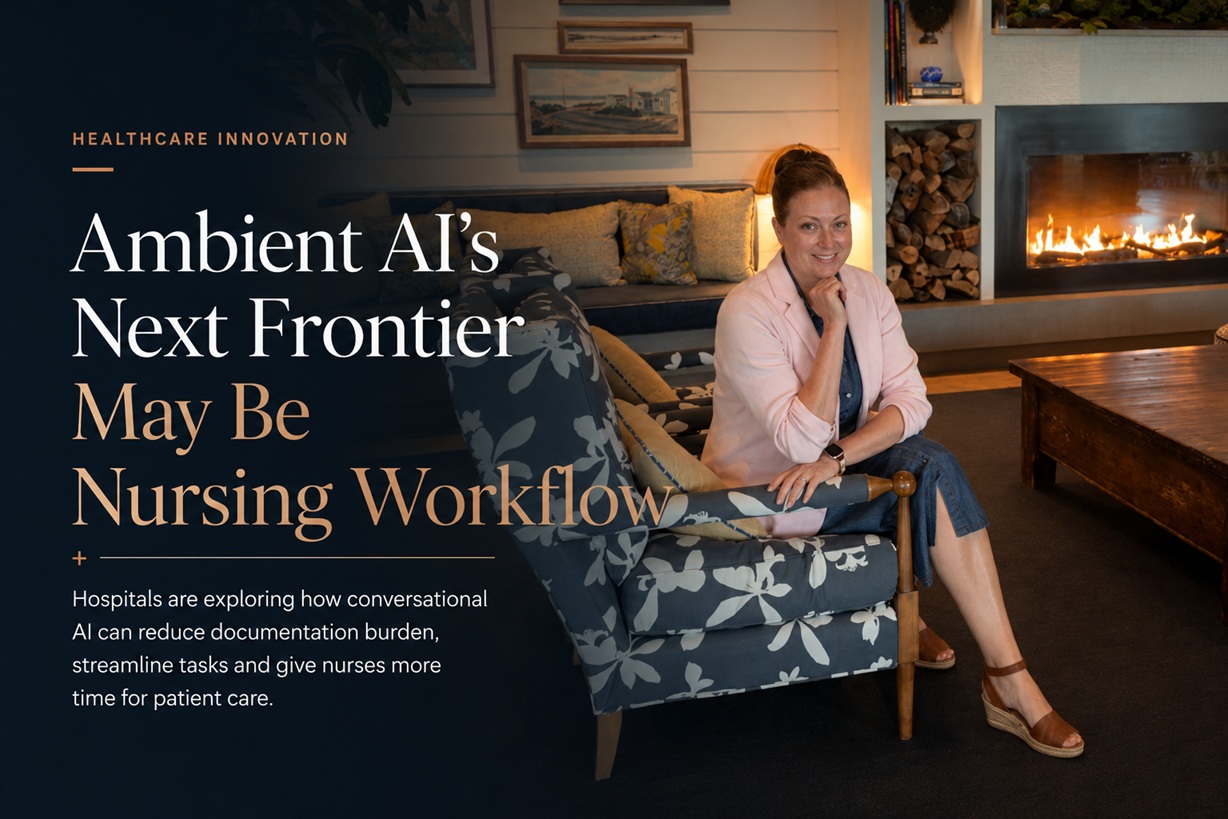
Ambient artificial intelligence is spreading rapidly across healthcare, but most early attention has centred on physicians. Hospitals have introduced AI documentation tools that listen to clinical conversations and convert them into draft notes, helping doctors spend less time typing and more time engaging with patients.
That success has encouraged healthcare organisations to consider where ambient AI could deliver value next. Nursing appears to be one of the most promising areas, but applying the same technology to bedside care will not be as simple as adapting a physician-focused note generator.
Nurses document care differently, work across more systems and record far more structured information throughout a shift. For AI to genuinely improve nursing work, it must understand these operational realities rather than treating nursing documentation as another version of a physician's narrative note.
Nursing Documentation Is Fundamentally Different
Physician documentation commonly relies on narrative notes. A doctor may describe the patient's symptoms, examination findings, clinical assessment and treatment plan in several paragraphs once or twice during the day.
Nursing documentation is much more continuous and structured.
Nurses may record vital signs, pain scores, fluid intake, urine output, wound condition, mobility, neurological status, fall risks, medication responses and numerous other observations. Much of this information must be entered into predefined fields and flowsheets rather than written as free-form text.
Sarah Visker, RN, director of clinical informatics at Aiva Health, has highlighted that a nurse may interact with approximately 600 to 800 individual data points across multiple documentation areas during a shift.
Some information must be updated repeatedly, sometimes every hour or whenever the patient's condition changes.
This makes the nursing environment far more complex than simply generating a well-written clinical note. An AI system must understand what was observed, determine where it belongs in the electronic health record and document it accurately at the correct time.
Why Physician-Focused Ambient AI Cannot Simply Be Reused
Many existing ambient AI systems are designed around conversations between a doctor and patient. The technology listens to the discussion, identifies clinically relevant information and produces a draft narrative for the physician to review.
That model works because the output is largely textual.
Nursing care, however, may require an observation to be converted into several separate structured entries.
For example, a nurse might verbally state that a patient is alert, reporting moderate pain, walking with assistance and showing no visible drainage from a surgical wound. Each observation may need to be entered into a different section of the electronic health record.
The system must understand the meaning of the statement, identify the relevant documentation fields and avoid making assumptions about information that was not actually assessed.
It must also distinguish between what the patient reported, what the nurse directly observed and what was measured by medical equipment.
A tool that produces a polished paragraph may still create more work if the nurse must manually transfer every detail into the correct flowsheet afterwards.
Nursing Data Must Be Captured at the Right Time
The timing of nursing documentation is also clinically important.
A physician's note may summarise the patient's condition over several hours. Nursing observations often support immediate decisions about care, escalation and patient safety.
A delayed entry may mean that important information is unavailable when another clinician reviews the patient's record.
This is particularly relevant for systems that monitor for deterioration. Sepsis detection tools, early-warning scores and rapid-response programmes often depend on current vital signs and completed nursing assessments.
If a nurse observes a concerning change but cannot document it promptly because of competing clinical responsibilities, the digital system may not receive the information needed to generate an alert.
Ambient or voice-assisted documentation could help close that gap by allowing nurses to record observations closer to the moment of care.
Instead of returning to a workstation later and relying on memory, the nurse could potentially speak the observation while remaining near the patient, subject to privacy and workflow controls.
Early findings referenced from Cedars-Sinai presentations suggest that AI-supported nursing voice documentation may reduce the delay between an observation and its entry into the record while also improving documentation completeness.
These benefits could be clinically significant because the value of nursing data depends not only on accuracy, but also on how quickly it becomes available.
The Opportunity Extends Far Beyond Charting
Documentation is only one part of the technology burden nurses face.
During a typical shift, nurses may move between the electronic health record, secure messaging platforms, departmental systems, mobile devices, medication applications and hospital communication tools.
A task that appears straightforward can involve several separate steps.
Submitting a maintenance request may require opening a facilities application. Finding a clinical policy may involve searching an internal portal. Arranging interpretation services could require another system, while starting a virtual nursing consultation may depend on a separate device or communication platform.
Each system may have its own interface, login process and workflow.
These interruptions create what is often described as cognitive burden. Nurses must remember not only what clinical task needs to be completed, but also which system contains the relevant function and how to navigate it.
Individually, each interruption may take only a few minutes. Across an entire shift and multiple patients, the cumulative effect can become substantial.
A Single Conversational Interface for Multiple Tasks
This is where conversational AI may offer a broader opportunity.
Instead of asking nurses to learn and navigate many different applications, hospitals could potentially provide a single interface through which approved tasks can be requested.
A nurse might ask the system to locate a policy, contact an interpreter, start a virtual nursing session or submit a work request without manually opening each corresponding application.
The AI would act as an orchestration layer across existing systems rather than replacing them entirely.
This represents an important change in healthcare AI strategy. Early projects often focused on automating one isolated task. The next generation of systems may need to coordinate several technologies and workflows behind the scenes.
However, such an assistant would require strict access controls and clear confirmation steps. It must understand the user's role, protect patient confidentiality and avoid carrying out sensitive actions without proper verification.
Convenience cannot come at the expense of governance or patient safety.
Ambient AI Must Understand the Bedside Environment
The hospital ward is not a quiet consultation room.
Nurses work in environments filled with alarms, conversations, movement and frequent interruptions. They may care for several patients while coordinating with doctors, therapists, pharmacists, family members and other nurses.
An ambient system must therefore be able to distinguish the intended clinical interaction from surrounding noise.
It must also recognise when information should not be recorded. Casual conversation, comments about another patient or background discussions should not accidentally become part of the medical record.
Patient consent and privacy are equally important. Patients should understand when ambient technology is active, what information is being processed and how recordings or transcripts are handled.
Hospitals will need clear policies covering activation, data retention, human review, error correction and circumstances in which the technology should not be used.
Nothing for Nurses Without Nurses
The success of nursing AI may depend as much on governance as on technical capability.
Visker summarised the principle simply: "Nothing for nurses without nurses."
Hospitals commonly appoint physician champions when implementing major clinical technologies. Nursing leaders argue that nurses must receive the same level of involvement in AI programmes.
Frontline nurses understand where documentation becomes repetitive, which workflows cause delays and which shortcuts could introduce clinical risks. Their experience is essential for identifying whether a proposed feature will reduce work or merely move the burden elsewhere.
Nurses should therefore be involved from the earliest stages of design, testing and deployment.
This should include nurses from different specialties, levels of seniority and working environments. A workflow that performs well in an outpatient clinic may not be suitable for an intensive care unit, emergency department or surgical ward.
Without this participation, developers may create systems based on assumptions that do not reflect the realities of bedside care.
AI Should Reduce Work, Not Add Another Layer
Healthcare technology projects sometimes improve one process while creating several new ones.
An AI tool may generate a draft quickly, but the nurse may still need to correct it, transfer information into structured fields and confirm several additional screens. If the review process takes longer than manual documentation, the technology has not meaningfully improved the workflow.
The same risk applies to alerts.
An AI assistant that repeatedly interrupts nurses with low-priority suggestions may increase distraction rather than reduce it. Poorly designed notifications can contribute to alert fatigue, making it harder for staff to identify genuinely important warnings.
Hospitals should therefore assess the total effect of the technology across the nursing workflow.
The goal should not be to demonstrate that an AI feature works in isolation. It should be to show that the overall task becomes safer, faster or easier for the nurse.
Measuring More Than Adoption
Many technology programmes focus heavily on utilisation figures.
Hospitals may measure how many nurses activated the tool, how many notes were generated or how often the AI assistant was used.
Those figures are helpful, but they do not prove that the implementation created meaningful value.
Nursing leaders are often more concerned with operational and workforce outcomes, including:
Accuracy must also be measured carefully. An AI system that saves several minutes but introduces incorrect clinical information may create more risk than value.
Hospitals should examine correction rates, omitted information, inappropriate entries and the time nurses spend reviewing AI-generated content.
The most useful metric may ultimately be whether nurses feel the technology genuinely reduces mental and administrative burden without weakening clinical accountability.
Why Small Pilots Often Struggle to Transform Workflows
Many early nursing AI projects begin with a narrow use case, such as documenting one assessment or completing a limited number of fields.
This approach can be useful for testing safety and technical feasibility. However, a tool that addresses only a small fraction of the nurse's workload may not produce enough value to justify changing an established routine.
Nurses may be reluctant to adopt a new process when they must continue using the old workflow for nearly everything else.
Once clinicians experience a more intuitive conversational interface, they may also expect it to support additional tasks and systems. A tool that works only in one corner of the electronic record can quickly feel incomplete.
This does not mean hospitals should begin with an uncontrolled enterprise-wide deployment. It means that pilot projects should be designed with a clear pathway toward broader workflow integration.
The initial use case should form part of a larger strategy rather than remain an isolated experiment.
From Individual Automation to Workflow Redesign
The bigger opportunity is not simply helping nurses chart faster.
It is reconsidering how nurses interact with technology throughout the entire shift.
A well-designed AI assistant could potentially support documentation, information retrieval, communication and task coordination through one consistent interface. It might reduce repeated navigation and help ensure that important observations reach the correct system sooner.
Achieving this would require integration with electronic health records, communication platforms, hospital directories, policy repositories and operational systems.
It would also require a reliable identity and permissions framework. The system must know who is making the request, which patients they are authorised to access and which actions they are permitted to perform.
Every automated action should remain traceable so hospitals can determine what the system did, what information it used and which clinician approved the result.
AI Will Not Replace Nursing Judgment
Even the most advanced ambient AI cannot replace the full scope of nursing practice.
Nurses do much more than collect data. They recognise subtle changes, interpret behaviour, coordinate care, educate families, advocate for patients and respond to situations that may not fit neatly into predefined fields.
A patient may appear unusually quiet, confused or uncomfortable even when the recorded vital signs remain within an acceptable range. These observations depend on professional judgment and familiarity with the patient.
AI may help capture and organise information, but the nurse must remain responsible for validating the record and deciding what action is required.
The most valuable systems will support nurses without weakening their autonomy or reducing care to a collection of data points.
Final Thoughts
Ambient AI may have gained momentum through physician documentation, but nursing could become its more complex and potentially more consequential frontier.
The opportunity extends beyond turning spoken words into chart entries. Hospitals could use conversational AI to simplify the many digital interactions that interrupt nursing work, from locating information to coordinating services across different systems.
Reaching that potential will require more than adapting tools originally built for doctors. Nursing documentation is structured, repetitive and closely tied to real-time clinical care. The technology must be designed around those realities from the beginning.
Most importantly, nurses must be treated as co-designers rather than end users who are introduced only after the system has been built.
When frontline experience, strong governance and meaningful performance measures guide development, ambient AI could reduce administrative friction and return valuable time to patient care. Without that foundation, it risks becoming just another system nurses must manage during an already demanding shift.











Comments 0