

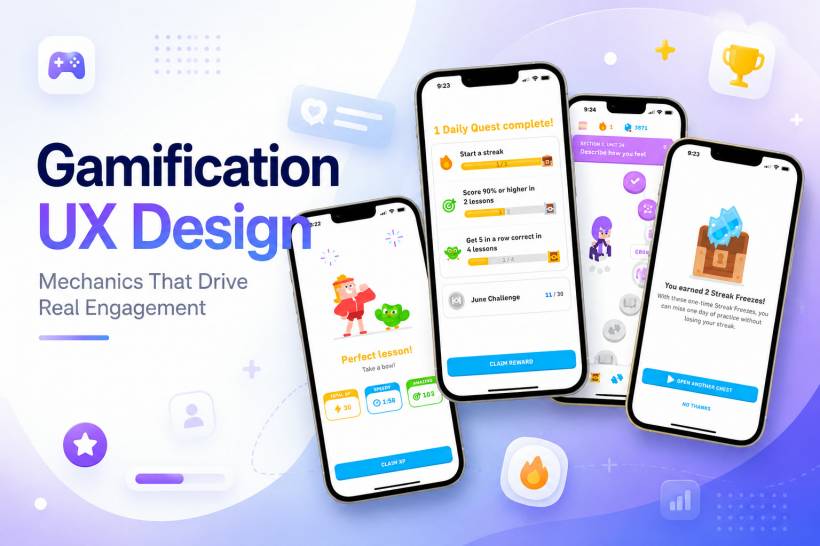
Gamification is one of those ideas that sounds simple until it is done badly. Add a badge here, throw in a leaderboard there, give users a few points for clicking around, and suddenly the product is supposed to feel more engaging. In reality, that is not real gamification. That is decoration.
Good gamification is not about making an app look like a game. It is about designing meaningful systems that make progress easier to understand, effort feel worthwhile, and long-term improvement feel achievable. When done properly, gamification supports the user's actual goal. When done poorly, it feels forced, shallow, and sometimes even manipulative.
The best gamification does not distract users from the task. It helps them care more about completing it.
Gamification Is Not the Same as a Game
A game is usually something people enter voluntarily for entertainment, challenge, or escape. Gamification is different. It takes elements commonly found in games and applies them to real tasks, such as learning, exercising, saving money, completing a profile, or building a daily habit.
That difference matters. The goal is not to turn every product into a mini-game. The goal is to make the user's journey feel clearer, more rewarding, and more motivating.
Bad gamification tries to create motivation out of nothing. It adds points for basic actions, rewards users for meaningless clicks, and celebrates things that do not actually matter. Users can usually sense this very quickly. It feels artificial because the reward has no real connection to their goal.
Good gamification works differently. It strengthens motivation that already exists. A person using a fitness app already wants to be healthier. A person using a learning app already wants to improve. The product's job is not to trick them into caring. The product's job is to help them see that their effort is producing results.
Progress Is One of the Strongest Engagement Drivers
One of the most powerful mechanics in gamification is visible progress. People are more likely to continue when they can clearly see that they are moving closer to a goal. This is often described as the goal-gradient effect: the closer someone feels to completing something, the more motivated they become to finish it.
This is why progress bars, completion meters, and step-by-step checklists can be so effective. They turn an abstract goal into something visible.
LinkedIn's profile strength meter is a good example. Users are not necessarily excited about earning a profile score. What works is the sense of nearing completion. Each added section fills the bar a little more, making the next action feel obvious and achievable.
A good progress system should answer three simple questions for the user:
• What have I completed?
• How much is left?
• What should I do next?
When progress is unclear, users lose momentum. When progress is visible, the product quietly encourages them to continue.
Feedback Loops Should Be Immediate and Useful
Feedback is another major part of effective gamification. When users take action, they need to know that something happened. If the product does not respond clearly, the interaction feels weak or incomplete.
This does not mean every action needs fireworks, animations, or dramatic celebrations. In many cases, simple confirmation is enough. The important thing is that the user understands the result of their action.
For example, a fitness app that confirms a completed workout immediately is not just celebrating the user. It is closing the loop. The user did something, the app recognized it, and the progress is recorded. That simple moment reinforces the habit.
The best feedback loops usually contain three parts:
• The user takes an action
• The product shows the result
• The product suggests the next logical step
For example, instead of simply saying "Meal logged," a nutrition app might say, "You logged lunch. You have 450 calories remaining for dinner. Add dinner later?" That is much more useful because it connects the action to the bigger goal.
Good feedback should not only confirm that something happened. It should help the user understand what that action means.
Mastery Matters More Than Points
Points are easy to add, but they are not always meaningful. Over time, points can become noise, especially if users do not understand why they matter. A better long-term approach is to design around mastery.
Mastery-based gamification makes users feel that they are improving. It gives them a sense of skill, growth, and personal achievement. This is much stronger than simply collecting points.
Duolingo is a familiar example. Its leagues, streaks, levels, and practice goals are not valuable because the points themselves are important. They work because they represent consistency and progress. A user who practices every day sees that effort reflected in the system.
That is the key difference. Good gamification should reward useful behavior, not random activity.
For mastery mechanics to work well, they should be difficult to fake. A user should not be able to earn meaningful status through one burst of activity or meaningless repetition. The system should reward sustained effort, improvement, and real engagement.
Examples include:
• Levels based on consistent practice
• Titles earned through meaningful contribution
• Skill tiers based on actual performance
• Streaks that encourage healthy routine
• Advanced achievements that require real effort
The goal is to make users feel, "I am getting better," not just, "I am collecting more points."
Be Careful With Leaderboards
Leaderboards are one of the most common gamification features, but they are also one of the easiest to get wrong. They can motivate highly competitive users, especially those near the top. But for everyone else, they can have the opposite effect.
A user ranked 7th might try harder. A user ranked 847th is more likely to feel that catching up is impossible. Instead of motivating them, the leaderboard reminds them that they are far behind.
This is why self-comparison often works better than global competition. Competing against your past self feels achievable. Competing against thousands of strangers often does not.
Strava is a good example of this balance. Its social features matter, but one of its strongest motivators is personal progress. Users can compare their own performance over time, challenge themselves on familiar routes, and aim for realistic improvements.
For many products, cooperation is also more inclusive than competition. Team goals, community milestones, shared challenges, and group progress can engage a wider audience without making lower-performing users feel excluded.
A good rule is simple: make personal progress the default, and make social comparison optional.
Badges Only Work When They Mean Something
Badges are probably the most overused gamification mechanic because they are easy to design and easy to implement. But easy does not mean effective.
A badge for completing basic onboarding is usually not exciting. The user expects to complete onboarding. There is no real achievement there. But a badge for maintaining a 100-day streak, mastering an advanced feature, helping other users, or completing a difficult challenge can feel meaningful.
The value of a badge comes from what it represents. If everyone gets it for doing something basic, it quickly becomes decorative clutter. If it reflects effort, skill, or consistency, it becomes recognition.
Badges should be used carefully. They should not be handed out for every small action just to create artificial excitement. Too many meaningless badges can cheapen the whole system.
A useful badge should represent at least one of these:
• Sustained effort
• Real skill
• Meaningful contribution
• A difficult milestone
• A behavior that supports the user's main goal
Recognition only works when the achievement is worth recognizing.
Variable Rewards Can Be Powerful, But They Need Ethics
Some of the most addictive digital products use variable rewards. This means the reward is unpredictable. The user does not know exactly when the next exciting result will appear, so they keep checking or engaging.
This mechanic can be powerful, but it can also become dangerous. Used irresponsibly, it can encourage compulsive behavior. Social media notifications, endless feeds, and unpredictable likes are common examples of variable rewards being used in ways that may not serve the user's best interest.
However, variable rewards are not automatically bad. The ethical question depends on the underlying behavior being encouraged.
In a learning app, a surprise bonus after several days of consistent study can make the experience more enjoyable. In a productivity app, a small unexpected encouragement after completing focused work can reinforce a healthy habit. The difference is that the reward supports something beneficial.
Variable rewards should be used sparingly. They should add delight, not dependency.
A useful test is to ask: does this mechanic help the user become better at something they actually care about, or does it simply keep them trapped in the app longer?
The First Session Matters More Than Many Designers Realize
Gamification should not begin after the user has already completed a long tutorial or gone through multiple setup screens. The first session is critical because it shapes the user's first impression of progress, value, and effort.
If the user feels lost or unrewarded in the first few minutes, they may never return. That is why onboarding should create a quick sense of progress.
This does not mean overwhelming the user with achievements immediately. It means giving them something useful early. A completed checklist, a personalized starting point, a beginner pack, a saved preference, or a recommended first action can all create momentum.
Headspace does this well by giving users a clear beginner path. The user does not need to understand the whole platform immediately. They are given a simple starting point, which makes the next action easier.
Good onboarding gamification should make the user feel:
• I have already started
• I know what to do next
• This product understands my goal
• My effort will lead somewhere
That early confidence can be more powerful than any badge or leaderboard.
Gamification Should Always Be Tested
One of the biggest mistakes in gamification design is assuming that a mechanic will motivate users simply because it looks engaging. Designers may love the idea of badges, streaks, points, or leaderboards, but users may react very differently.
That is why gamification should be treated as a hypothesis, not a permanent feature.
The right question is not, "Did users click on the badge?" The better question is, "Did this feature improve long-term retention?" A gamified mechanic that increases clicks but does not bring users back is probably not doing its job.
Engagement can be misleading. A user may interact with a feature once out of curiosity, but that does not mean it has lasting value. Retention is a stronger signal because it shows whether the mechanic actually supports repeated use.
A practical testing approach would be:
• Show the gamified feature to one group of users
• Hide it from another group
• Measure retention over time
• Compare meaningful outcomes, not vanity metrics
• Remove mechanics that do not improve long-term behavior
Gamification should earn its place in the product. If it does not help users return, improve, or complete meaningful goals, it may be better removed.
The Real Purpose of Gamification
At its best, gamification is not about making a product fun in a shallow way. It is about making effort feel visible and worthwhile. Users do not need to be tricked into engagement. They need to feel that their actions matter.
Good gamification helps users understand their progress, recognize their improvement, and stay connected to the reason they started in the first place.
The strongest mechanics are usually the quietest ones. A clear progress bar. A meaningful milestone. A useful next step. A personal best. A small confirmation that says, "You are moving forward."
That is what real engagement comes from. Not from badges slapped onto an interface, not from leaderboards that discourage most users, and not from points that mean nothing. Real gamification works because it supports human motivation instead of replacing it.
Final Thoughts
Gamification is most effective when users barely notice it as gamification. They are not thinking, "I am playing a game inside this app." They are thinking, "I am making progress."
That is the difference between gimmicky design and meaningful engagement. The best gamified systems do not distract users from their goals. They make those goals clearer, more achievable, and more rewarding to pursue.
For product designers, the lesson is simple: do not add game mechanics just because they look fun. Add them because they help users build momentum, develop mastery, and feel that their effort is leading somewhere.
When gamification is designed with purpose, it becomes more than a layer of rewards. It becomes part of the product's structure. And that is where real engagement begins.











Comments 0