

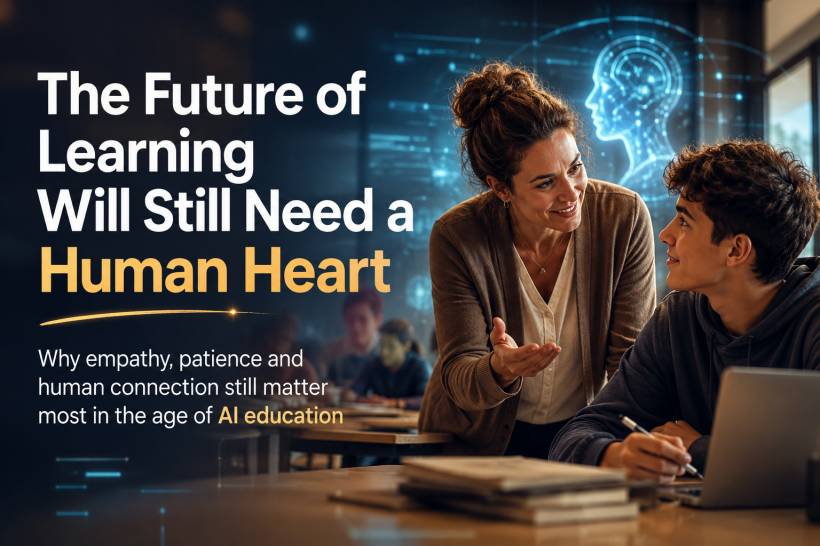
As technology becomes more capable, education is often discussed in terms of speed, efficiency and access. Artificial intelligence can now generate lesson materials, explain difficult concepts, provide instant feedback and adapt learning content to suit an individual student's progress. These developments are exciting, and they can genuinely improve the way people learn. But they also raise an important question: when technology can deliver information almost instantly, what makes a great educator truly valuable?
A recent cyberpsychology symposium exploring human behaviour, technology, games and the future of learning offered a simple but powerful answer. When asked what one trait lecturers need most in the age of AI, an experienced academic replied: empathy.
It was a response that resonated strongly with the audience, and for good reason.
Knowledge Matters, but Connection Matters Too
Good education has always required knowledge, preparation and subject expertise. A lecturer still needs to understand the topic deeply enough to explain it clearly, answer questions and guide students beyond what can be found in a textbook or online search.
However, knowledge alone does not guarantee effective teaching.
Students do not all arrive in class with the same confidence, learning pace, family support or emotional capacity. One person may grasp a concept immediately, while another may need more time, repeated examples or a different way of looking at the problem.
The difference between simply delivering a lesson and truly teaching often comes down to recognising this reality.
A student who is quiet may not be uninterested. They may be worried about getting an answer wrong. Someone who appears tired or disengaged may be dealing with responsibilities outside the classroom that others cannot see. A learner who was previously doing well but suddenly begins to struggle may be facing pressure, anxiety or a loss of confidence.
These situations cannot always be detected through test scores, attendance records or engagement analytics.
AI Can Support Learning, but It Cannot Fully Understand a Learner
Artificial intelligence is already changing classrooms and higher education. Adaptive learning platforms can personalise exercises based on a student's performance. AI tutors can answer questions at any time of day. Automated marking tools can help lecturers manage repetitive work, while AI-generated content can support lesson planning and revision.
Some institutions are also experimenting with systems that analyse behaviour, participation patterns and digital engagement to identify students who may need additional support.
Used responsibly, these tools can make education more flexible and responsive. They may help teachers spend less time on administrative work and more time supporting learners directly.
But there is still a major difference between detecting a pattern and understanding the person behind it.
An AI system may identify that a student has stopped participating in discussions. A caring lecturer may notice that the student is normally enthusiastic, ask whether everything is alright and create space for an honest conversation.
That human response matters.
Technology can measure behaviour. Empathy helps us understand the possible reasons behind it.
Psychological Safety Is Part of Learning
One of the biggest barriers to learning is fear. Students may be afraid of failing, being judged, slowing down the class or appearing less capable than their peers.
When this happens, they may stop asking questions even when they are confused. They may avoid trying difficult tasks because they are afraid of making mistakes. Over time, that fear can become a bigger obstacle than the topic itself.
This is where patience and emotional awareness become essential.
Effective educators know when to explain something again without making a learner feel embarrassed. They know when to simplify an idea, when to provide an example and when to give someone more time to process information.
They also know that frustration rarely produces better outcomes.
A student who feels safe to try, fail and try again is more likely to build confidence. That confidence can be the difference between someone giving up on a subject and eventually discovering that they are capable after all.
Today's Students Need More Than Fast Answers
Young people are growing up in a digital environment filled with constant comparison. Social media encourages visibility and validation. Games reward persistence with immediate feedback. Online platforms provide instant reactions, recommendations and responses.
As a result, many students are not only looking for information. They are looking for relevance, belonging and reassurance that their perspectives matter.
At the same time, being constantly connected does not always mean feeling connected emotionally. A student can have access to countless online resources while still feeling isolated, uncertain or overwhelmed.
This makes the role of educators even more important.
Students do not necessarily need lecturers who can provide information faster than an AI assistant. They need people who can explain difficult ideas in a way that makes sense, encourage them when progress is slow and help them believe that they belong in the room.
Learning is closely connected to confidence, self-worth, identity and the fear of not being good enough. A strong educator understands that the challenge is sometimes not only about helping a student understand a concept. It is also about helping them believe they are capable of understanding it.
The Educator's Role Is Evolving
AI will continue to become more useful in education. It may eventually handle many routine tasks more efficiently than humans, including content summaries, basic assessments, personalised practice and instant explanations.
That does not make educators less important. It changes where their greatest value lies.
The future lecturer may spend less time acting as the sole source of information and more time acting as a guide, mentor and trusted human connection. Their role may become increasingly focused on encouraging curiosity, helping students think critically and supporting them through the emotional side of learning.
The best teachers are not always the people with the most impressive slides or the most advanced tools. They are often the ones who make students feel noticed, respected and capable of improving.
Students may forget specific facts from a lecture over time. But they are far more likely to remember the educator who made them feel heard when they were struggling.
Final Thoughts
Technology will remain an important part of education, and AI can help create more personalised, accessible and efficient learning experiences. But education has never been only about transferring information from one mind to another.
At its best, it is about helping someone discover that they can grow beyond what they once believed possible.
The more advanced AI becomes, the more valuable qualities such as patience, care, emotional understanding and empathy may become. Machines can deliver information at remarkable speed, but genuine human connection remains something far more personal.
The future of learning may be powered by technology, but it will still be shaped by people.











Comments 0