

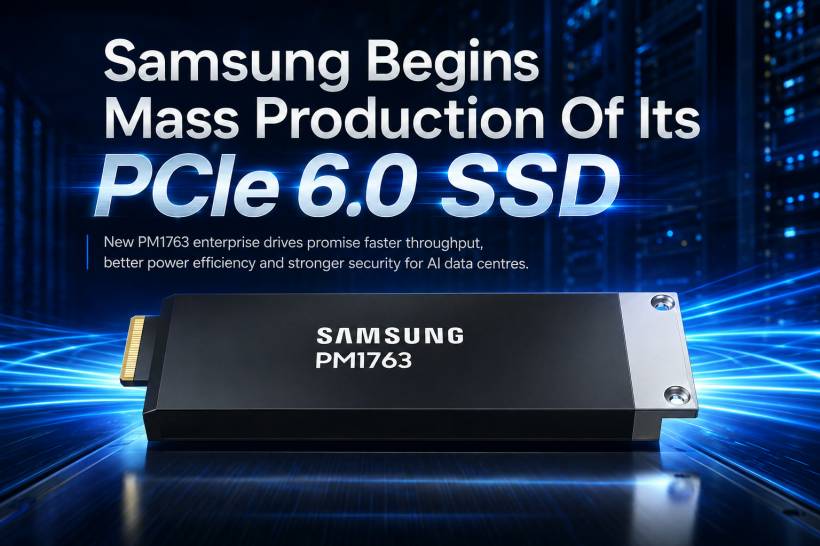
Samsung has begun mass production of its new PM1763 enterprise SSD, a PCIe 6.0 storage drive designed for AI data centres, high-performance computing systems and other workloads where extremely fast data movement is becoming increasingly important.
The new drive represents a major step beyond PCIe 5.0 storage, offering significantly higher throughput while also improving power efficiency, thermal management and hardware-level security.
For data centres handling large AI models, databases and analytics platforms, these improvements are not simply about achieving higher benchmark numbers. Faster storage can reduce the time required to load datasets, move models between systems and keep expensive processors supplied with data.
PCIe 6.0 Doubles the Available Bandwidth
The biggest upgrade is the move to the PCIe 6.0 interface.
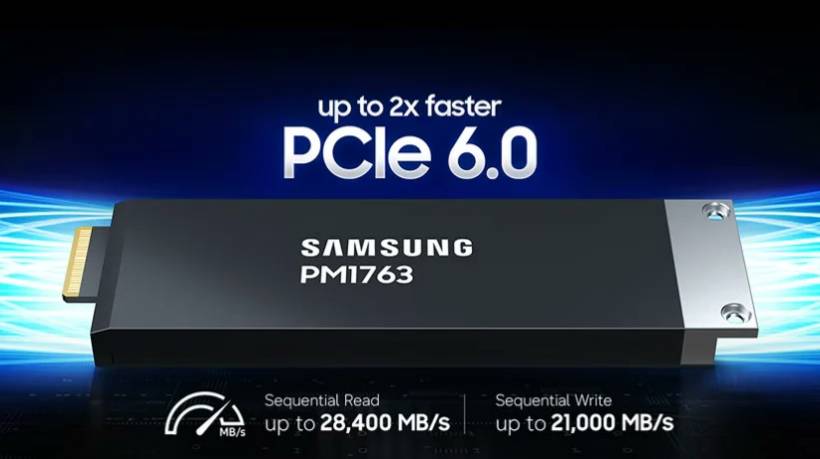
Samsung says the PM1763 can reach sequential read speeds of up to 28.4GB/s and sequential write speeds of up to 21.9GB/s on the 16TB model.
That is roughly double the interface throughput available from the previous generation, giving data-centre operators far more bandwidth for workloads that constantly move large volumes of information.
In practical terms, Samsung claims the drive can transfer a 40GB large language model in approximately 1.4 seconds. Its PCIe 5.0-based PM1753 predecessor reportedly takes around 2.7 seconds to complete the same transfer.
A difference of just over one second may sound small in isolation, but it can become substantial when AI models are repeatedly loaded, copied or distributed across large computing clusters.
Built for AI and High-Performance Computing
Modern AI infrastructure relies heavily on GPUs, accelerators and high-core-count processors, but those components can only perform efficiently when data reaches them quickly enough.
Storage bottlenecks can leave expensive computing hardware waiting for datasets, model weights or database records to arrive.
The PM1763 is intended to reduce that delay across workloads such as:
These environments often require both strong sequential performance and consistent operation over long periods. A drive that performs well briefly but slows significantly under sustained workloads would be less useful in enterprise deployments.
Samsung is therefore positioning the PM1763 as a storage platform built for continuous heavy use rather than occasional peak performance.
Available in 4TB, 8TB and 16TB Capacities
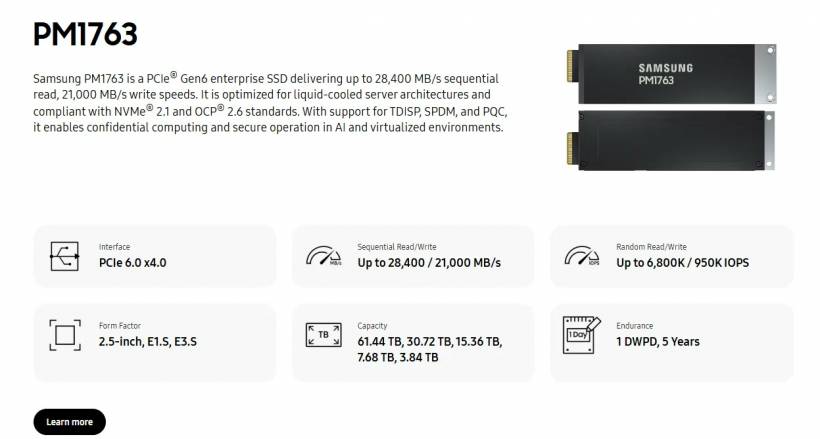
The initial PM1763 lineup includes 4TB, 8TB and 16TB models.
The 16TB version is currently highlighted as the highest-performing option, with the full advertised read and write speeds.
However, larger capacities may be planned.
Samsung has also listed approximately 30.72TB and 61.44TB versions on its product materials, suggesting that 32TB-class and 64TB-class models could eventually join the lineup.
Higher-capacity drives would be especially useful in dense data-centre deployments, where operators want to store more information without using additional server bays, cables or power connections.
Increasing storage density can also reduce the total number of drives needed, simplifying maintenance and potentially lowering infrastructure costs.
New V-NAND and Controller Improve Efficiency
The PM1763 combines Samsung's ninth-generation V-NAND with a new controller built using a 4nm manufacturing process.
Samsung claims this combination provides up to 1.8 times better power efficiency than the previous generation.
Power efficiency has become one of the most important measurements in enterprise hardware.
Data centres already consume large amounts of electricity, and AI infrastructure has increased those demands even further. Higher storage performance is useful, but it becomes less attractive if it also causes a major increase in power consumption and heat.
A more efficient SSD can help reduce operating costs while placing less pressure on cooling systems. Across thousands of drives, even relatively small efficiency improvements can create meaningful savings.
Designed for Liquid-Cooled Servers
Samsung has also prepared the PM1763 for use in liquid-cooled server environments through direct-to-chip cooling support.
Liquid cooling is becoming more common in high-density AI systems because conventional air cooling can struggle to remove the heat generated by powerful GPUs, processors and storage components packed closely together.
Direct-to-chip cooling places cooling equipment closer to the heat-producing components, allowing heat to be removed more efficiently.
By designing the PM1763 for these environments, Samsung is preparing the drive for servers where storage is installed alongside increasingly powerful and thermally demanding hardware.
The emphasis on thermal control should also help the SSD maintain more consistent performance during prolonged workloads, rather than reducing its speed to avoid overheating.
Support for Modern Enterprise Standards
The PM1763 supports both E1.S and E3.S form factors, which are commonly used in modern enterprise servers.
These formats are designed specifically for data-centre use and can provide better airflow, serviceability and storage density than traditional consumer SSD designs.
The drive also supports NVMe 2.1 and OCP 2.6 compatibility.
NVMe 2.1 introduces updated capabilities for managing high-performance storage, while OCP compatibility helps the drive fit into infrastructure based on standards developed for large-scale cloud and data-centre environments.
This makes the PM1763 suitable for deployment across a range of server platforms rather than limiting it to a single proprietary system.
Post-Quantum Security Becomes Part of the Storage Design
Performance is not the only major focus of Samsung's new enterprise SSD.
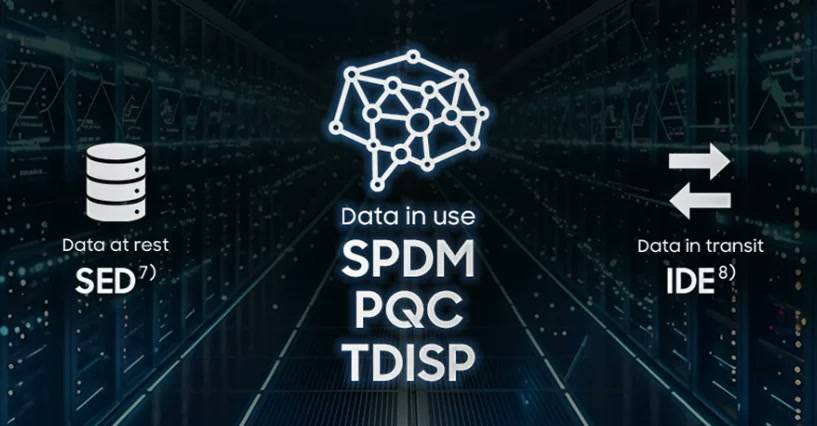
The PM1763 also introduces support for post-quantum cryptography algorithms intended to help protect data against future computing threats.
Today's encryption methods are considered secure against conventional computers, but sufficiently powerful quantum computers could eventually weaken or break some widely used cryptographic systems.
Large-scale practical quantum attacks are not an immediate everyday threat, but enterprise hardware often remains in use for many years. Sensitive information stored today may also still need protection in the future.
By beginning to add post-quantum protections at the hardware level, Samsung is preparing the drive for a security landscape that may look very different later in its operational life.
Stronger Hardware Authentication and Isolation
The PM1763 also supports SPDM and TDISP.
SPDM, or Security Protocol and Data Model, is designed to improve authentication and establish trust between hardware components.
TDISP helps isolate hardware resources so that confidential virtual machines can communicate with devices while protecting sensitive data pathways.
These features are becoming more important as organisations adopt confidential computing, where data remains protected not only while stored or transmitted, but also while being processed.
In a shared cloud or virtualised environment, stronger hardware isolation can help prevent one workload from accessing another workload's protected data.
Why Enterprise Storage Is Becoming More Important
AI discussions often focus on GPUs and specialised accelerators, but storage plays an equally important supporting role.
Large language models, training datasets and analytics systems can involve enormous quantities of data. Moving that information quickly and reliably is essential to maintaining overall system performance.
A slower storage layer can limit the value of faster processors because the computing hardware spends more time waiting.
PCIe 6.0 SSDs such as the PM1763 are intended to reduce that imbalance by bringing storage bandwidth closer to the performance levels required by modern AI systems.
This does not mean storage alone will solve every AI infrastructure challenge, but it can remove one of the major bottlenecks in data-heavy workloads.
PCIe 6.0 May Have a Limited Time at the Top
The PM1763 represents a major improvement over PCIe 5.0 enterprise drives, but the storage industry is already preparing for future generations.
PCIe 8.0 is expected to push interface performance even higher later in the decade, potentially around 2028.
That does not make PCIe 6.0 obsolete before it arrives. Data-centre platforms typically adopt new standards gradually, and organisations may continue using PCIe 6.0 hardware for many years.
The more immediate question is how quickly server manufacturers and data-centre operators will deploy systems capable of taking full advantage of the new interface.
A PCIe 6.0 SSD requires compatible servers, processors and platform infrastructure. Installing the drive in an older system would not provide its full performance benefits.
Final Thoughts
Samsung's PM1763 shows how quickly enterprise storage is evolving to meet the demands of AI and high-performance computing.
Its headline speeds of up to 28.4GB/s for reads and 21.9GB/s for writes are impressive, but the broader improvements may be just as important.
Better power efficiency, support for liquid cooling, higher storage density and stronger hardware security all address real challenges faced by modern data centres.
The move to post-quantum cryptography and confidential-computing protections also shows that enterprise SSDs are becoming more than simple storage devices. They are increasingly being treated as trusted components within the wider computing platform.
For organisations building the next generation of AI infrastructure, the PM1763 could help reduce data-transfer delays while improving efficiency and long-term security. However, its real-world impact will depend on how quickly PCIe 6.0 servers become widely available and how effectively data-centre workloads can use the additional bandwidth.











Comments 0