

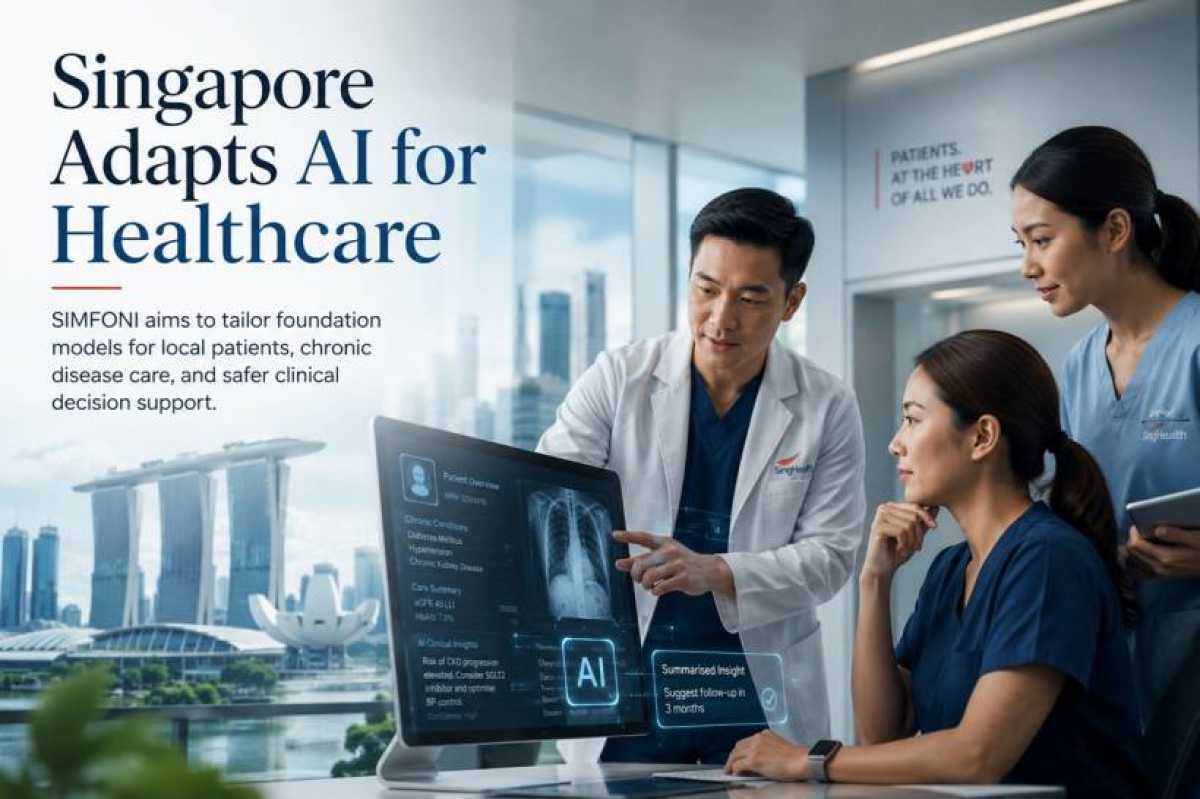
Singapore is taking a more localised approach to healthcare artificial intelligence through a national programme that will adapt existing foundation models for the country's population, disease patterns and public healthcare system. Known as SIMFONI, the initiative is not trying to build every AI model from the ground up. Instead, it will take existing foundational technologies and refine them using clinically relevant data, local guidelines and Singapore's real-world healthcare workflows.
The programme arrives as Singapore faces several connected pressures: an ageing population, a growing number of people living with chronic diseases and a healthcare workforce already managing increasingly complex demands.
Rather than positioning AI as a replacement for clinicians, SIMFONI aims to develop tools that bring the right information together at the point of care while keeping doctors and other healthcare professionals responsible for the final decision.
Why Existing Healthcare AI May Not Be Enough
Many of today's advanced healthcare AI models are trained primarily on datasets collected from Western populations. These models may still be technically impressive, but their performance can become less reliable when applied to patients with different ethnic backgrounds, disease risks, lifestyles and healthcare experiences. Singapore has a diverse population made up of several major ethnic groups, each potentially carrying different risk profiles for conditions such as diabetes, cardiovascular disease and certain eye disorders.
Local treatment pathways may also differ from those used in the countries where the original AI models were developed. National clinical guidelines, referral processes, medication practices and electronic medical record structures all influence how care is delivered. An AI system trained on overseas data may therefore produce recommendations that appear reasonable but do not fully match the realities of Singapore's healthcare environment. SIMFONI is intended to close that gap by adapting existing foundation models to better reflect local patients and clinical practice.
What Is a Healthcare Foundation Model?
A foundation model is an AI system trained on a large amount of information that can later be adapted for different tasks. In healthcare, such a model could potentially work with clinical notes, laboratory results, medical images, medication records and other types of patient information. Instead of developing a completely separate AI system for every condition, researchers can start with a broader model and refine it for specific uses. For example, the same underlying technology might eventually support chronic disease risk assessment, imaging interpretation, patient triage or clinical summarisation. The advantage is flexibility. However, a broad model also requires careful validation because healthcare decisions depend heavily on context. A system that performs well in one hospital, specialty or patient group may not automatically be suitable elsewhere.
Creating a National Standard for Healthcare AI
SIMFONI is being led as a programme under the Consortium for Clinical Research and Innovation, Singapore, with support from the Ministry of Health through the National Medical Research Council Office. One of its main responsibilities will be creating a standardised dataset for developing and adapting healthcare foundation models in Singapore. This is important because AI quality depends heavily on the data used to train and test it. If datasets are incomplete, inconsistent or biased towards particular patient groups, the resulting tools may perform unevenly. A model could appear accurate overall while still producing weaker results for underrepresented populations.
A national approach can help establish common standards for data quality, evaluation and documentation. It may also reduce duplication by allowing healthcare clusters and research institutions to work from agreed foundations rather than creating separate systems that cannot easily be compared. Alongside the data work, SIMFONI will develop frameworks for evaluating, governing and deploying AI responsibly. That means questions about privacy, cybersecurity, clinical accountability, monitoring and patient safety must be considered before the technology becomes part of routine care.
First Focus: Cardiometabolic Conditions in Primary Care
One of SIMFONI's first areas of attention will be cardiometabolic conditions such as diabetes, high blood pressure and elevated cholesterol. These conditions represent a major part of Singapore's long-term disease burden and often develop together. A patient with poorly controlled diabetes, for example, may also have hypertension, abnormal cholesterol levels and an increased risk of heart or kidney complications. Managing that patient requires clinicians to consider multiple measurements, medications and risk factors at the same time. The proposed AI-enabled clinical decision support system would combine validated risk-prediction models with national clinical guidelines. Its role would be to help primary care clinicians identify risks earlier, personalise treatment decisions and provide evidence-based care more consistently.
This could be especially useful during busy consultations where doctors must review years of laboratory results, medication changes and chronic disease indicators within a limited period. The AI might highlight worsening trends, identify patients who require closer follow-up or bring relevant guideline recommendations to the clinician's attention. However, it would remain a support tool. The clinician would still need to interpret the information in the context of the patient's overall condition, preferences and medical history.
Why Primary Care Is an Important Starting Point
Primary care is often the first place where chronic disease is detected and managed. It is also where early intervention can make the greatest difference. Helping a patient improve blood pressure, glucose control or cholesterol before complications develop is generally more effective than treating advanced disease later. AI could support this preventive approach by identifying patterns that are difficult to notice during a single appointment. For example, one slightly abnormal test result may not appear urgent. But when combined with a gradual change in weight, medication history and several years of laboratory data, it may point towards a growing risk.
A properly validated system could bring that pattern forward without requiring clinicians to manually examine every historical record. The challenge will be avoiding excessive alerts. If an AI system produces too many warnings, clinicians may begin ignoring them. SIMFONI will therefore need to ensure that recommendations are relevant, explainable and integrated naturally into existing workflows.
Second Focus: Multimodal AI for Eye Diseases
The programme's second major area involves eye conditions including cataracts, retinal diseases and glaucoma. Eye care is particularly suitable for multimodal AI because diagnosis may involve several different sources of information. A specialist might review retinal photographs, optical imaging, visual field tests, medical history, laboratory results and other clinical observations before reaching a conclusion. A multimodal model can bring these forms of information together rather than analysing each one in isolation.
This is closer to how clinicians actually work. Medical decisions are rarely based on a single image or laboratory value. Doctors combine several pieces of evidence while considering the patient's wider health. SIMFONI hopes that this approach can support more accurate diagnoses, better risk classification and improved triage of specialist referrals. Patients with urgent or high-risk findings could potentially be prioritised more quickly, while those with lower-risk conditions might continue being monitored in primary or community care.
The Eye Can Reveal More Than Eye Disease
The eye also provides valuable clues about broader health. Changes in retinal blood vessels can sometimes be associated with diabetes, cardiovascular conditions and other systemic diseases. This means an eye-focused AI model could eventually support more than ophthalmology alone. Once the technology has been properly developed and validated, it may be adapted for other specialties or used to identify relationships between eye findings and wider health risks.
That potential is significant, but it also requires caution. An AI model should not generate broad conclusions about a patient's neurological or cardiovascular health simply because it detects an unusual eye pattern. Any expanded use would need separate evidence, testing and clinical approval. SIMFONI has indicated that its tools will mature at different speeds rather than being launched as one large package.
That phased approach is sensible because each use case will have its own clinical risks, data requirements and level of readiness.
Working Towards Integration With the National EMR
The longer-term goal is to integrate successful AI tools with Singapore's national electronic medical record environment. Integration is critical because clinicians are unlikely to benefit from an AI system that operates as a separate application requiring additional logins, copied information or constant switching between screens. A well-integrated tool could review relevant patient information within the existing workflow and present support at the moment it is needed.
For example, a primary care doctor reviewing a patient's chronic disease record might receive an evidence-based risk summary without leaving the clinical system. An eye-care team could receive a prioritised referral assessment together with the images and supporting patient information. However, integration also gives the AI access to highly sensitive data. Strong controls will be needed to determine what information each model can use, who can view its output and how every interaction is recorded.
Clinicians Must Remain in Control
A central principle behind SIMFONI is that AI should support healthcare professionals rather than independently determine care. This distinction is especially important as AI systems become more capable. A model may be able to generate a risk score, summarise a record or suggest a guideline-based action. But it may not understand every clinical detail affecting the patient. A recommendation could be inappropriate because of an allergy, pregnancy, frailty, personal preference or another factor that was not captured correctly. Clinicians provide judgement, accountability and the ability to recognise when the standard pathway does not fit the individual patient. The safest model is therefore one in which AI brings together relevant information while a qualified professional decides what action to take.
Rigorous Testing Will Be Essential
Moving from research into real clinical use requires much more than achieving a strong result during model development. Each tool will need to be tested across different hospitals, patient groups and clinical environments. Researchers must determine whether performance remains consistent across age, ethnicity, gender and disease severity. The system will also need to be monitored after deployment. Clinical practices change, patient populations evolve and the data entering the model may shift over time. This can cause performance to decline—a problem sometimes described as data drift.
Healthcare organisations will need mechanisms to detect unusual outputs, measure accuracy and suspend or modify a tool when necessary. Doctors and nurses should also have a simple way to report incorrect, irrelevant or confusing recommendations. Their feedback will be essential for improving the system and maintaining trust.
Supporting a More Sustainable Healthcare System
Singapore's healthcare system is attempting to manage rising demand without relying entirely on increasing manpower. AI could help by reducing repetitive administrative work, highlighting relevant patient information and supporting earlier intervention. It may also help make expertise more widely available. A carefully validated model could support primary care teams in identifying patients who need specialist attention while helping specialists focus on the most complex cases.
This does not remove the need for healthcare professionals. Instead, it could help clinicians use their limited time more effectively. The value of the programme will ultimately depend on whether it improves patient care rather than simply introducing more technology. Faster processing alone is not enough. The tools must contribute to better decisions, more appropriate referrals, earlier treatment or a safer and less burdensome clinical workflow.
Part of Singapore's Wider Healthcare AI Strategy
SIMFONI forms part of a much larger national effort to bring data and AI into healthcare. Singapore is already advancing its National Precision Medicine programme, which uses diverse datasets to support more personalised care. SingHealth has also been working on a Healthy Longevity Panel intended to support AI-powered prediction of chronic disease and cognitive risks using long-term health information.
In 2024, the government announced a five-year investment of S$150 million to expand AI development and integration across the national healthcare system. National health technology agency Synapxe has also pursued AI collaborations with major technology companies while developing new healthcare applications and solutions. Together, these efforts show that Singapore is not treating healthcare AI as a series of isolated experiments. It is building the data, infrastructure, governance and research capabilities required for wider adoption.
What Other Countries Can Learn From Singapore
Many countries are experimenting with healthcare AI, but Singapore's approach offers several practical lessons. The first is that imported AI cannot simply be assumed to work equally well for every population. The second is that local data and clinical guidelines are essential for making AI relevant at the point of care. The third is that national coordination can help establish common standards before hospitals begin deploying disconnected solutions independently.
For neighbouring countries, including Malaysia, the same questions are increasingly important. Malaysia also has a diverse population, a growing chronic disease burden and differences between urban, rural, public and private healthcare settings. AI models developed elsewhere may therefore require local adaptation before they can be trusted for clinical use. A nationally coordinated framework could help ensure that healthcare AI reflects local populations, treatment protocols and data-protection requirements rather than relying entirely on overseas systems.
Final Thoughts
Singapore's SIMFONI programme represents a careful shift from general-purpose AI towards tools designed for the country's own patients and healthcare environment. Its initial focus on cardiometabolic conditions and eye diseases addresses areas where earlier detection, better risk assessment and more personalised care could provide meaningful benefits. More importantly, the programme recognises that healthcare AI is not only a technology challenge. It also involves data quality, clinical validation, governance, workflow design and public trust.
Adapting existing foundation models may allow Singapore to move faster than starting from zero, but speed will not be the only measure of success. The real test will be whether these tools improve clinical decisions, support an overstretched workforce and deliver safer, more sustainable care—while ensuring that healthcare professionals remain firmly responsible for the final decision.











Comments 0