

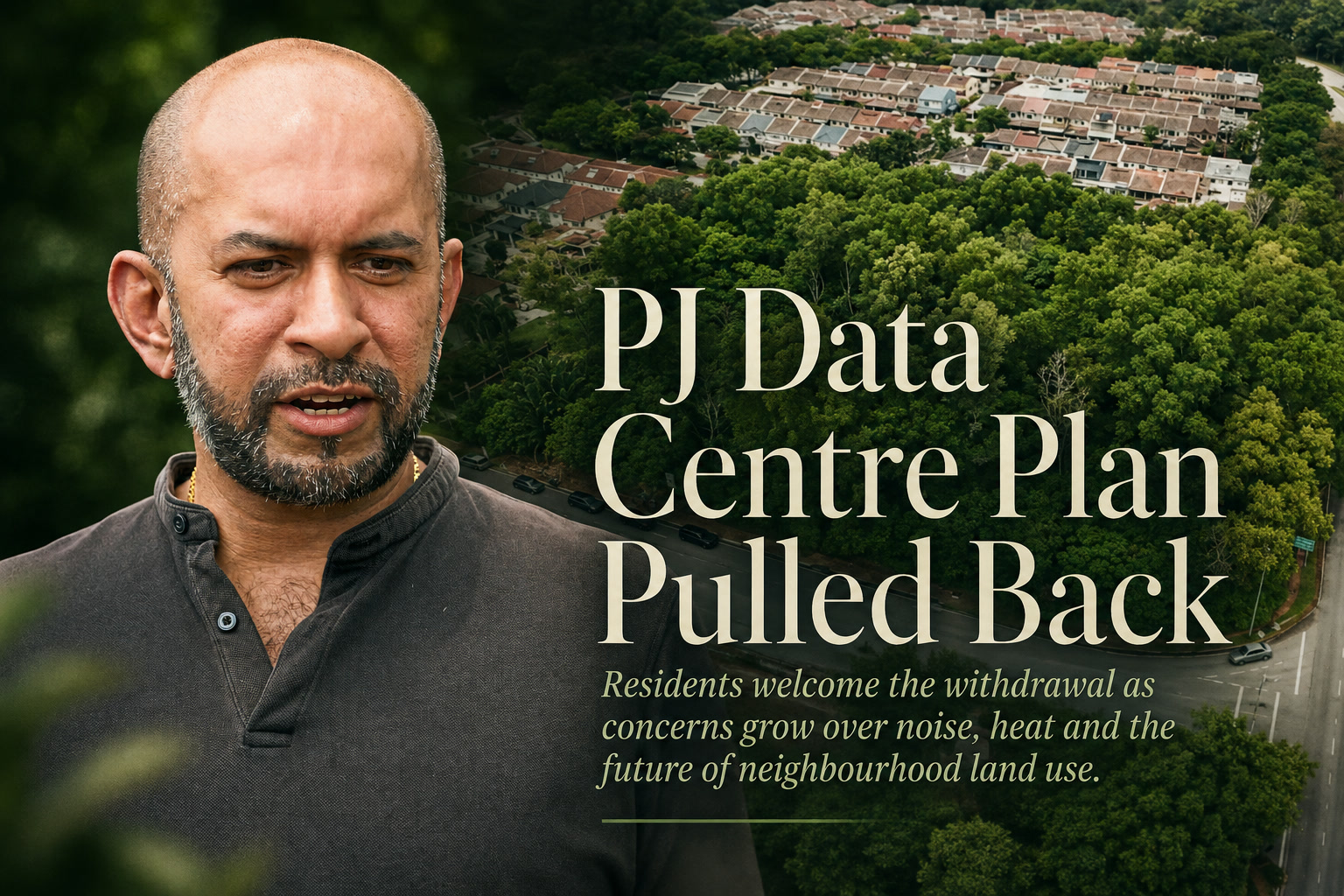
The proposed data centre in Section 9, Kota Damansara, will not proceed in its current form after the project consultant withdrew the planning-permission application submitted to Petaling Jaya City Council.
MBPJ confirmed that it received the formal withdrawal notice on July 28. According to the council, the consultant said the developer wanted to reconsider whether the site and its proposed development components were financially practical, environmentally sustainable and compatible with the surrounding neighbourhood.
For residents who had raised concerns about the project's location, the withdrawal will likely come as a relief. However, it does not necessarily mean the proposal has been permanently abandoned, as the developer may still submit a new application in the future.
The Application Covered More Than Planning Permission
The withdrawn submission was not limited to permission to construct the data centre.
It also involved applications relating to land alienation under Section 76 of the National Land Code 1965 and the surrender of alienated land under Section 197 of the same legislation. These land matters had been submitted alongside the planning application as part of the overall development proposal.
The project site consisted of 19 privately owned lots and part of a government road reserve along Jalan Rimba Riang 9/6 in Petaling Jaya.
The original proposal involved constructing two three-storey data centre blocks. Although the buildings were not described as unusually tall, their intended use raised significantly different concerns from those associated with ordinary shops or offices.
A data centre may appear quiet from the outside, but it operates continuously and requires considerable supporting infrastructure, including cooling equipment, backup generators, electrical systems and frequent maintenance.
Residents No Longer Need to Attend the Planned Briefing
Outgoing Petaling Jaya mayor Datuk Mohamad Zahri Samingon said there was no longer a need to hold a briefing for those who had submitted objections because the application had been withdrawn.
This means MBPJ will not continue evaluating that particular submission or proceed with the consultation process attached to it.
However, the mayor also made it clear that the developer could submit a fresh proposal later, provided that it complies with the uses permitted under the local plan.
Any future application would still need to go through the normal planning process. Residents would again have the opportunity to review the proposal, provide feedback and submit formal objections.
The withdrawal should therefore be viewed as the end of the current application rather than a permanent guarantee that no similar development will ever be proposed for the site.
Why the Community Objected
Gabungan Penduduk Kota Damansara, which represents more than 500 households in Section 9, formally opposed the project.
The residents raised several concerns, including possible noise pollution, heat generated by the facility, round-the-clock operations, high electricity consumption, traffic risks and the potential use of government road-reserve land.
Its proximity to the Kota Damansara Community Forest was another major issue. Residents were concerned that placing an energy-intensive facility near a sensitive environmental area could create additional pressure on the surrounding ecosystem.
A modern data centre requires substantial cooling to prevent servers and other equipment from overheating. Depending on the technology used, this can involve large cooling systems, fans, water consumption and the constant release of heat.
Backup generators are also normally required to ensure that services remain available during power interruptions. Testing and operating those generators can create additional noise and emissions, particularly if the facility is close to homes.
These concerns do not mean that data centres should not be developed. They highlight the importance of selecting an appropriate site and providing detailed technical information before expecting nearby communities to accept such a project.
A 24-Hour Facility Changes the Character of an Area
Unlike ordinary commercial premises, a data centre never truly closes.
Servers must continue running throughout the day and night. Cooling systems remain active, security is maintained continuously and maintenance work may be required outside conventional business hours.
For residents living nearby, the concern is not necessarily the appearance of the building itself. It is the cumulative effect of continuous equipment noise, additional traffic, electrical infrastructure, cooling systems and other operational requirements.
Even when a development complies with broad commercial zoning, its practical effect on the surrounding community may be very different from that of shops, restaurants or offices.
This is why land-use decisions should consider more than whether a particular category is technically permitted. Authorities also need to examine whether the scale and operational nature of the development are suitable for that specific location.
Questions Were Also Raised About the Notification Process
The controversy was not limited to the data centre's environmental and neighbourhood impact.
Residents reportedly found inaccurate reference numbers and contact information on the project notification board. They were also concerned that the original objection period gave the community only around one week to respond.
MBPJ subsequently issued a directive requiring the developer to correct the errors. This effectively extended the public feedback period until July 27.
A development of this scale requires a notification process that is accurate, accessible and long enough for residents to understand what is being proposed.
People need time to review the plans, obtain technical advice, discuss the matter with neighbours and prepare meaningful feedback. A short objection window—especially when the notice itself contains errors—can create the impression that consultation is merely procedural rather than genuine.
Public participation should begin before community frustration reaches the level of protest. Clear information from the beginning would help residents determine whether their concerns can be addressed through design changes, operational controls or a different site altogether.
Local Representatives Also Objected
The objections were not raised by residents alone.
Sungai Buloh MP Datuk Seri R. Ramanan, Kota Damansara assemblyman Muhammad Izuan Ahmad Kasim and MBPJ Zone 3 councillor Muhamad Shazwan Suhaimi also submitted formal objections.
Their participation demonstrated that concerns about the proposal had moved beyond a small group of neighbouring homeowners and had become a wider local-planning issue.
When elected representatives and local councillors object to a project, it does not automatically mean that development should be rejected. However, it signals that the proposal requires much stronger justification and more transparent engagement.
A developer would need to clearly demonstrate how noise, heat, water usage, energy demand, traffic, safety and environmental effects would be controlled.
The Site Was Originally Expected to Accommodate Shops
The land is reportedly zoned for "business and services" and "transport" under the Petaling Jaya Local Plan 2.
Residents nevertheless argued that the earlier proposal to develop shops would provide more direct benefits to the surrounding community.
A retail or neighbourhood commercial development could provide services, employment opportunities and useful amenities for residents. A data centre, by comparison, may generate considerable economic value but typically creates fewer visible community benefits once construction is complete.
Data centres are important infrastructure for cloud services, artificial intelligence, financial systems, streaming platforms and countless online applications. Malaysia's growing digital economy will undoubtedly require more of them.
The real issue is not whether data centres are necessary. It is whether a particular site is appropriate and whether the surrounding community receives any meaningful benefit in exchange for accepting the environmental and infrastructure burden.
Buffer Zones Must Be More Than a Number on Paper
PLANMalaysia's 2024 guidelines reportedly require a 50-metre buffer between data centres and residential boundaries.
Such requirements are important, but a standard buffer alone may not answer every concern. Noise and heat can behave differently depending on building orientation, terrain, cooling-system placement and the location of generator facilities.
A proper assessment should consider the cumulative effect of the entire development rather than only measuring the distance from the nearest house.
For example, cooling equipment positioned on the side facing residential properties could cause more disruption than equipment placed on the opposite side of the development. Similarly, generator exhaust, delivery access and electrical substations need careful placement.
Compliance with a minimum distance should be treated as the starting point, not the end of the assessment.
Personally, I Agree with the Residents
Personally, I agree with the residents who objected to the project.
A data centre may be valuable infrastructure, but that does not mean it belongs close to established residential neighbourhoods or environmentally sensitive areas.
Facilities of this nature should ideally be located within dedicated industrial or technology zones where the necessary electrical capacity, cooling infrastructure, security controls, road access and environmental safeguards can be planned properly from the beginning.
Relocating the project to a more suitable dedicated site would not mean rejecting digital development. It would mean supporting that development in a more responsible and sustainable way.
A purpose-built data centre zone could also reduce conflict with residents while allowing operators to expand more easily. These facilities often grow over time, and a constrained site near homes may create future problems even if the initial phase appears manageable.
From my perspective, separating large-scale digital infrastructure from residential areas is the better long-term approach for both the operator and the surrounding community.
Malaysia Still Needs More Data Centres
It is important not to interpret the Kota Damansara opposition as resistance to technology.
Malaysia is attracting significant investment in cloud computing, artificial intelligence and digital infrastructure. Data centres support essential services used by businesses, hospitals, financial institutions, government agencies and ordinary consumers.
However, rapid growth must be accompanied by proper planning.
Data centres require reliable electricity, water or alternative cooling solutions, telecommunications connectivity, emergency access and strong environmental controls. Placing them wherever suitable land becomes available may create avoidable problems later.
A more coordinated national and state-level strategy could identify dedicated locations with the necessary infrastructure already available. This would allow investment to continue while reducing pressure on residential communities.
Public Consultation Needs to Be Strengthened
Coalition spokesperson Narindera Pall Singh also urged MBPJ to improve its public-notification procedures.
That request deserves serious attention.
Planning notices should clearly explain what is being proposed, where supporting documents can be obtained and how residents may submit feedback. Contact details, reference numbers and deadlines must be accurate.
For technically complex projects such as data centres, the public should also receive understandable summaries covering noise levels, cooling methods, generator use, energy demand, traffic movement and environmental safeguards.
Residents should not need specialist knowledge merely to understand what may be built beside their homes.
Strengthening the notification process would also benefit developers. Early and meaningful engagement can reveal concerns before companies spend heavily on detailed designs and formal applications.
What Happens Next
For now, the Section 9 proposal is no longer moving forward.
The developer may re-evaluate the project, revise its components or identify a different site. It may also return with a fresh application that attempts to address the concerns raised by residents and local representatives.
Any new proposal should not simply repeat the original plan with minor cosmetic changes. It would need to demonstrate that the selected location is suitable, that the environmental and operational impacts are manageable and that the public-consultation process is credible.
A relocation to a dedicated industrial or technology area may ultimately be the more practical option.
Final Thoughts
The withdrawal of the proposed Kota Damansara data centre represents an important example of community participation influencing local development.
Residents raised legitimate concerns about noise, heat, energy demand, traffic, environmental effects and the use of road-reserve land. Questions surrounding errors in the public notice and the limited objection period also demonstrated why planning consultation must be clear and meaningful.
Personally, I agree with the community's position. Malaysia needs data centres, but they should be developed in locations designed to support them—not placed close to residential neighbourhoods simply because a site can potentially be interpreted as commercially suitable.
A dedicated data centre zone would provide better access to electricity, cooling infrastructure, security and transport while creating fewer conflicts with nearby households. It would also give operators greater certainty about future expansion.
The project's withdrawal should therefore not be viewed as opposition to progress. It is an opportunity to reconsider where essential digital infrastructure should be built and how development can move forward without sacrificing the wellbeing of surrounding communities.











Comments 0