

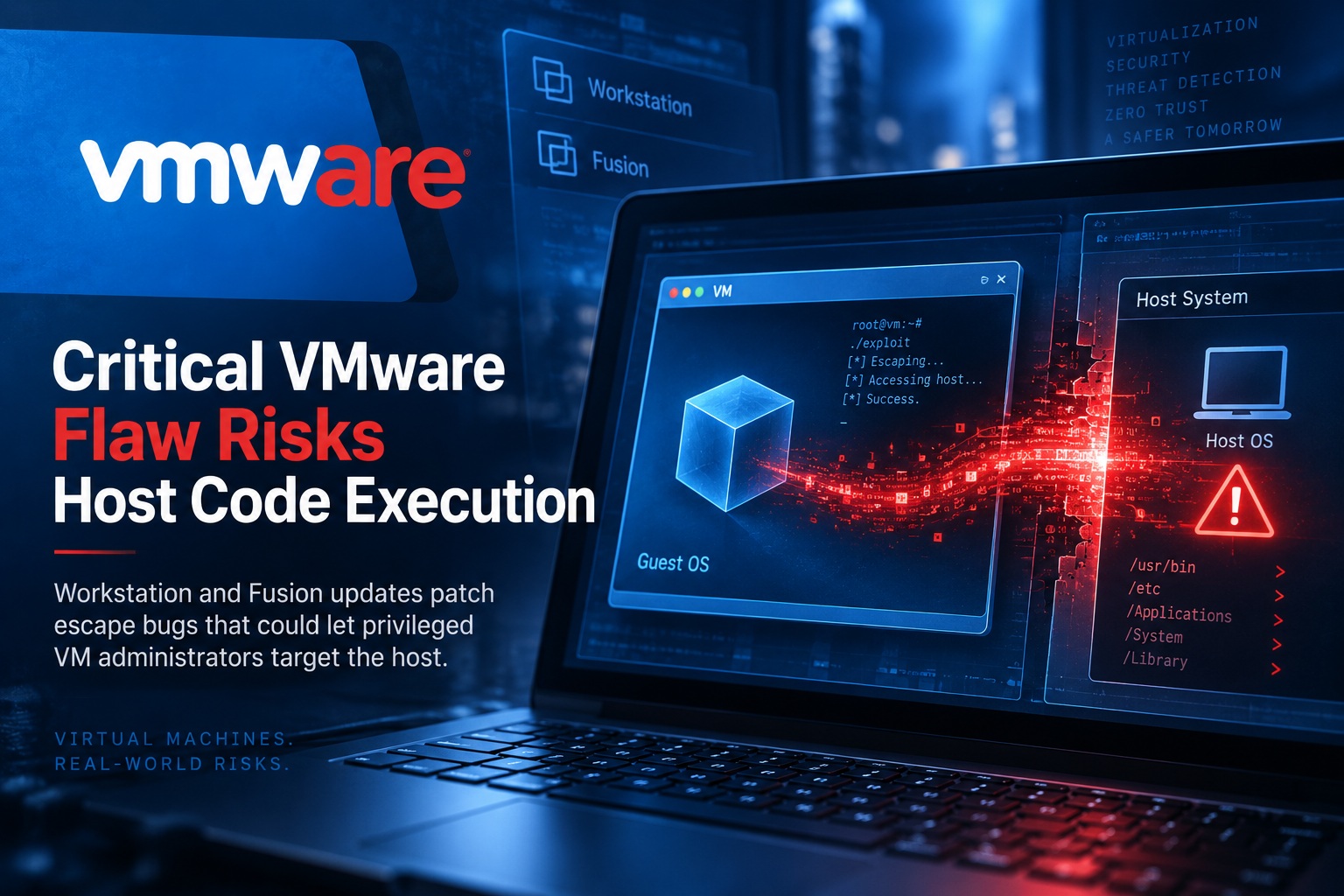
Virtual machines are designed to create a strong boundary between the guest operating system and the physical computer running it. That isolation is one of the main reasons virtualisation is so widely used for software testing, development, security research and running potentially risky workloads. When that boundary fails, however, a compromised virtual machine can become a path into the host itself.
Broadcom has released security updates for two vulnerabilities affecting VMware Workstation and VMware Fusion, including one Critical-severity flaw that could allow an attacker with administrative privileges inside a virtual machine to execute arbitrary code on the host. The more serious vulnerability, tracked as CVE-2026-59346, carries a CVSS score of 9.3 and affects systems using VMware's VMXNET3 virtual network adapter.
Why Escaping a Virtual Machine Is Such a Serious Problem
Virtualisation is built around isolation. Applications and operating systems running inside a virtual machine should normally remain separated from the host, even when something inside the guest becomes compromised. This allows developers to test unfamiliar software, security researchers to analyse suspicious programs and organisations to isolate workloads without exposing the underlying machine.
A vulnerability that allows code to cross that boundary changes the risk considerably. Instead of being limited to compromising the guest system, an attacker may gain the ability to execute code through processes running on the host. Depending on what access those processes have, that could create opportunities for further compromise of the physical machine and other resources available to it.
This class of vulnerability is particularly important for developers and researchers who deliberately use virtual machines to contain untrusted workloads. The protection only works if the boundary between guest and host remains intact.
CVE-2026-59346 Targets VMware's VMXNET3 Adapter
The first vulnerability is CVE-2026-59346, an integer-overflow flaw with a CVSS score of 9.3. Broadcom says a malicious actor with local administrative privileges inside a virtual machine using the VMXNET3 virtual network adapter could exploit the weakness to execute code on the host.
Integer-overflow vulnerabilities occur when software performs numerical calculations that exceed the range expected by the program. The resulting value can behave differently from what developers intended and, in memory-sensitive code, may eventually lead to unsafe memory operations.
In this case, the vulnerability sits close to the virtual networking boundary between the guest and VMware's host-side components. That helps explain why successful exploitation could have consequences outside the virtual machine itself.
Broadcom credited security researchers @h4urek, @cameudis and Stan S with discovering and reporting the flaw.
A Second Vulnerability Affects VMware Shared Folders
Broadcom has also patched CVE-2026-59347, a separate stack-based buffer-overflow vulnerability affecting HGFS, VMware's Host-Guest File System functionality. The issue carries a CVSS score of 8.1, putting it in the High-severity category.
HGFS supports file-sharing functionality between the host system and virtual machines. According to Broadcom, an attacker with local administrative privileges inside the guest could exploit the vulnerability to execute code as the VM's VMX process running on the host.
Although its CVSS score is lower than the VMXNET3 vulnerability, the underlying concern is similar: a feature designed to connect the guest environment with the host contains a memory-safety weakness that may allow the attacker to cross that boundary.
Researchers Yeonghyeon Choi and Tianchu Chen of Tencent Xuanwu Lab were credited with identifying CVE-2026-59347.
Administrative Access Inside the VM Is Required
Neither vulnerability allows an anonymous internet attacker to immediately compromise a VMware host. Exploitation requires the attacker to already have local administrative privileges inside the virtual machine, which creates an important prerequisite.
That does not make the flaws harmless. Administrative access to a VM can be obtained through other attacks, including phishing, stolen credentials, malware or exploitation of vulnerable software inside the guest operating system. Once that initial foothold exists, the VMware vulnerabilities could potentially provide the next stage of the attack.
This is why security teams often think about vulnerabilities as parts of an attack chain rather than completely isolated problems. One weakness gets the attacker into a virtual machine, while another may allow them to move from the VM to the host.
A Compromised VM Should Ideally Remain a Compromised VM
One of the fundamental assumptions behind virtualisation is that even if the guest operating system becomes completely compromised, the attacker should remain trapped inside it. In other words, administrator-level access to the VM should not automatically translate into control over the host.
That isolation is particularly important in malware-analysis environments. Researchers may intentionally execute malicious code inside virtual machines because they expect the host to remain protected. Development environments also routinely run unfamiliar dependencies, containers and test workloads that may be less trusted than the host itself.
CVE-2026-59346 and CVE-2026-59347 weaken that assumption under specific configurations. They demonstrate why virtual-machine escape vulnerabilities tend to receive significant attention even when exploitation requires privileged guest access.
Which VMware Versions Are Affected?
The vulnerabilities affect VMware Workstation and VMware Fusion versions 25H2 and 26H1. Broadcom says there are no practical configuration workarounds that completely address the two flaws.
The vulnerabilities are fixed in:
Users running affected releases should therefore upgrade to the patched versions rather than relying on configuration changes to reduce exposure.
The absence of a workaround makes updating particularly important. Organisations that cannot immediately patch should at least minimise exposure by limiting who receives administrative privileges inside virtual machines and avoiding untrusted workloads where possible.
VMware Workstation and Fusion Serve Different Platforms but Similar Use Cases
VMware Workstation is widely used on Windows and Linux systems, particularly among software developers, IT professionals and security researchers. VMware Fusion provides similar virtualisation capabilities for macOS users.
Both products allow users to create desktop virtual machines capable of running complete guest operating systems. That makes them extremely useful for testing software, maintaining development environments and isolating workloads.
The same versatility also makes vulnerabilities in the virtualisation layer potentially valuable to attackers. A machine running several VMs may contain source code, credentials, development tools and connections to corporate infrastructure on the host, giving an attacker strong motivation to escape from the guest environment.
The VMX Process Is an Important Security Boundary
VMware's VMX process plays a central role in operating a virtual machine. It manages significant aspects of the VM's interaction with virtualised hardware and the host environment.
A vulnerability that allows attacker-controlled code to execute within that process therefore deserves particular attention. Even if the original attacker begins inside a guest system, moving into a host-side VMX process means they have crossed one of the major boundaries virtualisation is designed to enforce.
From a defensive perspective, this reinforces the importance of keeping desktop virtualisation software patched just as aggressively as browsers, operating systems and other security-sensitive applications.
No Known Exploitation Has Been Reported So Far
Broadcom has not reported evidence that either CVE-2026-59346 or CVE-2026-59347 is currently being exploited in real-world attacks. That gives administrators an opportunity to patch before the vulnerabilities become part of active campaigns.
However, history suggests that VMware vulnerabilities frequently attract attacker interest once sufficient technical information becomes public. Virtualisation platforms are attractive targets because compromising them can provide access to systems that organisations often consider highly trusted.
Waiting until confirmed exploitation appears is therefore an unnecessarily risky strategy, particularly when Broadcom has already released fixed versions.
Recent vCenter Attacks Show How Quickly VMware Flaws Can Be Weaponised
The urgency becomes clearer when looking at recent activity involving other VMware products. Threat actors were recently observed actively exploiting CVE-2026-59309 and CVE-2026-59310 in VMware vCenter.
The latter vulnerability was suspected of being used by a China-linked advanced persistent threat actor. According to reported figures, exploitation began only five calendar days after public disclosure, illustrating how quickly attackers can move once information about a valuable VMware flaw becomes available.
The campaign was estimated to have affected 361 unique victim IP addresses across 47 countries. Germany recorded the highest number of observed infections with 55, followed by the United States with 41, Turkey with 38, Iran with 26 and France with 25.
That timeline is a useful reminder for Workstation and Fusion users: the absence of exploitation today does not guarantee a long window before attackers begin experimenting.
Virtualisation Software Has Become an Attractive Security Target
VMware products sit in privileged positions within many environments. Enterprise hypervisors may host numerous production servers, while desktop virtualisation platforms frequently run development environments and specialised workloads on valuable workstations.
From an attacker's perspective, escaping a virtual machine can provide access to a far more interesting system than the original guest. A development host may contain SSH keys, source repositories, cloud credentials and corporate VPN access that were intentionally kept outside the VM.
Virtualisation vulnerabilities can therefore become particularly powerful when combined with credential theft or other methods of obtaining administrative access inside a guest.
Developers Should Take These Updates Seriously
Developers may be among the most exposed users because virtual machines are commonly used for testing software and maintaining isolated environments. A developer might assume that downloading an unfamiliar project into a VM protects the host from anything malicious inside that project.
That remains a reasonable security practice, but it should never create complacency. Virtualisation software itself becomes part of the trusted computing base and needs regular security updates.
If an attacker can first compromise the guest and then exploit a VM escape vulnerability, the protective environment intended to contain the threat can become the bridge into the developer's main workstation.
Security Researchers Face an Even More Obvious Risk
Malware analysts and security researchers often use VMs specifically because the software being executed may already be malicious. In these environments, the requirement for administrative access inside the guest may be less reassuring because malware samples may deliberately attempt to obtain elevated permissions as part of their normal behaviour.
Researchers should therefore update affected VMware installations before continuing to analyse high-risk samples. Layered isolation can also help, including network separation, limited host integration and avoiding unnecessary shared folders between guest and host.
No single protection should be treated as infallible when the workload is intentionally hostile.
Shared Features Increase Convenience but Also Expand the Attack Surface
Virtualisation platforms include numerous integration features designed to make VMs easier to use. Shared folders, clipboard synchronisation, drag-and-drop, virtual networking and other conveniences create controlled communication channels between host and guest.
Every one of those channels also represents additional code operating across the isolation boundary. CVE-2026-59347's impact on HGFS demonstrates how a feature as ordinary as shared folders can become security-sensitive when memory-handling mistakes are present.
This does not mean integration features should never be used. It means organisations dealing with untrusted workloads should enable only the host-guest integration features they actually require.
Least Privilege Inside Virtual Machines Still Matters
Because both vulnerabilities require local administrative privileges in the guest, reducing unnecessary administrator use can lower the likelihood of successful exploitation.
Users should avoid running normal workloads permanently under privileged accounts where possible. Administrative credentials should be reserved for tasks that genuinely require elevated access.
This principle is useful even beyond these specific VMware vulnerabilities. Malware running under a limited user account generally has fewer capabilities than malware operating with full guest administrative privileges, making subsequent attack stages harder.
What VMware Users Should Do Now
The most important action is straightforward: affected users should upgrade to VMware Workstation 26H1u1 or VMware Fusion 26H1u1 as soon as practical. Because Broadcom says there are no workarounds that fully address the vulnerabilities, remaining on an affected version leaves the underlying flaws present.
Organisations should also review where VMware desktop products are installed, particularly on developer and security-research workstations. Systems running potentially hostile or less-trusted virtual machines should receive the highest patching priority.
It is also worth reviewing whether shared folders, VMXNET3 networking and other guest-host integration features are needed in every environment. Reducing unnecessary functionality can shrink the available attack surface even after patching.
Final Thoughts
CVE-2026-59346 and CVE-2026-59347 are important because they attack one of the core promises of virtualisation: what happens inside the virtual machine should stay inside the virtual machine. Under the right conditions, both flaws could allow an attacker with administrative access inside a guest to execute code through components running on the host.
The most serious issue, CVE-2026-59346, carries a CVSS score of 9.3 and affects VMware's VMXNET3 virtual networking functionality. CVE-2026-59347, rated 8.1, affects the HGFS shared-folder mechanism. Both are fixed in Workstation and Fusion 26H1u1, and Broadcom has not provided configuration-based workarounds.
There is currently no evidence of active exploitation, but recent attacks against VMware vCenter show how quickly vulnerabilities in valuable virtualisation products can attract attention. For developers, researchers and organisations depending on VMware for isolation, the safest response is simple: update before attackers get the opportunity to turn a virtual-machine compromise into a host compromise.











Comments 0