

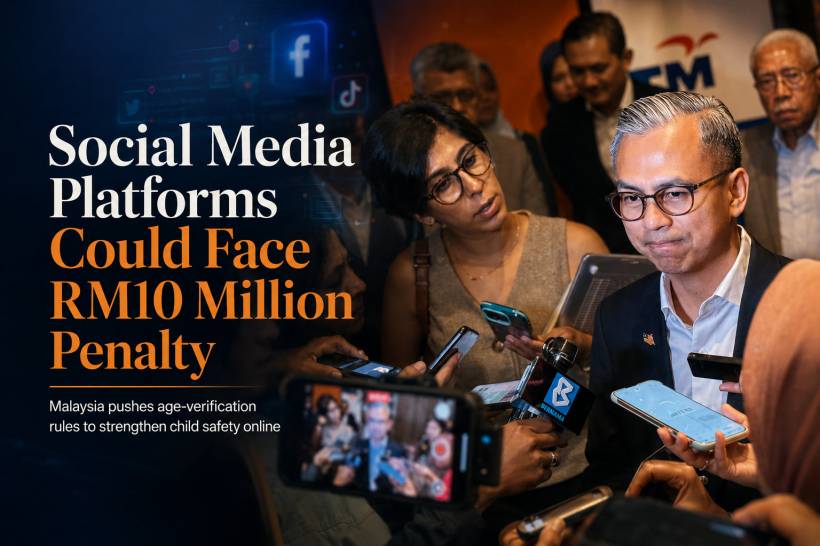
Malaysia is raising the stakes for social media companies when it comes to protecting younger users online. Under the Online Safety Act 2025 and its related codes, licensed service providers are now expected to introduce stronger safeguards for children. One of the most significant requirements is age verification, aimed at preventing children below the permitted age from opening or maintaining social-media accounts on major platforms.
For companies that fail to meet these responsibilities, the consequences can be serious. Financial penalties may reach as high as RM10 million, placing clear pressure on platforms to treat online child safety as a core compliance issue rather than an optional feature.
Why Age Verification Is Becoming a Major Issue
For years, most websites have relied on a simple checkbox or date-of-birth field when asking users to confirm their age.
The weakness is obvious. A child can easily enter a different birth year and continue using the platform without any meaningful check. That may have been sufficient in the early days of social media, but it is no longer seen as enough when platforms are dealing with harmful content, online grooming, scams, cyberbullying and other digital risks.
Malaysia's approach is built around the idea that self-declaration alone is too easy to manipulate.
Instead, age verification must be supported by official government records or equivalent documents. This may include MyKad, passports, birth certificates or other recognised identification records.
The objective is not simply to ask users how old they are. It is to establish a more reliable way to confirm whether they meet the required age threshold.
Which Platforms Are Affected?
The requirement is aimed at licensed service providers, particularly social-media platforms with a large user base in Malaysia.
Platforms with at least eight million users in the country are required to implement effective age-verification measures. The rules are intended to ensure that users aged below 16 cannot register for accounts or access functions that are not appropriate for their age.
This does not mean every website, forum or small online service will automatically face the same obligations. The focus is on major platforms that have broad reach, significant influence and a large number of young users.
For these companies, age verification is now becoming part of a wider online-safety responsibility that also includes content moderation, reporting tools, parental controls and safer recommendation systems.
RM10 Million Penalties Raise the Pressure
The financial consequences are substantial.
Licensed service providers that fail to comply with their responsibilities under Part III of the Online Safety Act 2025 may face penalties of up to RM10 million. The Malaysian Communications and Multimedia Commission, or MCMC, can issue notices of non-compliance and require companies to respond.
A provider receiving such a notice may either pay the prescribed penalty or submit representations for MCMC review.
There is also a separate enforcement layer. MCMC has the authority to issue written directions to licensed providers. Failure to comply with those directions can become an offence, carrying a possible fine of up to RM1 million upon conviction, along with an additional daily penalty if the breach continues.
This gives the law more weight than a simple policy guideline. Platforms are being told clearly that online child safety is now part of their legal and operational responsibility in Malaysia.
A Technology-Neutral Approach
The government is not forcing every company to use one exact age-verification tool.
That is important because different platforms operate in different ways. A global messaging service, video platform, gaming community and photo-sharing app may each need a different method to balance security, privacy and usability.
Malaysia's approach focuses on the outcome: platforms must use a method that works, is secure and cannot be easily bypassed through a simple self-declared age.
This leaves room for companies to develop or adopt different technologies, whether through digital identity checks, document verification, trusted third-party services or other secure systems.
However, flexibility does not remove accountability. The system still needs to reliably establish that users meet the age requirements.
Privacy Will Be One of the Biggest Concerns
Age verification can improve child safety, but it also introduces sensitive privacy questions.
Government-issued documents contain personal information, so platforms need to be careful about how that data is collected, stored, processed and eventually disposed of. The rules require providers to comply with Malaysia's personal data protection laws, which means age verification should not become an excuse to collect more user information than necessary.
For users, trust will depend on whether platforms can explain the process clearly.
People will want to know what information is being submitted, who can access it, how long it will be retained and whether it will be used for anything beyond verifying age. A strong verification system needs to protect children without creating unnecessary privacy risks for everyone else.
Platforms Have Been Given Time to Prepare
The government has been engaging social-media companies through a regulatory sandbox since January to discuss the practical challenges of age verification.
More than 30 sessions have reportedly been held with the relevant platforms, either individually or as a group. This reflects the reality that implementation is not as simple as adding a new button to a registration page.
Platforms need to consider existing accounts, global privacy policies, document-verification systems, parental access, customer support and how to handle users who are unable to complete verification immediately.
A separate grace period is expected to apply to the completion of age verification for existing users on affected platforms. This gives companies time to build and test their systems before full enforcement becomes necessary.
What This Means for Malaysian Users
For younger users and their families, the policy could result in more visible checks when creating or maintaining accounts on major social-media platforms.
Parents may also see stronger control tools, safer privacy settings and more restrictions around features that could expose children to harmful interactions or content.
For adult users, age verification may feel inconvenient at first. However, the policy is part of a broader attempt to make platforms more accountable for the environment they create, especially for children and teenagers.
The success of the system will depend heavily on implementation. It needs to be accurate enough to stop easy manipulation, private enough to avoid unnecessary data collection and simple enough that legitimate users are not locked out without a clear reason.
Final Thoughts
Malaysia's age-verification requirements signal a major shift in how social-media platforms are expected to operate.
The message is clear: large platforms cannot rely on self-declared ages alone when children may be exposed to harmful online experiences. They are expected to introduce more meaningful safeguards, protect personal data and demonstrate that they are taking online safety seriously.
The RM10 million penalty gives the policy real force, but the longer-term test will be whether the system can protect children while remaining fair, practical and privacy-conscious for the millions of Malaysians who use social media every day.











Comments 0