

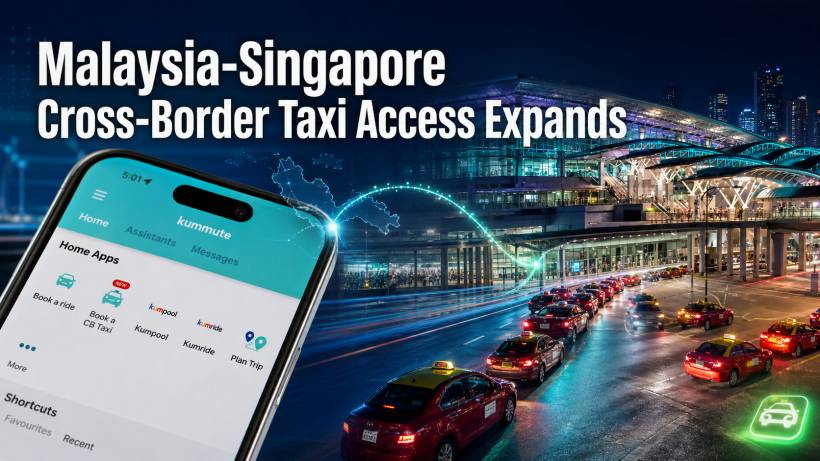
Travelling between Johor and Singapore is getting a small but meaningful upgrade. From 4 May 2026, Malaysia and Singapore will enhance their cross-border taxi arrangement, giving passengers more flexibility while still keeping the service within a regulated framework. The update follows coordination between Singapore's Ministry of Transport, Malaysia's Ministry of Transport, Singapore's Land Transport Authority, and Malaysia's Land Public Transport Agency, APAD.
For regular travellers, this is a useful development. The Johor-Singapore land crossing is one of the busiest in the region, and anyone who has crossed the Causeway or Second Link during peak hours knows how tiring the journey can be. More structured transport options may not magically solve congestion, but they can make planning easier for people who prefer a direct taxi ride instead of switching between buses, trains, private cars, or multiple ride-hailing trips.
More Flexibility For Cross-Border Taxi Passengers
Under the enhanced scheme, licensed cross-border taxis will be allowed to drop passengers off anywhere in Singapore, and anywhere within selected areas in Malaysia. These Malaysian areas include Johor Bahru, Iskandar Puteri, Forest City, Kulai, and Senai.
That is a notable change because cross-border taxis have traditionally operated within tighter location controls. The new arrangement gives passengers more practical drop-off options, especially for those heading to hotels, offices, shopping centres, homes, industrial areas, or transport hubs within the approved zones.
However, this does not mean taxis from either side can operate freely like normal domestic taxis in the other country. The scheme remains regulated, and foreign taxis still face limits on where they can pick up passengers. According to CNA, foreign taxis can only do pick-ups at designated points, even though drop-offs are being expanded.
Why The Fixed Pick-Up Rule Still Matters
The fixed pick-up rule is important because cross-border taxi services need to balance passenger convenience with local transport regulations. If foreign taxis were allowed to pick up passengers anywhere, it could create unfair competition with local taxi and ride-hailing drivers.
By expanding drop-off areas while keeping pick-ups controlled, both governments appear to be trying to improve convenience without fully opening the domestic transport market. It is a compromise: passengers get more useful destinations, but operators still work under clear boundaries.
This is also why the official framework still emphasises licensed taxis. The goal is not to encourage informal or illegal cross-border rides, but to provide a safer and more traceable alternative.
More Taxi Licences Will Be Added
The updated scheme also increases the number of licensed cross-border taxis. Reports indicate that each country will add another 100 taxi licences to the existing 200, bringing the total to 300 licensed taxis per country in 2026.
This matters because availability has often been one of the biggest weaknesses of cross-border taxi services. If only a small number of vehicles are allowed to operate, passengers may still struggle to find a ride during busy periods. Increasing the quota should help improve supply, although the real impact will depend on how quickly drivers are onboarded and how many actually operate regularly.
Licensed taxis must also be clearly identifiable when operating in the other country. The requirements include visible livery, a predefined vehicle plate prefix, and taxi topper signage.
Grab Enters With A Cross-Border Ride-Hailing Pilot
Alongside the enhanced taxi scheme, Grab has received the first Cross-Border Ride-Hail Service Operator Licence, also known as CRSOL. This allows Grab to run a pilot app-based booking service for cross-border taxi journeys between Singapore and selected parts of Johor.
Grab's pilot service is called Cross-Border SG-JB (Beta). It will be rolled out gradually from 4 May 2026, with Grab onboarding licensed cross-border taxi drivers from both Singapore and Malaysia over time.
This is a major shift because it brings a more familiar ride-hailing experience into cross-border taxi travel. Instead of relying only on terminals, phone bookings, or walk-in arrangements, passengers will be able to use an app-based booking flow.
Advance Booking Makes The Service More Practical
One of the more useful parts of Grab's pilot is advance booking. The service allows passengers to book cross-border trips in advance, from 12 hours up to seven days before the journey.
This is especially useful for planned travel. For example, someone catching a flight from Senai, attending meetings in Johor Bahru, visiting family, or travelling with luggage may prefer to secure a ride earlier instead of searching for transport at the last minute.
It also gives drivers and operators better visibility of demand. Cross-border journeys are not like normal short city trips. They involve immigration checkpoints, traffic uncertainty, and longer travel times. Advance booking helps make the service easier to manage.
Door-To-Door Rides From Singapore To Johor
Grab says the pilot will allow taxi bookings for cross-border journeys between anywhere in Singapore and selected areas in Malaysia, namely Johor Bahru, Iskandar Puteri, Forest City, Kulai, and Senai.
This makes the service more attractive for Singapore-to-Johor travel because passengers do not need to begin their trip only from a terminal. For many users, the appeal is simple: book from the app, get picked up from a convenient location in Singapore, and travel directly to an approved destination area in Johor.
That said, the rollout is still a beta pilot. Grab has said it will expand and refine the service as more licensed cross-border taxis are onboarded and as feedback comes in from drivers and passengers.
Fixed Fares And Introductory Discounts
Grab's cross-border service will use fixed upfront fares. Current starting rates are listed at SGD80 for trips from Singapore to Johor and from RM240 for journeys starting in Malaysia. Grab is also offering introductory discounts of up to 20 percent during the pilot phase.
Fixed pricing is useful for cross-border travel because passengers are often concerned about uncertainty. Traffic at the checkpoints can be unpredictable, and a metered fare could become stressful if delays are long. With upfront fares, passengers know the cost before confirming the ride.
However, the price also means this service will not replace cheaper public transport options. Buses and trains will still be more affordable for many travellers. Grab's cross-border taxi pilot is likely to appeal more to people who value convenience, luggage space, direct travel, or travelling in a small group.
Safety Features And Cross-Border Coverage
Grab says the pilot will include its standard safety features, such as trip monitoring, emergency SOS, and audio recording safeguards. The service also includes insurance coverage that accounts for cross-border travel.
This is an important point because cross-border journeys carry different risks and operational requirements compared with normal city trips. Passengers are moving between two jurisdictions, through immigration checkpoints, and often across longer distances. Having proper licensing, insurance, and in-app safety features helps make the service more reassuring for users.
Other Players May Join Later
Grab is the first operator to receive the CRSOL, but it may not be the only one in the long run. Since both governments are expanding the licensing framework and increasing the number of taxi licences, more operators could potentially join the scheme over time.
This would be good for passengers. More operators could mean better availability, more booking channels, and possibly more competitive service options. However, because the service crosses national borders, any expansion will likely remain carefully regulated.
Kummute Was Already Exploring Cross-Border Taxi Booking
It is also worth noting that app-based cross-border taxi booking is not entirely new. Kummute previously introduced a cross-border taxi booking feature developed with taxi associations from Malaysia and Singapore. The service allowed users to book rides digitally, with payment support in both Ringgit and Singapore Dollars.
At the earlier stage, drop-off points were more limited, with key points such as Larkin Sentral in Johor Bahru and Ban San Street Terminal in Singapore. The latest government-backed enhancements and Grab's CRSOL pilot suggest that the cross-border taxi market is now moving into a more formal and expanded phase.
Final Thoughts
The updated Malaysia-Singapore cross-border taxi scheme is a practical improvement for travellers who want more direct and flexible travel between Singapore and Johor. The ability to drop off passengers across Singapore and within selected Johor areas should make the service more useful than before, especially for people travelling with luggage, family members, or tight schedules.
Grab's Cross-Border SG-JB beta pilot adds another layer of convenience by bringing app-based booking, advance reservations, upfront fares, and familiar safety features into the cross-border taxi experience. It will not be the cheapest way to cross the border, but it could become one of the more convenient options for travellers who want a direct ride.
The bigger picture is clear: both Malaysia and Singapore are trying to improve regulated cross-border mobility without allowing uncontrolled transport activity. If the pilot works well and more licensed drivers come onboard, this could become a much more practical option for regular JB-Singapore travellers.











Comments 0