

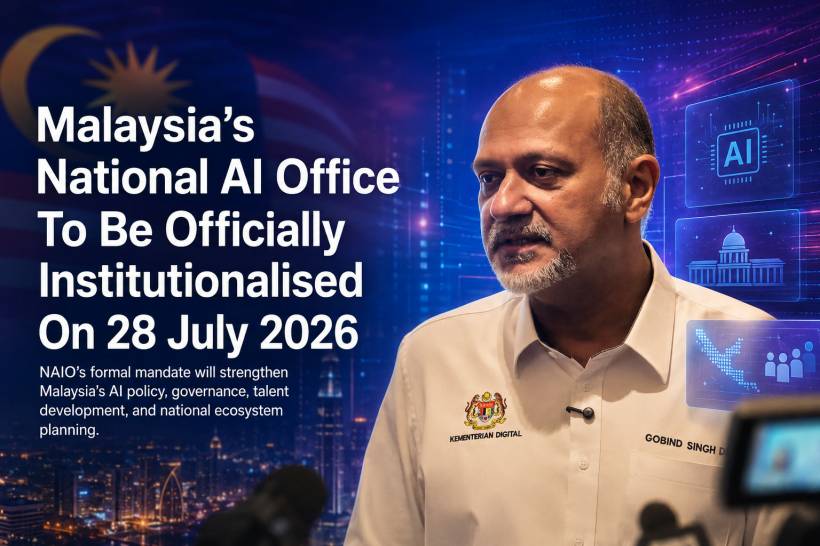
Malaysia's National Artificial Intelligence Office, better known as NAIO, is set to be officially institutionalised on 28 July 2026. The announcement was made by Digital Minister Gobind Singh Deo, who said the move will give NAIO a more formal role in shaping the country's artificial intelligence direction.
This is an important development because AI is no longer just a technology trend discussed by startups, researchers, and big tech companies. It is quickly becoming part of national policy, economic planning, public service transformation, cybersecurity, education, healthcare, and industrial development. For Malaysia, having a central body to coordinate AI-related efforts is becoming increasingly necessary.
At the moment, NAIO operates under incubation at MyDIGITAL Corporation. Once institutionalised, it will have a clearer mandate to coordinate national AI policies, governance, talent development, and ecosystem building.
A More Formal Role For Malaysia's AI Direction
Gobind confirmed the institutionalisation date during the inauguration of the Digital Realty data centre campus. According to him, Prime Minister Datuk Seri Anwar Ibrahim had confirmed that NAIO would be formally institutionalised on 28 July 2026.
This step is expected to strengthen NAIO's role as Malaysia's central AI coordination body. Instead of functioning mainly as an initiative under incubation, the office will be positioned with a more structured national responsibility.
That matters because AI development involves many moving parts. It is not only about building chatbots or adopting automation tools. It also involves national data strategy, infrastructure readiness, ethical standards, privacy concerns, talent pipelines, industry adoption, and regulatory planning.
Without a central coordinating body, AI initiatives can easily become fragmented across ministries, agencies, universities, private companies, and research institutions. NAIO is expected to help bring those efforts together under a clearer national direction.
Supporting Malaysia's AI Nation 2030 Vision
NAIO is also expected to play a key role in supporting the government's AI Nation 2030 vision. This vision is aimed at positioning Malaysia as a stronger player in artificial intelligence and digital transformation.
For Malaysia, the AI opportunity is not only about consuming foreign technologies. The bigger challenge is whether the country can build its own AI capabilities, develop local talent, support local companies, and create a governance model that fits the country's own economic and social needs.
Gobind said NAIO will help oversee policy development, governance, talent cultivation, and support for local players that are capable of developing AI technologies. This suggests that the agency's role will not be limited to regulation alone. It will also be involved in ecosystem building.
That is important because AI governance and AI growth must move together. Too much regulation too early may slow innovation, but too little governance may create risks around privacy, bias, security, misinformation, and misuse. NAIO's challenge will be to find the right balance.
Why NAIO Was Created In The First Place
NAIO was first launched in December 2024 as a strategic initiative under the Digital Ministry. From the beginning, the office was intended to act as a central agency for coordinating Malaysia's AI agenda.
The establishment of NAIO reflected the government's recognition that AI needed more focused national attention. As AI adoption accelerates worldwide, countries are increasingly creating dedicated offices, councils, task forces, or regulatory bodies to manage the technology's impact.
Malaysia cannot afford to approach AI in a scattered or reactive way. The technology is moving quickly, and decisions made today may shape future competitiveness. This includes how local companies use AI, how workers are reskilled, how public services adopt automation, and how sensitive data is protected.
By formalising NAIO, the government is signalling that AI will be treated as a long-term national priority rather than a temporary digital initiative.
AI Governance Framework Still In Progress
One of NAIO's major responsibilities is the development of Malaysia's AI Governance Framework. Gobind said work on the framework is ongoing, with a dedicated department within NAIO currently responsible for drafting it.
A standards office based in Cyberjaya is also expected to become part of the organisation eventually. This could be important because AI governance will likely require not only broad policy statements, but also practical standards that organisations can follow.
• How should AI systems be tested before deployment?
• What level of transparency should be required when AI is used in public services?
• How should organisations manage AI-related data privacy risks?
• What safeguards should exist for high-impact sectors such as healthcare, finance, education, and security?
• How should Malaysia encourage innovation while still protecting the public?
These are not easy questions, especially because AI technology is changing so quickly. A framework that is too rigid may become outdated within a short time. A framework that is too vague may not provide enough protection or guidance.
Possible AI Legislation Is Also Being Studied
Apart from a governance framework, the government is also studying whether Malaysia may eventually need dedicated AI legislation.
Gobind said an advisory body is being considered to help shape future regulations. However, he also stressed that any future framework must remain flexible enough to keep up with technological change.
That is a sensible position. AI regulation is difficult because the technology does not stay still. Models become more capable, use cases expand, and risks evolve. A law written too narrowly may fail to cover new developments, while a law written too broadly may create uncertainty for businesses and developers.
This is where NAIO could become important. By bringing together experts, policymakers, industry players, and standards specialists, the office can help Malaysia anticipate future risks instead of only reacting after problems appear.
The Need For Practical Guardrails
Gobind said NAIO's institutionalisation is partly intended to bring experts together to anticipate challenges and establish suitable guardrails for AI.
That word, guardrails, is important. AI does not necessarily need to be blocked or feared, but it does need boundaries. These boundaries are especially important when AI is used to make decisions, process personal data, generate content, automate workflows, or support public-facing services.
For businesses, proper guardrails can provide confidence. Companies are more likely to adopt AI when they understand the rules, risks, and compliance expectations. For the public, governance provides reassurance that AI systems are not being deployed carelessly.
Malaysia's challenge will be to create guardrails that are practical, not merely theoretical. Organisations will need guidance that can actually be implemented, especially small and medium enterprises that may not have large legal, compliance, or AI governance teams.
A Data Commission Is Also Being Planned
Separately, the Digital Ministry is also working towards the creation of a Data Commission to oversee data governance in Malaysia.
According to Gobind, the proposal is currently being studied from a statutory perspective, with a target introduction sometime in the fourth quarter of the year.
This is closely connected to the AI discussion because AI depends heavily on data. Without proper data governance, AI governance becomes incomplete. Issues such as data ownership, data sharing, privacy, consent, retention, and cross-border data use all affect how AI systems are trained, deployed, and monitored.
A Data Commission could therefore become an important part of Malaysia's broader digital governance structure. While NAIO focuses on AI coordination, policy, and ecosystem development, a Data Commission could help strengthen the rules around the data that powers many digital systems.
What This Means For Malaysia's Digital Future
The institutionalisation of NAIO is not just an administrative update. It represents a bigger shift in how Malaysia intends to manage artificial intelligence as part of national development.
AI is already affecting businesses, government agencies, education providers, healthcare institutions, media platforms, and everyday digital services. As adoption grows, Malaysia will need stronger coordination between innovation, regulation, talent development, and infrastructure.
The key will be execution. Creating an office is one thing. Giving it enough authority, expertise, resources, and industry engagement is another. NAIO will need to avoid becoming just another policy body. It must be able to produce practical frameworks, support real adoption, encourage local innovation, and help Malaysia respond quickly to AI-related risks.
Final Thoughts
NAIO's official institutionalisation on 28 July 2026 marks an important step in Malaysia's AI journey. It gives the country a more formal structure to coordinate AI policy, governance, talent development, and ecosystem growth.
The timing also makes sense. AI is becoming too significant to be handled in a fragmented way. Malaysia needs a central body that can bring together government, industry, academia, and technical experts to shape a balanced national approach.
If done well, NAIO can help Malaysia move beyond simply adopting AI tools from elsewhere. It can support local capability building, responsible innovation, and clearer governance standards. The challenge now is to make sure the office is not only institutionalised on paper, but also empowered to guide Malaysia's AI future in a practical and meaningful way.











Comments 0