

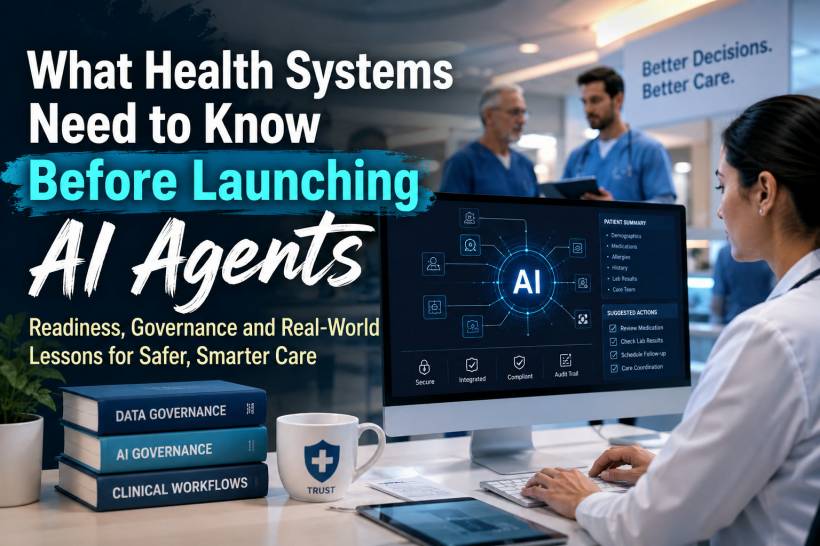
AI agents are quickly becoming one of the most talked-about technologies in healthcare. Unlike traditional chatbots or copilots that simply respond to questions, agentic AI can review information, follow workflows, trigger actions and complete selected tasks with less direct human intervention.
That sounds promising, especially for hospitals dealing with staff shortages, administrative pressure and increasingly complex clinical systems. But the technology is not something a healthcare organisation can safely deploy simply because the budget is available.
Before launching autonomous AI agents, health systems must first address data governance, cybersecurity, compliance, workflow design, clinical validation and the shortage of people with the right AI expertise. Organisations adopting the technology mainly because they fear being left behind may end up with a platform they are not prepared to manage.
AI Readiness Comes Before AI Deployment
The biggest mistake is treating AI agents like another software installation.
A normal business application may be configured, tested and released according to a fixed implementation plan. An AI agent behaves differently because its output depends on the quality of the underlying data, the instructions it receives and the context of each task.
Healthcare organisations need to understand:
Without these controls, an agent may generate an impressive response while still creating operational, privacy or patient-safety risks.
Hospitals also need to prepare for data drift. Clinical practices, documentation patterns, formularies and workflows change over time. An agent that performs accurately today may become less reliable if the information and assumptions supporting it are not continuously reviewed.
Start With a Clearly Defined Problem
The safest healthcare AI projects usually begin with a narrow and measurable problem.
Instead of asking an agent to interpret an entire patient journey and make broad clinical recommendations, the organisation might ask it to summarise a specific set of records, check whether required information is present or prepare staff for a scheduled workflow.
This narrower approach makes validation easier. Teams can compare the agent's output with the existing manual process and identify exactly where errors occur.
It also reduces the risk of turning AI into an uncontrolled decision-maker.
The goal should not be to make the agent as powerful as possible. It should be to give it only enough authority to perform one well-understood task safely.
Why Integration Into Clinical Workflows Matters
Healthcare employees already work across electronic health records, communication systems, reporting tools and specialised clinical applications. Introducing another separate screen can create more frustration than efficiency.
Epic's Agent Factory is designed to allow healthcare organisations to build and manage agents directly within the Epic environment. Its no-code visual tools can use templates or custom workflows while applying the organisation's own policies, standards and clinical protocols.
The advantage is not simply convenience.
When an agent operates inside the existing electronic health record, staff do not need to copy information into an external AI platform or move between multiple applications. Security controls, access permissions and audit functions can also remain connected to the clinical environment.
The platform can track agent activity and decisions while providing access to Epic's existing data without requiring a separate repository or additional data-extraction layer.
This kind of integration is important because clinicians are unlikely to adopt a tool that interrupts their workflow, even when its technology is impressive.
Small Health Systems Can Still Use AI Agents
AI adoption is often associated with major hospital groups that have large technology teams and dedicated innovation budgets.
However, smaller health systems can also benefit when vendors or implementation partners provide sufficient support.
ECU Health, a regional academic network serving largely rural communities in North Carolina, deployed two Epic-built AI agent prototypes despite having a smaller IT team. Its agents focus on patient transfers and discharge planning rather than attempting broad autonomous clinical decision-making.
This approach demonstrates that health systems do not necessarily need to build every agent internally.
However, they still need staff who can understand the workflow, evaluate the output and eventually maintain the solution. Vendor support can help an organisation begin, but long-term ownership cannot remain unclear.
Reducing Manual Review During Patient Transfers
One of ECU Health's agents supports its transfer centre.
The agent reviews a limited set of information from the electronic health record and produces a short summary based on a capabilities framework describing what each hospital can provide.
This reduces the amount of time nurses spend manually reviewing full charts before deciding where a patient may be transferred.
According to the health system, the tool saved approximately 20 hours of chart-review work per week during its first month, equivalent to about half of a full-time role.
The important lesson is that the agent remains tightly constrained.
It is not reviewing every available record and attempting to produce an independent clinical opinion. It receives selected information and completes a specific operational task.
That limitation likely contributes to its reliability.
User Feedback Must Shape the Agent Quickly
ECU Health's discharge-planning agent provides another useful lesson: the first version of an AI workflow may not satisfy the people expected to use it.
The tool was designed to create high-level patient summaries for case managers preparing for daily multidisciplinary rounds. However, the initial summaries were too long and closely resembled the records staff were already reviewing.
On the first day, most users rated the tool negatively.
The IT team adjusted the instructions that evening, shortened the output and focused it on the most important information. By the next day, approximately 75% of users responded positively.
That rapid improvement illustrates why feedback mechanisms must be built into healthcare AI projects from the beginning.
A technically accurate agent can still fail if its output is badly formatted, too detailed or presented at the wrong stage of the workflow.
Clinical trust is earned not only through accuracy, but through relevance and usability.
AI Agents Can Reduce Cognitive Burden
Large health systems are exploring agents in more complex operational settings.
Advocate Health has developed agents for inpatient pharmacy and infusion preparation. Its medication-verification agent gathers information from patient history, home medications, active care and progress notes before presenting a concise summary to pharmacists.
The agent does not replace the pharmacist's judgement.
Instead, it reduces the amount of time spent searching across different parts of the record. The pharmacist remains responsible for confirming that the medication is suitable, but the relevant context is presented more efficiently.
This is one of the strongest use cases for healthcare AI: reducing the mental effort required to locate information while keeping qualified professionals in control of the final decision.
Improving Infusion Preparation and Patient Communication
AI agents are also being used to support infusion services, where delays can be stressful for patients and staff.
Agents can review whether necessary clinical information is available, support treatment preparation and help coordinate communications before the appointment.
Through patient-portal integration, an agent may provide instructions about fasting, medication use and other pre-visit requirements weeks before treatment.
This could reduce missed requirements, prevent avoidable delays and improve the patient experience.
However, direct patient communication requires additional safeguards. Instructions must be validated, written clearly and escalated to a human when the situation falls outside the approved workflow.
Hospitals should be especially cautious before allowing an autonomous agent to handle complex questions or communicate information that could influence clinical decisions.
Security and Auditability Cannot Be Added Later
Healthcare AI agents may access medication records, diagnoses, progress notes, laboratory results and other highly sensitive information.
Security therefore needs to be part of the design—not something added after a successful pilot.
Organisations should require:
Auditability is particularly important. The organisation must be able to reconstruct what information the agent accessed, what output it generated and what action followed.
Without that record, investigating an error becomes extremely difficult.
Clinical Validation Must Continue After Go-Live
Passing a pilot does not mean an AI agent is permanently safe.
Performance should be monitored after deployment using indicators such as:
Health systems also need thresholds for intervention. If an agent's performance falls below an accepted level, it should be restricted, retrained or temporarily disabled.
AI governance must therefore be an ongoing operational process, not a one-time committee approval.
Large and Small Organisations Need Different Strategies
A major hospital group may have data scientists, clinical informaticists, cybersecurity specialists and an internal AI development team. A smaller hospital may depend heavily on its electronic health record vendor or an external implementation partner.
Both can deploy AI agents, but they should not follow the same model.
Large organisations may be able to build and customise agents internally, while smaller providers may be better served by validated templates and narrowly defined vendor-supported workflows.
What matters is whether the organisation has enough internal knowledge to govern the agent after implementation.
An AI system should not become an unexplained black box that only the supplier understands.
Final Thoughts
AI agents could become valuable tools for reducing administrative work, preparing clinical teams and improving patient coordination. Early examples in transfer centres, discharge planning, pharmacy and infusion services show that practical benefits are already possible.
But successful adoption depends far more on preparation than enthusiasm.
Health systems need strong data governance, clear workflows, clinical oversight, security controls and rapid user feedback. They must also begin with narrowly defined tasks rather than allowing agents to make broad decisions before trust has been established.
The hospitals that gain the most from agentic AI will not necessarily be the ones that deploy it first. They will be the ones that understand exactly what the agent should do, how its performance will be measured and when a human must remain firmly in control.











Comments 0