

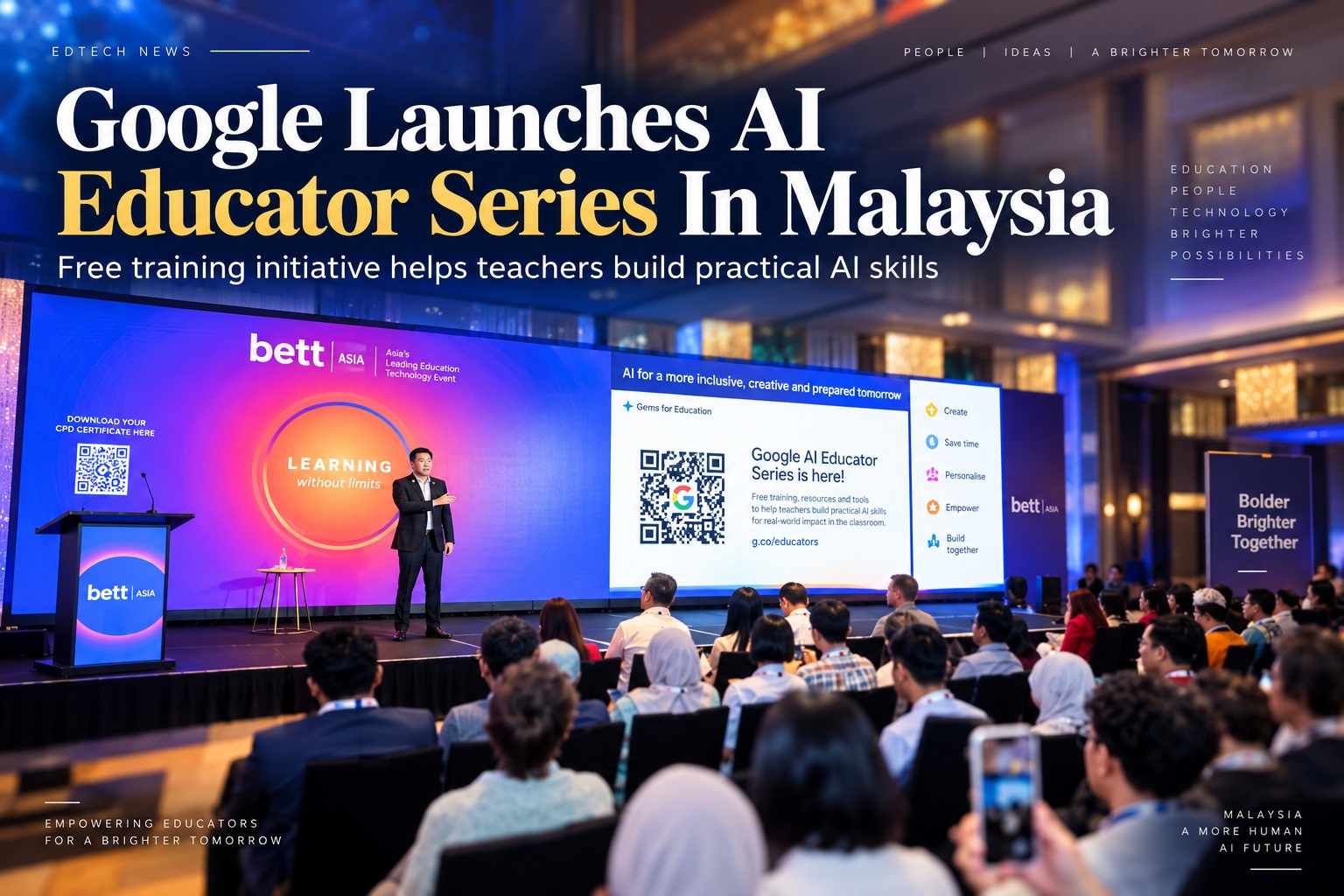
Artificial intelligence is becoming increasingly common across Malaysian classrooms, and Google is expanding its education initiatives to help teachers keep pace with that shift. The company has officially introduced its Google AI Educator Series (GES) in Malaysia, unveiling the programme during Bett Asia 2026.
Google Launches Free AI Educator Series in Malaysia to Help Teachers Build Practical AI Skills
Artificial intelligence is becoming increasingly common across Malaysian classrooms, and Google is expanding its education initiatives to help teachers keep pace with that shift. The company has officially introduced its Google AI Educator Series (GES) in Malaysia, unveiling the programme during Bett Asia 2026.
The initiative provides free, self-paced AI literacy training for educators across both schools and higher education. Rather than focusing only on AI theory, the programme is designed to show teachers how tools such as Gemini can be applied to everyday teaching tasks, from preparing lesson plans and learning materials to communicating with parents and creating interactive educational experiences.
AI Is Already Reaching Malaysian Classrooms
Google's latest initiative arrives as AI tools become more deeply integrated into Malaysia's education system. According to the company, the Ministry of Education (MOE) and Ministry of Higher Education (MOHE) have enabled Gemini for Education for millions of students and educators across K-12 schools and public universities.
Google also says that more than 200,000 Malaysian educators have already earned its Gemini Certified Educator certification. That figure suggests AI literacy is moving beyond a small group of technology-focused teachers and becoming increasingly relevant across the wider education sector.
The next challenge is helping educators understand how to use these tools responsibly and practically rather than simply providing access to them.
Google AI Educator Series Is Completely Free
The Google AI Educator Series is a free AI literacy programme aligned with education standards and designed for both K-12 teachers and higher-education faculty members.
Training is self-paced, allowing educators to complete lessons according to their own schedules rather than attending lengthy fixed sessions. Google says individual modules generally take between 15 and 45 minutes, making them easier to fit between teaching, administrative work and other responsibilities.
That shorter structure could make the programme more accessible to educators who want to improve their AI skills but cannot commit to a traditional multi-day training course.
The Programme Focuses on Practical Classroom Use
Rather than simply explaining how generative AI works, the lessons concentrate heavily on practical applications.
Teachers can learn how AI can assist with creating lesson plans, preparing supporting materials and drafting communications for parents. These are everyday tasks that often consume significant amounts of time outside actual classroom teaching.
Used carefully, AI could help reduce some of that repetitive workload. A teacher might generate the initial structure for a lesson, create variations of learning exercises or draft a parent communication before reviewing and adapting the content personally.
The objective is not to remove the teacher from the process but to make routine preparation more efficient.
Teachers Can Also Experiment With Vibe Coding
One of the more interesting areas included in the programme is vibe coding, where users describe what they want to build using natural language and allow AI-assisted development tools to help produce the underlying code.
For educators, this could lower the barrier to creating simple interactive learning experiences without requiring traditional programming expertise.
A science teacher might build a basic simulation, for example, while a mathematics teacher could create an interactive exercise where students manipulate values and immediately see the results. Language educators could potentially develop small quizzes, vocabulary activities or other classroom tools tailored to a specific lesson.
This gives teachers more opportunities to create digital materials themselves rather than depending entirely on existing educational software.
AI Literacy Is Becoming as Important as AI Access
Providing teachers with AI tools is only one part of the challenge. Educators also need to understand where AI works well, where it can make mistakes and how its output should be evaluated.
Generative AI can produce useful content very quickly, but it can also provide inaccurate information, introduce bias or produce material that is inappropriate for a particular learning level.
Training therefore becomes increasingly important as these tools move into everyday education. Teachers need enough AI literacy to review generated material critically rather than assuming that everything produced by the system is automatically correct.
That responsibility becomes even more important when AI-generated content reaches students.
Guided Learning Is Coming to Google Classroom
Google is also preparing to expand Guided Learning into Google Classroom in the coming months.
The feature will allow teachers to choose their own class materials while AI provides students with step-by-step guidance based on that content. Instead of simply delivering an answer, Guided Learning is intended to help students work through the subject progressively.
This approach could make AI more useful as a learning companion rather than simply a shortcut for completing assignments.
Teachers will also receive visibility into student progress, including real-time insights that can help identify where individual learners may be struggling.
Teachers Remain in Control of the Learning Material
An important aspect of Guided Learning is that educators select the materials the system works with.
This gives teachers more control over the information students receive and helps keep AI assistance aligned with the curriculum being taught. Rather than allowing students to interact with a completely open-ended system, the AI can operate within the context defined by the educator.
That model could also make AI-assisted learning more practical in formal education environments, where lesson objectives, assessment requirements and curriculum standards need to remain consistent.
The technology provides the guidance, but the teacher still defines the learning context.
Real-Time Insights Could Help Identify Students Who Need Support
Google says educators will also be able to monitor student progress through Classroom.
These insights could help teachers recognise patterns that are difficult to notice when working with large classes. If several students repeatedly struggle with the same concept, for example, the teacher may decide to revisit that area during the next lesson.
Likewise, an individual learner who appears to be falling behind could potentially receive additional support sooner.
AI therefore becomes useful not only for generating educational content but also for helping teachers understand how students are interacting with that content.
Read Along Is Becoming Free for Google Workspace for Education
Google is also expanding access to Read Along, its digital reading tutor, at no additional cost for Google Workspace for Education users.
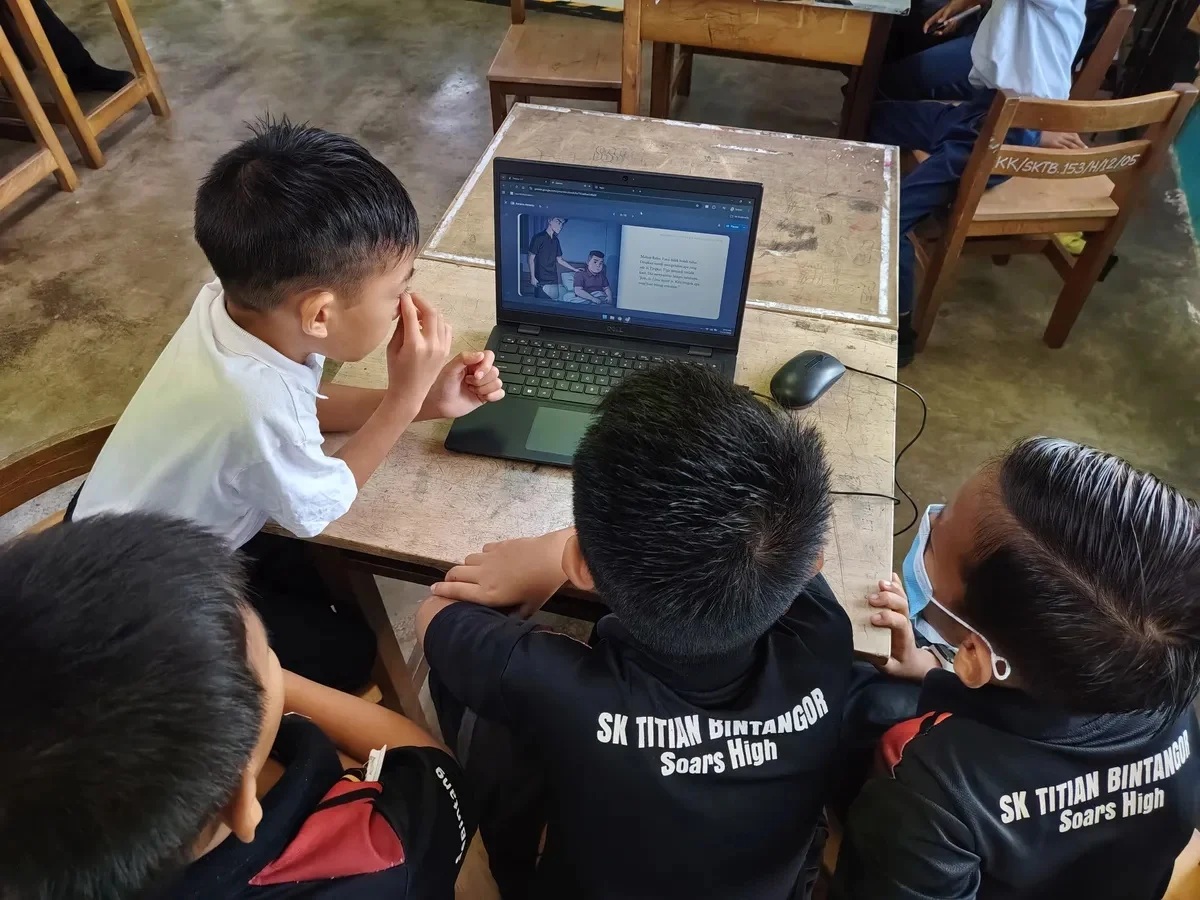
Read Along provides interactive reading exercises and uses AI to help students practise pronunciation while they read aloud. The platform now includes more than 60 Malay-language titles, giving Malaysian students a larger selection of locally relevant reading material.
Interactive comprehension questions are included as well, helping students practise understanding the material rather than simply pronouncing the words correctly.
Students Can Practise Reading at Home
Read Along is not limited to classroom use. Students can also access the mobile application from home and practise reading independently.
The app provides real-time AI-powered pronunciation feedback, helping learners recognise when words may have been pronounced incorrectly and encouraging them to try again.
For younger students, this could complement classroom reading exercises by providing additional opportunities to practise without requiring a teacher or parent to listen continuously.
Teachers and students using Malaysia's DELIMa accounts can access these capabilities as part of Google's education ecosystem.
Bahasa Melayu Support Makes the Tools More Relevant Locally
The availability of more than 60 Malay-language Read Along titles is particularly important because educational AI becomes much more useful when it supports the languages students actually use.
Global AI platforms often begin with stronger English-language capabilities before gradually expanding into other languages. For Malaysia, meaningful Bahasa Melayu support is essential if these technologies are expected to reach students beyond English-focused environments.
Local-language content also helps teachers integrate AI tools more naturally into existing lessons rather than treating them as separate technology demonstrations.
The more closely these platforms align with Malaysian classrooms, the easier it becomes for teachers to use them practically.
AI Could Reduce Some of the Administrative Burden on Teachers
One of the most practical opportunities for generative AI in education may have little to do with replacing classroom instruction.
Teachers spend significant time preparing lesson materials, creating exercises, writing reports, adapting content for different learning levels and communicating with parents. AI can potentially assist with the initial drafting of many of these tasks.
That does not eliminate the need for professional judgement. Teachers still need to review the material, confirm its accuracy and ensure that it suits their students.
But starting with a useful draft rather than a blank page can save meaningful amounts of preparation time.
The Teacher's Role Becomes Even More Important
As AI becomes more capable, the role of educators is unlikely to simply disappear. Instead, teachers may increasingly become responsible for helping students understand how to use these systems critically.
Students need to learn when AI is useful, when its answers should be questioned and how to distinguish genuine understanding from simply generating a response.
That makes teachers particularly important in the transition. AI can provide explanations and generate materials, but educators understand the student, classroom environment, curriculum and broader learning objectives in ways that a general-purpose model does not.
The strongest classroom use of AI will therefore probably involve technology supporting teachers rather than replacing them.
Final Thoughts
Google's launch of the AI Educator Series in Malaysia shows how quickly artificial intelligence is becoming part of mainstream education. With Gemini for Education already being enabled across schools and public universities, simply giving educators access to AI is no longer enough. They also need practical training that helps them understand how to use it effectively.
GES addresses that need through free, self-paced lessons covering everyday teaching activities, AI-assisted content creation and even vibe coding for interactive educational experiences.
Meanwhile, Guided Learning in Google Classroom and the expansion of Read Along provide a glimpse of how AI could increasingly support students directly while keeping teachers involved in selecting materials and monitoring progress.
The most important part of this transition may not be how much AI Malaysian classrooms use.
It will be how well teachers understand the technology, guide its use and ensure that it genuinely improves learning rather than simply adding another digital tool to the classroom.











Comments 0