

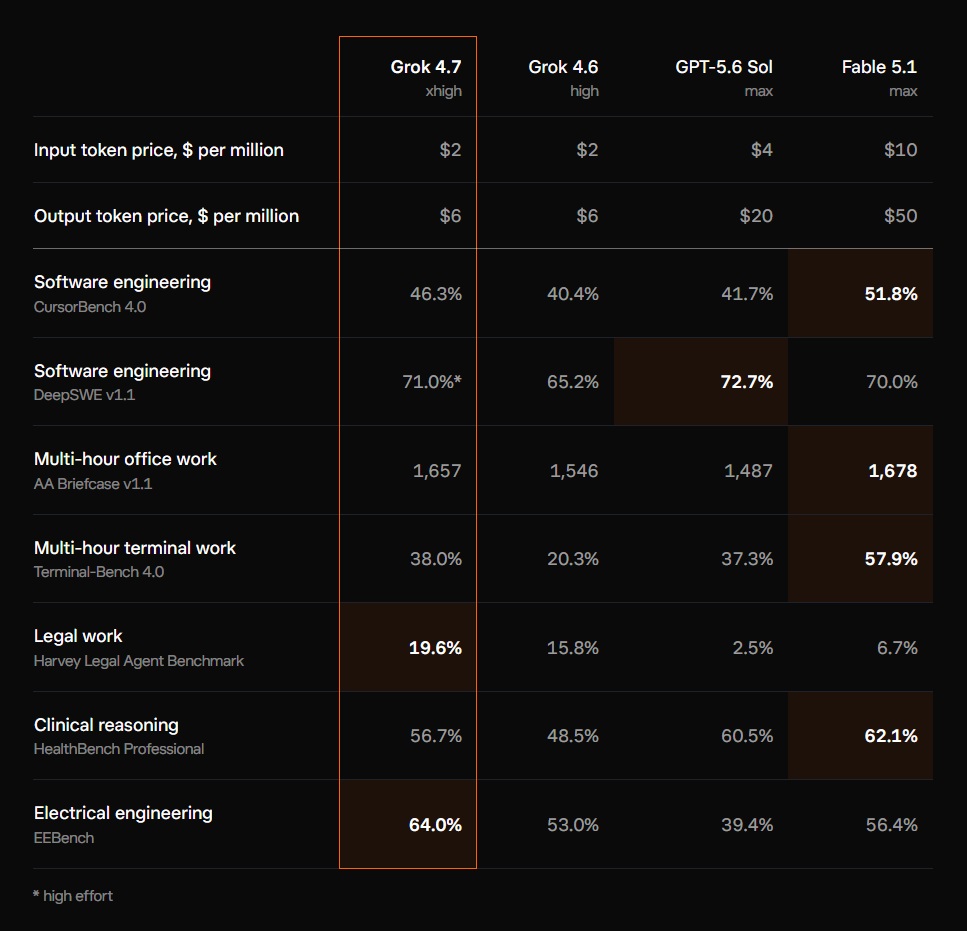
SpaceXAI has introduced Grok 4.7, its latest model aimed primarily at software development and professional knowledge work. The company is positioning the release as its most capable model yet for difficult coding and reasoning tasks, while also emphasising lower operating costs compared with competing systems. Grok 4.7 keeps the same API pricing and execution speed as Grok 4.6, costing US$2 per million input tokens and US$6 per million output tokens.
For organisations that care more about latency than cost, SpaceXAI is also offering a faster variant that generates output at roughly twice the normal speed. That option comes at double the standard price, giving developers a choice between lower operating costs and faster responses depending on the workload.
Built to Spend More Time on Difficult Problems
According to SpaceXAI, Grok 4.7 is designed to work for longer periods on complex tasks, verify its own work more carefully, and operate with stronger safeguards than earlier versions. The underlying model uses an expanded base architecture trained through longer reinforcement-learning runs, with particular attention given to problems that require sustained reasoning across several hours.
This focus is important because modern coding agents increasingly need to do more than generate a short function or fix one isolated bug. They may be expected to inspect a large codebase, reason through dependencies, make multiple changes, test their work, and continue adjusting until the task is complete. SpaceXAI says Grok 4.7 has been trained specifically to handle these longer and more complicated workflows.
The model also includes direct compatibility with the Grok Bot harness, which is intended to improve how it interacts conversationally and handles less structured information in professional environments. This makes the model relevant not only for programming but also for technical analysis and broader enterprise knowledge work.
Coding Benchmarks Show Clear Gains
On CursorBench 4.0, which measures sustained programming tasks, Grok 4.7 achieved a 46.3% success rate at an average cost of US$11.95 per completed task. That places it ahead of Grok 4.6 at 40.4% and GPT-5.6 Sol at 41.7%, although it still trails Fable 5.1 at 51.8%.
The model performed particularly well on DeepSWE v1.1, reaching 71% under high-effort settings. That exceeded Grok 4.6 at 65.2% and narrowly surpassed Fable 5.1 at 70%. On Terminal-Bench 4.0, Grok 4.7 posted 38%, nearly doubling the 20.3% score achieved by the previous generation.
Taken together, the results suggest that Grok 4.7 is not simply improving at short-form code generation. Its stronger performance appears to come from sustained execution, iterative reasoning, and the ability to continue working through complex software-engineering problems over longer sessions.
Professional Knowledge Work Also Improves
SpaceXAI is also targeting fields beyond software development. On the GDPval benchmark, which evaluates professional knowledge tasks, Grok 4.7 achieved an Elo score of 1695. That placed it behind Fable 5.1 at 1735 Elo, but ahead of Grok 4.6 at 1605 and GPT-6 Astra at 1542.
The model also performed strongly on the EEBench electrical engineering evaluation, where it scored 64.0% compared with 39.4% for GPT-5.6 Sol. This suggests that the model's gains may extend into specialised technical reasoning rather than being limited to programming.
Legal tasks showed a similar improvement. On the Harvey Legal Agent Benchmark, Grok 4.7 reached 19.6%, compared with 15.8% for Grok 4.6, 6.7% for Fable 5.1, and 2.5% for GPT-5.6 Sol. While the absolute number still indicates substantial room for improvement, the generational progress is noticeable.
Healthcare Results Are Better, but Not Category-Leading
Clinical knowledge was another area where Grok 4.7 improved over its predecessor. On HealthBench Professional, the model scored 56.7%, up from Grok 4.6's 48.5%.
However, Grok 4.7 did not lead this category. GPT-5.6 Sol scored 60.5%, while Fable 5.1 reached 62.1%. That shows the model's performance profile varies depending on the domain, with stronger results in coding and some technical professional tasks than in clinical evaluation.
This kind of variation matters for organisations choosing models for specialised work. A model that performs exceptionally well on engineering tasks may not necessarily be the strongest choice for legal, healthcare, or other professional environments, so task-specific evaluation remains important.
Security Safeguards Have Been Reworked
SpaceXAI says it has also rebuilt parts of the model's safety architecture to better manage dual-use technical requests. The goal is to allow legitimate scientific and security work while restricting responses that could facilitate harmful activity.
On LatchBio's biological safety benchmark, Grok 4.7 achieved a 62.4% score, which the company says reflects a balance between useful responses to benign queries and refusals for potentially dangerous biological requests. This area is particularly challenging because many legitimate research questions overlap technically with material that could be misused.
Cybersecurity safeguards were tested through HackerBench v0.3, where the model reportedly allowed unauthorised or destructive completions on only 3.3% of risky prompts while still supporting legitimate defensive-security workflows. SpaceXAI has also provided selected cybersecurity partners with restricted, invite-only access to evaluate more advanced red-team capabilities for defensive research.
Lower Token Costs Are Part of the Pitch
One of the most commercially important parts of the Grok 4.7 release is pricing. SpaceXAI is presenting the model as capable of delivering competitive performance at roughly half the operating cost of some rival systems, while keeping the same pricing structure as Grok 4.6.
For teams running coding agents continuously, token costs can become significant very quickly. Large software-engineering tasks may involve huge context windows, repeated tool calls, long chains of reasoning, and many rounds of code inspection and revision. Even relatively small differences in price can therefore have a major impact when the model is deployed across an entire development organisation.
The optional high-speed tier gives customers another trade-off. Teams handling interactive or latency-sensitive workloads can pay more for faster generation, while background coding or analysis jobs can remain on the lower-cost standard tier.
Grok 4.7 Is Already Available Across Developer Platforms
General access to Grok 4.7 has begun across multiple deployment routes. Developers can use the model through the Grok API, third-party model routers, and managed cloud environments.
The model has also been integrated into development environments including Cursor and Grok Build, making it available directly inside coding workflows. Terminal-based installation options are also being distributed through standard shell environments for teams that prefer command-line tooling.
This broad availability suggests SpaceXAI wants Grok 4.7 to compete as an everyday development model rather than remain limited to experimental access. Integration with existing tools lowers the barrier for teams that want to compare it directly against models already used in their software pipelines.
The Bigger Shift Is Toward Longer-Running AI Agents
Perhaps the most interesting part of Grok 4.7 is not one individual benchmark score but the direction of the model itself. The emphasis on multi-hour problems, self-checking, tool integration, and professional workflows reflects a broader shift away from short prompt-and-response AI toward agents capable of working through entire tasks.
Coding is a particularly obvious use case because software development naturally involves repeated cycles of understanding, implementation, testing, debugging, and refinement. Models that can remain coherent over those longer loops become much more useful than systems that simply generate isolated code snippets.
The same idea applies to professional knowledge work. A capable model increasingly needs to handle context over time, revisit earlier assumptions, compare multiple sources of information, and verify its own reasoning before producing a final result.
Final Thoughts
Grok 4.7 appears to be a meaningful step forward for SpaceXAI, particularly in coding and extended technical work. The strongest gains show up in sustained programming benchmarks, terminal-based tasks, and specialised engineering evaluations, suggesting the model has been tuned for longer, more demanding workloads rather than just faster text generation.
Its pricing strategy could be equally important. Keeping standard API costs at US$2 per million input tokens and US$6 per million output tokens gives developers a relatively clear way to experiment with the model without paying a premium simply because capability has increased.
The benchmark results are not universally dominant, and Grok 4.7 still trails competitors in several categories, especially some professional and healthcare evaluations. But the overall direction is clear: SpaceXAI is focusing on models that can stay engaged with difficult work for longer, verify more of their own output, and operate inside real developer tooling.
For organisations evaluating coding agents, that may matter more than winning every individual benchmark. The increasingly important question is not simply how well a model answers one prompt, but how effectively it can keep working until the job is actually finished.











Comments 0