

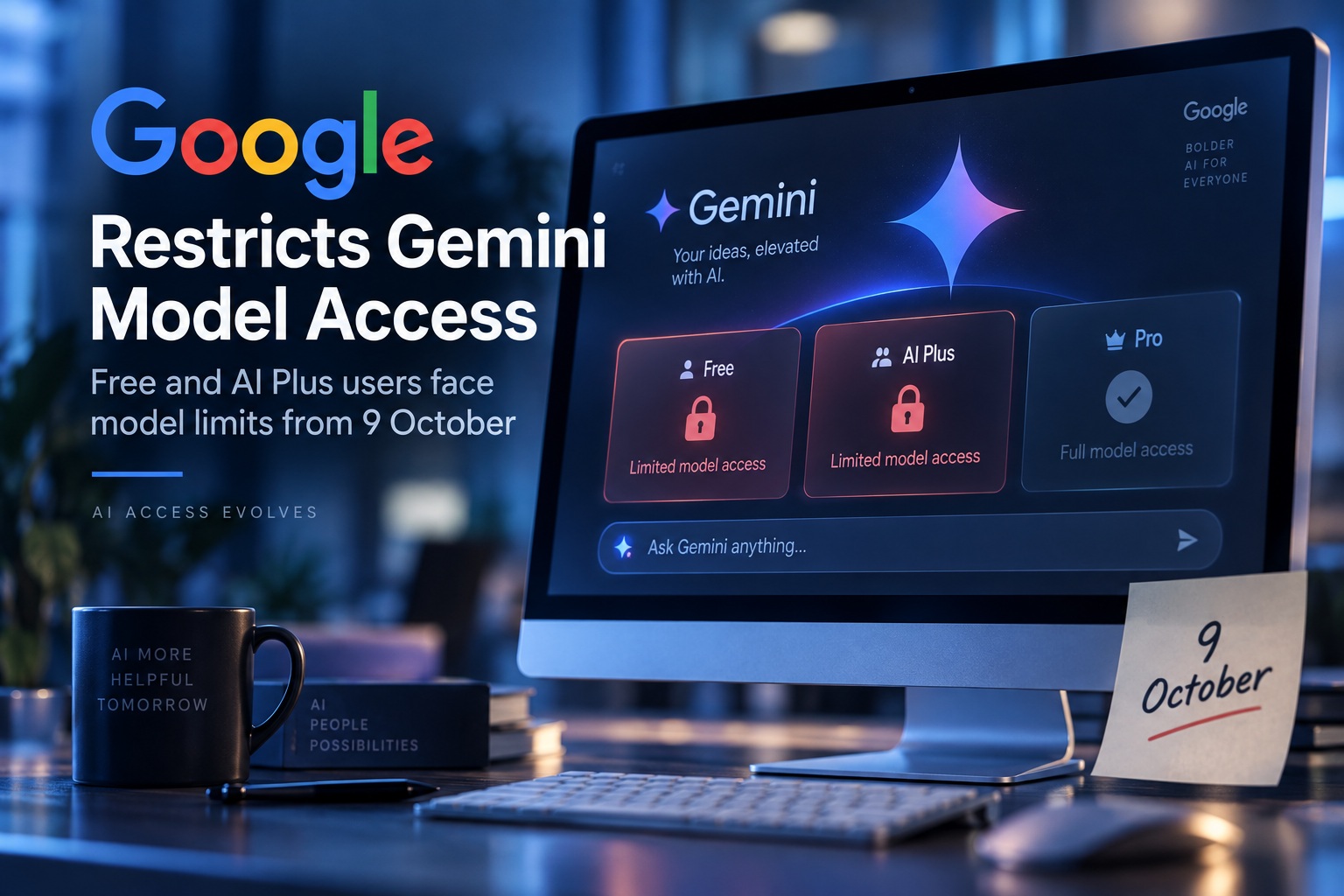
Google is making changes to how different Gemini models are distributed across its subscription tiers, with free users and AI Plus subscribers set to lose access to some of the more capable models. According to a recently published support document, the changes will begin from 9 October and will reduce the number of Gemini models available on the lower tiers. AI Pro and AI Ultra subscribers, however, will continue to receive access to the full model lineup.
The update further separates Google's free and lower-cost AI plans from its more premium subscriptions. Rather than offering the same collection of models with different usage allowances, Google will now restrict certain models entirely based on subscription level. This means the type of Gemini model a user can select will increasingly depend on which AI plan they are paying for.
Free Gemini Users Will Be Limited To Flash-Lite
From 9 October, Gemini users without an AI subscription will lose access to both the Gemini 3.6 Flash and Gemini 3.1 Pro models. Free users will instead be limited to the Gemini 3.5 Flash-Lite model. This makes Flash-Lite the default option for people using Gemini without a paid AI subscription.
The change could be particularly noticeable for users who currently rely on the more capable Pro model for complex tasks or use Flash when they want a faster model with stronger capabilities than Flash-Lite. Once the new restrictions take effect, accessing those models will require moving to one of Google's paid AI subscription plans.
AI Plus Subscribers Will Also Lose Pro Access
The changes are not limited to free Gemini accounts. AI Plus subscribers will also lose access to the Gemini Pro model, leaving them with Gemini 3.5 Flash-Lite and Gemini 3.6 Flash. This means the Pro model will effectively become reserved for Google's higher-tier AI subscriptions.
Google said AI Plus subscribers will receive an email explaining when the changes will take effect for their accounts. However, the company has not provided a single specific transition date covering every AI Plus subscriber. This suggests the restrictions may be introduced gradually depending on account or subscription status.
AI Pro And AI Ultra Keep All Three Models
Users subscribed to AI Pro and AI Ultra will continue to have access to Gemini 3.5 Flash-Lite, Gemini 3.6 Flash and Gemini 3.1 Pro. These plans therefore become the only tiers among those mentioned that retain the complete selection of Gemini models after the changes are implemented.
Google is also adding more advanced reasoning capabilities for these higher-tier subscribers. AI Pro and AI Ultra users will gain access to Deep Think, which Google describes as providing "maximum parallel reasoning". The feature is intended for more demanding tasks where the system benefits from spending additional computational effort exploring multiple reasoning paths.
Model Access And Usage Limits Are Separate
The new restrictions on model availability are separate from Gemini's compute-based usage limits. Google introduced this usage system in May, moving away from a simple structure where users were limited primarily by the number of prompts they submitted. Instead, usage is now influenced by the amount of computing resources required to complete each request.
Several factors can affect how quickly a user consumes their allowance. More complex prompts can require greater processing power, while certain Gemini features may also consume additional resources. Longer conversations can increase usage as well because the model needs to process more context as the chat grows.
Complex Tasks Can Consume Allowances Faster
Under the compute-based system, two users sending the same number of prompts may not necessarily consume the same amount of their allowance. A series of simple questions could require relatively little processing, while fewer complicated requests involving extensive reasoning may use significantly more resources.
This approach gives Google more flexibility in how it manages access to expensive AI workloads. It also means users need to consider not only how frequently they interact with Gemini but also how demanding their tasks are. Those regularly working with lengthy conversations or complex reasoning could therefore reach their usage limits more quickly.
Users Can Choose Different Effort Levels
Google also allows users to select between low, medium and high effort levels for supported Gemini models. These settings control how much computational effort the model applies when handling a request. Higher effort can improve performance for complicated questions and often results in more detailed responses.
The trade-off is that higher effort levels consume more of the user's available compute allowance. For straightforward requests, lower effort may therefore be more efficient, while higher settings can be reserved for tasks that genuinely require additional reasoning. This gives users some control over the balance between response quality and usage consumption.
A Clearer Divide Between Gemini Subscription Tiers
The latest changes create a more defined distinction between Google's Gemini plans. Free users will receive access only to Flash-Lite, while AI Plus subscribers retain Flash alongside Flash-Lite but lose the Pro model. AI Pro and AI Ultra subscribers remain at the top of the lineup with access to all three models and Deep Think.
This means choosing a Gemini subscription will increasingly involve more than simply deciding how much usage capacity is required. Model availability itself is becoming an important differentiator, particularly for users who depend on Pro for more demanding work. Google is effectively positioning its strongest capabilities as benefits reserved for higher subscription tiers.
Final Thoughts
Google's decision to restrict Gemini model access from 9 October represents a significant change for both free users and AI Plus subscribers. Free accounts will be limited to Gemini 3.5 Flash-Lite, while AI Plus customers will retain Flash and Flash-Lite but lose access to Gemini 3.1 Pro. AI Pro and AI Ultra subscribers, meanwhile, will continue receiving the full model selection together with access to Deep Think.
Combined with Google's existing compute-based usage limits and selectable effort levels, the Gemini ecosystem is becoming increasingly structured around both capability and resource consumption. For casual users, Flash-Lite may remain sufficient, but anyone depending on Gemini's more advanced models will increasingly need to consider one of Google's higher-tier subscriptions.











Comments 0