

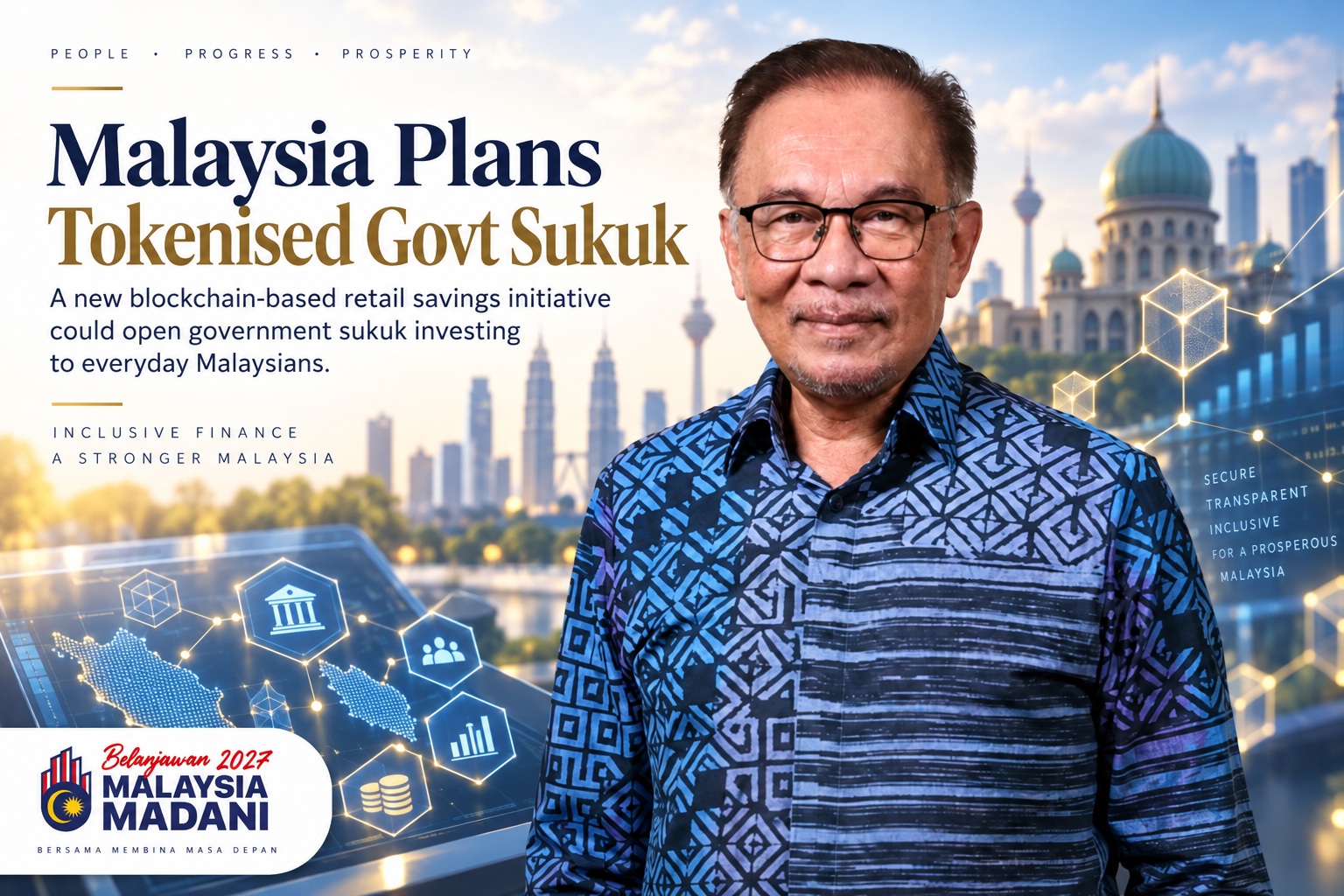
Malaysia is preparing to open a new investment avenue for individual investors through a proposed tokenised government sukuk initiative. Prime Minister and Finance Minister Datuk Seri Anwar Ibrahim announced the plan during the tabling of Budget 2027 on 9 October, signalling another step towards integrating blockchain technology into Malaysia's Islamic capital market.
Unlike earlier tokenised sukuk initiatives that primarily involved institutional investors, the new programme is intended for retail participation. Investors will also be able to choose which public-sector area their investment supports, with the government highlighting education, healthcare and social protection for lower-income groups as potential options.
Tokenised Sukuk Opens Government Investment To Retail Investors
The proposed initiative would allow ordinary Malaysians to invest in government sukuk through a blockchain-based structure. Sukuk are Shariah-compliant investment instruments that provide investors with returns linked to underlying assets or financing arrangements rather than conventional interest-bearing debt.
Tokenisation represents the sukuk digitally on a blockchain or distributed ledger. In practice, this could eventually make issuance, ownership records and transactions more digitally integrated, although the government has not yet disclosed the exact technical structure of the retail programme.
The initiative therefore combines an established Islamic finance product with newer financial technology. Its significance lies less in replacing traditional sukuk and more in providing another mechanism through which retail investors may eventually participate.
Investors Can Choose Which Social Sector Their Funds Support
One of the more distinctive features announced under Budget 2027 is the ability for investors to choose the area they want their funds to support. The options mentioned include education, healthcare and social protection programmes for lower-income communities.
This gives the proposed sukuk an element of purpose-based investing. Rather than simply buying a government security without knowing which broad area it contributes towards, investors could potentially align their investment with a social priority they personally value.
The exact mechanics have not yet been announced, so it remains unclear whether each category will be represented by separate sukuk issuances or through another allocation structure. More details will likely be required before retail subscriptions begin.
Malaysia Has Already Tested Tokenised Sukuk With Institutional Investors
The Budget 2027 announcement builds on earlier tokenisation initiatives already carried out within Malaysia's capital market. In April, Khazanah Nasional priced a RM100 million tokenised sukuk in collaboration with the Securities Commission Malaysia.
That transaction formed part of a pilot involving institutional investors rather than the general public. The sukuk was completed in May, with V Systems acting as the technology platform provider.
The exercise demonstrated that tokenised securities could be issued and managed within Malaysia's financial ecosystem. The new retail initiative appears to take that experimentation a step further by exploring how similar technology could be made accessible to individual investors.
CIMB Also Tested Tokenised Settlement
Another important pilot took place in August, when CIMB completed a transaction involving tokenised deposits used to settle RM1.38 billion worth of tokenised sukuk.
This showed how tokenisation could potentially extend beyond the investment instrument itself. Digital deposits can also be used as part of the settlement process, creating a more integrated digital environment for issuing and completing securities transactions.
Together, the Khazanah and CIMB pilots provide some practical background for the government's latest retail proposal. Malaysia is therefore not starting entirely from scratch when exploring tokenised sukuk for individuals.
What Tokenisation Could Change
Traditional sukuk ownership and settlement already operate through established financial infrastructure, so blockchain does not automatically make the underlying investment fundamentally different. The potential benefit lies in how ownership, transactions and settlement can be represented digitally.
Tokenisation could potentially make smaller investment denominations easier to manage, streamline settlement processes or enable more direct digital participation. Whether those advantages will apply to Malaysia's retail government sukuk will depend on how the final scheme is designed.
The government has not yet explained which blockchain infrastructure will be used, how investors will access the product or whether participation will require a dedicated platform or existing financial applications.
Several Important Details Are Still Missing
Budget 2027 confirmed the direction of the initiative but did not provide several details retail investors will ultimately need before deciding whether to participate. No official launch date has been announced, and the government has not disclosed the minimum investment amount.
Expected returns have also not been revealed. This will be particularly important because retail investors will need to compare the sukuk with alternatives such as fixed deposits, unit trusts, conventional government securities or other Shariah-compliant investments.
Details surrounding investment tenure, liquidity, redemption and eligibility have also not yet been specified. Until those terms are announced, the programme should be viewed as a planned initiative rather than an investment product that Malaysians can already purchase.
Could Make Government Sukuk More Accessible
If implemented with relatively low minimum investment requirements, the programme could broaden participation in government sukuk beyond institutions and higher-value investors. Retail accessibility would allow more Malaysians to gain exposure to government-backed Islamic investment instruments.
The ability to select areas such as education or healthcare may also appeal to investors interested in combining financial returns with measurable social outcomes. That element could make the initiative more engaging than a conventional savings product, particularly if the government clearly explains how the funds are allocated.
However, ease of access will depend heavily on the eventual digital platform and how simple the onboarding and investment process becomes.
Part Of Malaysia's Wider Digital Finance Push
The proposal also reflects Malaysia's broader interest in applying blockchain and tokenisation within regulated financial markets. Rather than treating tokenised assets solely as cryptocurrency-related products, financial institutions are increasingly exploring distributed ledger technology for conventional securities, deposits and settlement.
Malaysia's previous institutional pilots suggest that regulators and major financial institutions are already testing how this infrastructure can operate within existing rules. Extending the concept to retail investors would represent a more visible next phase.
The challenge will be making the technology largely invisible to ordinary users. Retail investors are unlikely to care about the blockchain itself if the product is difficult to understand or cumbersome to use. The investment experience, transparency and returns will ultimately matter more than the underlying technology.
Final Thoughts
Malaysia's planned tokenised government sukuk could become one of the more interesting retail investment initiatives announced under Budget 2027. By combining government sukuk with blockchain-based tokenisation and allowing investors to direct their funds towards areas such as education, healthcare or social protection, the programme introduces both digital innovation and a stronger social-investment element.
Malaysia already has experience with institutional tokenised sukuk through the RM100 million Khazanah pilot and CIMB's RM1.38 billion tokenised settlement exercise. The next challenge is translating that infrastructure into something practical for everyday investors. With no launch date, minimum investment or expected return announced yet, the real appeal of the programme will become clearer once the government releases its full terms.











Comments 0