

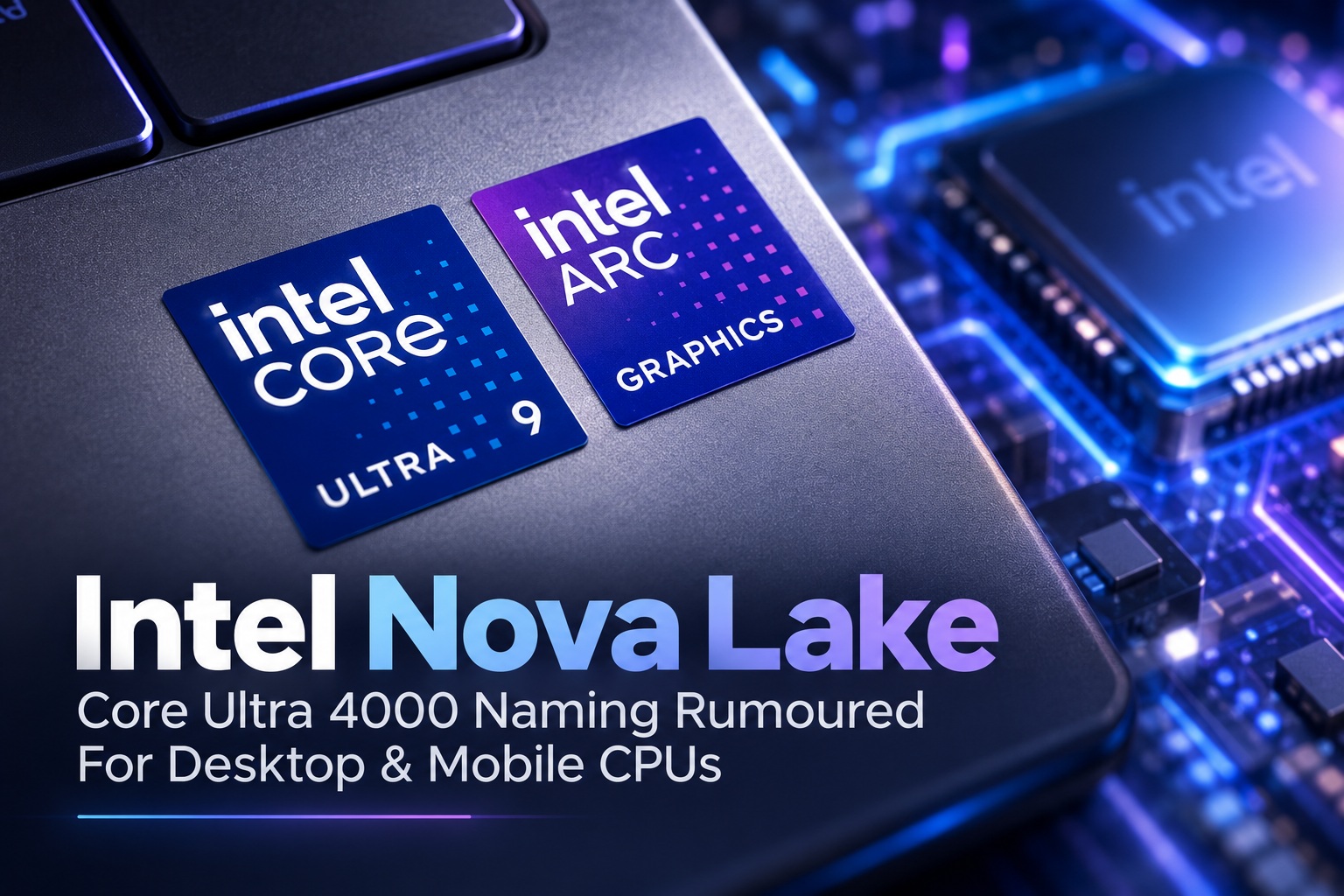
Intel's upcoming Nova Lake processor family may be getting a more unified naming structure than previously expected. Earlier rumours suggested that the Core Ultra 4000 Series branding would apply mainly to desktop processors and higher-performance mobile chips, but a newer leak claims the naming convention could extend across the entire Nova Lake mobile lineup as well.
If accurate, this would mean Intel plans to use the Core Ultra 4000 branding consistently across desktop, high-performance mobile and lower-power notebook processors. While the change may seem minor on the surface, it gives us a clearer picture of how Intel could organise one of its most important future CPU generations.
Core Ultra 4000 Could Cover The Entire Nova Lake Family
The latest information comes from serial hardware leaker Jaykihn, who stated on 16 October that both H-Series and suffix-less Nova Lake mobile processors are expected to carry the Core Ultra 4000 Series designation.
That expands on previous reports suggesting that the branding would mainly cover Nova Lake desktop chips and high-end mobile processors.
If the rumour proves correct, Intel could use the same naming structure across:
• Nova Lake-S desktop processors
• Nova Lake-P mobile processors
• Nova Lake-U mobile processors
• Nova Lake-UL low-power processors
• H-Series performance notebooks
• Other suffix-less mobile configurations
This would give the generation a much more consistent naming convention than some of Intel's recent CPU lineups.
Intel May Be Returning To Four-Digit Model Numbers
One of the more interesting aspects of the rumour is Intel's reported return to four-digit CPU model numbers.
That style feels surprisingly old-school.
Long-time PC enthusiasts may remember processors such as the Core i7-2600K from Sandy Bridge, Core i7-3770K from Ivy Bridge and Core i7-4770K from Haswell.
Intel continued using broadly similar four-digit naming for several generations before eventually moving towards five-digit product numbers.
Nova Lake could bring that simpler structure back.
The Naming Style Feels Like Classic Intel
For many years, Intel's processor names were relatively easy to understand.
The first digit or digits generally indicated the generation, while the remaining numbers positioned the processor within the lineup.
That familiar system lasted through architectures such as:
• Sandy Bridge
• Ivy Bridge
• Haswell
• Broadwell
• Skylake
• Kaby Lake
• Coffee Lake
By the time Intel reached later generations, model numbers had become increasingly complicated.
The move towards Core Ultra branding simplified some things while also introducing another naming transition.
A Core Ultra 4000 structure could bring back some of the familiarity of Intel's older naming schemes.
Nova Lake-S Desktop Names Have Already Started Leaking
Several alleged Nova Lake-S desktop processors have already appeared in leaks.
Reported examples include:
• Core Ultra 9 4970K BFC
• Core Ultra 9 4950K
• Core Ultra 7 4870K BFC
If those names are accurate, the first digit would clearly identify the Core Ultra 4000 generation while the remaining numbers distinguish different performance tiers.
The familiar K suffix also appears to remain, indicating unlocked desktop processors.
Intel users who have followed the company's processors for years should therefore find at least part of the naming structure very familiar.
What Does BFC Mean?
One unusual new suffix appearing in the leaks is BFC.
This is reportedly Intel's branding for processors equipped with what had previously been referred to as bLLC, or big Last Level Cache.
In other words, certain Nova Lake CPUs may feature substantially larger cache configurations.
This is conceptually similar to how additional cache has become an increasingly important performance differentiator across modern processors, particularly for gaming.
AMD has already demonstrated the advantages of large cache configurations through its X3D processors, so it would not be surprising to see Intel place more marketing emphasis on cache-heavy models.
Big Last Level Cache Could Become A Major Nova Lake Feature
Processor performance is no longer determined purely by clock speeds or core counts.
Cache capacity can have a major effect on workloads where the processor repeatedly accesses the same data.
Gaming is one of the most obvious examples.
A larger last-level cache can reduce how frequently the CPU needs to access slower system memory, improving latency and potentially increasing performance.
If Intel's BFC models genuinely feature significantly larger cache pools, they could become some of the most interesting Nova Lake processors for enthusiast gamers.
Not Every Nova Lake CPU May Get BFC
The leaked model names also suggest that BFC may not be standard across the lineup.
For example, the alleged Core Ultra 9 4970K BFC carries the designation, while another rumoured model, the Core Ultra 9 4950K, apparently does not.
That could mean Intel plans to create distinct cache-enhanced variants alongside conventional processors.
Such segmentation would allow Intel to target different performance and pricing levels without requiring completely separate architectures.
It could also give buyers another specification to consider beyond core count and clock speed.
Nova Lake May Bring Huge Core Counts
Naming may not be the most exciting part of Nova Lake.
The upcoming architecture has also been associated with rumours of processors featuring extraordinarily high core counts.
At least one Nova Lake configuration is expected to reach as many as 52 cores.
If that figure proves accurate, it would represent a substantial leap in mainstream desktop CPU complexity.
The final configuration will likely involve different types of cores rather than 52 identical high-performance cores, but even so, the number is remarkable.
Hybrid Architecture Will Likely Remain Central
Intel has relied heavily on hybrid CPU designs in recent generations.
Rather than using only one type of CPU core, Intel combines higher-performance P-cores with efficiency-focused E-cores.
Future Nova Lake processors are expected to continue evolving this approach.
That means a theoretical 52-core processor would almost certainly distribute those cores across different architectural categories.
The exact configuration remains unconfirmed, but the architecture could allow Intel to dramatically increase multi-threaded performance without making every core equally large or power-hungry.
Nova Lake-P Could Target Premium Laptops
Nova Lake-P is expected to cover higher-performance mobile processors.
These chips would likely appear in premium laptops designed for gaming, content creation and demanding productivity workloads.
Bringing the Core Ultra 4000 name to Nova Lake-P makes sense because Intel could then maintain one clearly identifiable generation across both desktops and notebooks.
A buyer comparing a Core Ultra 9 desktop CPU with a Core Ultra 9 laptop processor would immediately understand that both belong to the same broader architectural generation.
Nova Lake-U Could Focus More On Efficiency
Nova Lake-U is expected to target more power-efficient notebooks.
These processors would likely appear in thinner laptops where battery life, thermals and portability matter more than maximum sustained performance.
Using the Core Ultra 4000 designation here as well would reinforce Intel's apparent move towards one consistent branding system.
That could be particularly helpful for ordinary buyers who have struggled to understand Intel's increasingly complicated mobile CPU naming over the last few years.
Nova Lake-UL May Push Into Even Lower-Power Systems
Nova Lake-UL is expected to represent another lower-power segment.
While exact positioning remains uncertain, such chips would presumably target compact notebooks and systems designed around efficiency.
Again, the important part of the latest rumour is that Intel apparently does not plan to create an entirely different naming family for these processors.
Instead, Core Ultra 4000 would act as the common umbrella across all of them.
That consistency is arguably more important than the individual suffixes.
Intel's Current Naming Has Been Confusing
Intel has changed its branding several times over recent years.
Consumers have had to adapt from familiar Core i3, i5, i7 and i9 generations towards Core and Core Ultra branding, while mobile chips have also used a variety of suffixes.
The architecture names do not always align cleanly with the product numbers either.
That makes buying a laptop particularly confusing because two processors carrying superficially similar names can have very different architectures and performance characteristics.
A cleaner Core Ultra 4000 structure across Nova Lake could help reduce some of that confusion.
The Four-Digit Structure Could Be Easier To Understand
A processor called Core Ultra 9 4970K immediately looks like part of the same family as a hypothetical Core Ultra 7 4870 or Core Ultra 5 4650.
That is easier to mentally organise than having several different numbering systems across desktop and mobile.
Intel would still need to communicate what suffixes such as K, H, U, UL and BFC mean.
But at least the generation itself would remain clearly identifiable.
For enthusiasts, that may sound trivial.
For ordinary consumers comparing dozens of laptop specifications, it could make a real difference.
Nova Lake Is Expected To Be A Major Architecture
The amount of discussion surrounding Nova Lake suggests it will be more than a routine CPU refresh.
Intel is expected to make substantial architectural changes, potentially involving new cores, much larger cache configurations and significantly higher total core counts.
That makes the naming strategy particularly important.
If Intel plans to maintain Nova Lake across several desktop and mobile product families, having one coherent naming structure should make the generation easier to market.
It also simplifies comparisons across devices.
BFC Could Become Intel's Answer To Cache-Focused Gaming CPUs
The reported BFC branding may become one of the most interesting elements of the lineup.
AMD's X3D processors have demonstrated that large cache configurations can provide exceptional gaming performance without simply increasing clocks or power consumption.
Intel may be looking for its own way to market processors designed around similar priorities.
A Core Ultra 9 4970K BFC could therefore become a specialised enthusiast product focused heavily on gaming or latency-sensitive workloads.
Exactly how much extra cache Intel plans to provide remains unknown.
Pricing Could Become Complicated
If Intel introduces conventional and BFC versions alongside several desktop and mobile classes, the Nova Lake lineup could still become complicated despite the simplified naming.
Buyers may need to compare:
• Core Ultra 5, 7 and 9 tiers
• Desktop and mobile variants
• Different core configurations
• BFC cache-enhanced models
• Unlocked K processors
• H, U, P and UL mobile classes
So while the four-digit numbering may help, product segmentation could remain extensive.
Intel will need to communicate the differences clearly when the lineup finally launches.
Competition With AMD Will Remain Intense
Nova Lake will arrive into a CPU market where AMD continues to compete aggressively across both desktop and mobile systems.
AMD's Ryzen X3D chips remain especially strong in gaming, while its mobile processors continue improving integrated graphics and efficiency.
Intel therefore needs more than a naming refresh.
Nova Lake will need meaningful improvements in performance, power efficiency and platform capabilities.
Larger cache configurations and higher core counts could be part of that strategy.
Mobile Competition Is Becoming Much Broader Too
Intel is no longer competing only with AMD in laptops.
Qualcomm's Snapdragon processors have brought Arm-based Windows laptops into the mainstream, while NVIDIA is also expanding further into Arm-based PC platforms.
Apple continues setting high expectations for performance-per-watt with its own Arm silicon.
That puts additional pressure on Nova Lake mobile processors.
Intel needs the platform to deliver strong performance while remaining competitive in battery life and efficiency.
A unified naming structure may help marketing, but the underlying silicon still needs to perform.
Core Ultra Branding Is Clearly Here To Stay
One thing the rumours strongly suggest is that Intel remains committed to its Core Ultra branding.
The company moved away from the traditional Core i-series naming with its newer architectures, and Nova Lake appears likely to continue that strategy.
Core Ultra 4000 would therefore represent another major generation within Intel's redesigned product branding.
The naming may become more familiar over time as consumers see several generations use the same structure.
That consistency could eventually solve some of the confusion created during the transition away from the older Core i branding.
Nothing Has Been Officially Confirmed
It is important to remember that Intel has not officially announced the Nova Lake processor lineup.
The names, model numbers, BFC branding and 52-core configurations remain based on leaks and rumours.
Intel could still adjust product names before launch.
Individual SKUs may also change or disappear entirely before retail availability.
That is normal for hardware still under development.
For now, the information provides an interesting picture of Intel's possible plans rather than a confirmed product list.
Final Thoughts
The latest Nova Lake rumours suggest Intel may use the Core Ultra 4000 Series branding across its entire next-generation desktop and mobile CPU family, rather than limiting the designation to desktop and high-performance notebook processors.
If accurate, Nova Lake-S, Nova Lake-P, Nova Lake-U and Nova Lake-UL processors could all adopt familiar four-digit model numbers, bringing Intel's naming scheme somewhat closer to the style used during the Sandy Bridge, Ivy Bridge, Haswell and Coffee Lake eras.
The leaked names also introduce BFC, apparently Intel's branding for processors with significantly larger last-level cache configurations. Combined with rumours of a Nova Lake processor featuring as many as 52 cores, the upcoming generation could bring much more than a simple naming refresh.
For now, though, everything remains unofficial.
Intel has yet to properly reveal Nova Lake, so the exact product stack may still change. But if the latest information is correct, at least one part of the next generation could become easier to understand: whether you are buying a desktop or laptop, Core Ultra 4000 may be the name to look for.











Comments 0