

If you've been following the Malaysia–Singapore border tech updates lately, you've probably seen three names floating around that sound like they do the exact same thing: MyBorderPass, MyNIISe, and MyDigital ID. Add QR code autogates into the mix, and it's easy to assume the government built three "passport apps" that overlap.
So Malaysia's Immigration Department stepped in to clear the air: these are not duplicates. They're different layers of the same transition plan.
Think of it like a renovation while the building is still open
Immigration's explanation basically boils down to this:
They're upgrading the entire immigration "backend" and passenger flow system, but they can't shut down the border to rebuild everything. So they're rolling things out in phases, keeping the older setup running, while introducing newer parts in controlled locations.
That's why you're seeing multiple apps at the same time.
MyNIISe is the long-term "main system"
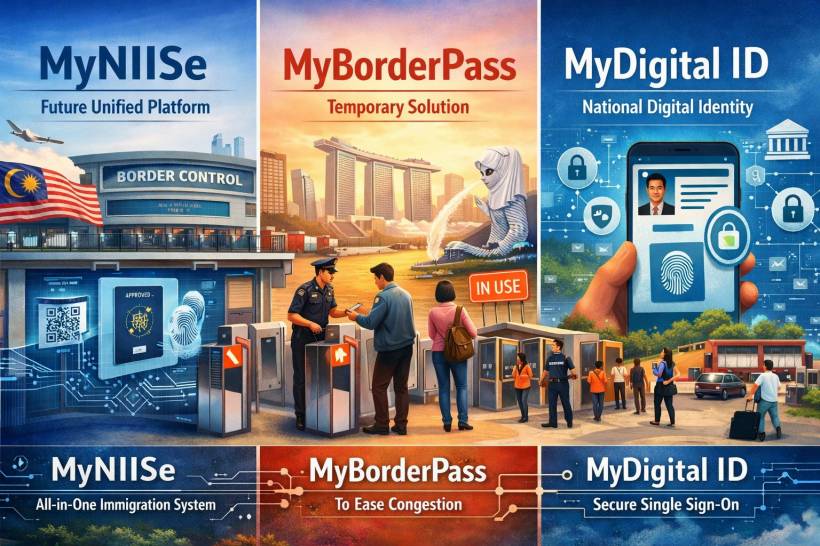
MyNIISe (linked to the National Integrated Immigration System project) is positioned as the future single platform for immigration-related services. The goal is to eventually consolidate immigration functions into one unified ecosystem and gradually replace legacy systems without disrupting current operations.
Right now, it's being supported in specific pilot locations first, including the Johor land checkpoints like Bangunan Sultan Iskandar (BSI) and Kompleks Sultan Abu Bakar (KSAB), and its use has been described as optional during the transition period.
In plain terms: MyNIISe is the destination.
MyBorderPass is the temporary "keep things moving" tool
MyBorderPass is not the endgame. Immigration describes it as a tactical, proof-of-concept solution introduced earlier (launched in 2024) to reduce congestion at major entry points while the larger MyNIISe platform is still being completed and integrated.
So if MyNIISe is the full renovation plan, MyBorderPass is the temporary walkway built so people can still enter the building without chaos.
And yes, Immigration's message is that once MyNIISe is fully rolled out, MyBorderPass is expected to be phased out or replaced by the newer system.
MyDigital ID is not an immigration clearance app
This is the big misunderstanding.
MyDigital ID is not meant to be "your immigration QR" or "another autogate app." Immigration describes it as a national digital identity platform that provides secure identity verification and single sign-on access across government services, including logging into systems like MyNIISe.
So MyDigital ID is more like the door keycard that proves you are you, while MyNIISe is the actual immigration service you're trying to use.
How they connect at the QR autogates
Here's the easiest way to map the roles:
This is also why Immigration pushed back against "duplication" claims: they see it as staged rollout, not three competing products.
Why not just wait and launch one app later?
Because borders don't get to pause.
Immigration's argument is operational continuity: the border has peak-hour pressure, daily commuters, safety requirements, and real-time constraints. If the final integrated system isn't fully ready everywhere yet, you still need something that works now to keep queues from exploding while integration continues.
So the "multi-app era" is basically a transitional compromise: not pretty, but practical.
What's next: more automation, smarter processing
Immigration also signaled that improvements won't stop at QR gates and app consolidation. They've talked about continuing upgrades and adopting AI to improve efficiency and user experience at entry points (think faster processing, better flow management, and smoother operations during peak surges).
Quick recap you can actually remember
The future all-in-one immigration platform meant to unify immigration services over time.
A temporary, 2024 proof-of-concept tool to reduce congestion while MyNIISe is still being finalized and integrated.
National digital identity and single sign-on for government services (including access to MyNIISe), not an immigration clearance app by itself.











Comments 0