

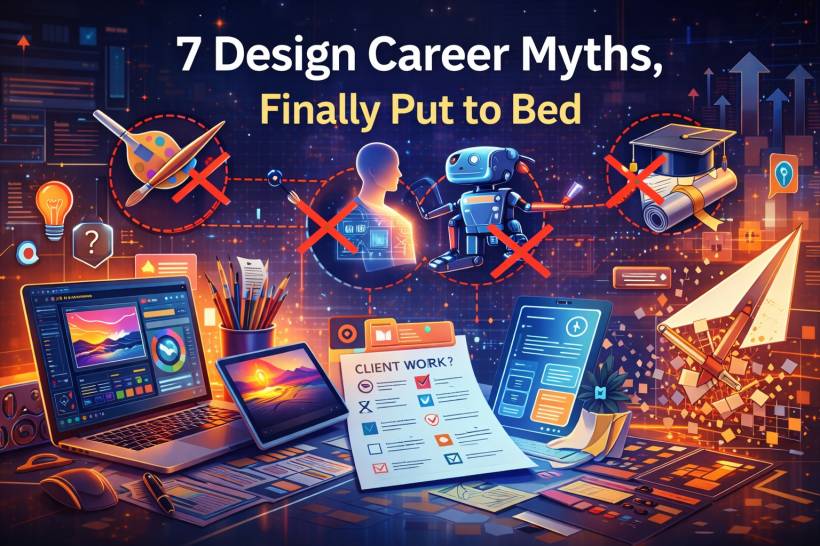
If you have ever googled "how to become a designer" or watched a few career videos, you have probably heard the same advice repeated over and over. Some of it is helpful. Some of it is outdated. And some of it is the kind of thing that sounds inspirational… but quietly makes beginners feel like they're already behind.
The creative industry is moving fast right now. AI tools are everywhere, clients expect faster turnaround, and there are more ways than ever to learn design without following the old "degree → junior job → agency ladder" path. So let's clear the air. Here are seven common design career myths, what's actually true, and how to think about your next move in a way that feels practical instead of intimidating.
Myth 1: "There's no future in art. AI is replacing designers."
AI is changing the industry, yes. But "AI replaces designers" is the lazy headline version of what's happening. In the real world, AI is being used like a power tool. It speeds up parts of the workflow and expands what's possible, especially for:
• Mockup variations
• Copy suggestions and layout experiments
• Background cleanup, resizing, and repetitive production work
The creative part you bring is still the thing that matters most: taste, judgment, storytelling, and knowing what a brand or audience actually needs. A useful mindset is this: AI is not your competitor. A designer who knows how to use AI well is your competitor. Learn it like you would learn any new tool and it becomes an advantage, not a threat.
Myth 2: "You need a unique style to succeed."
A personal style is nice. It is not a requirement, and depending on your path, it might even be a limitation early on.
If you work in an agency or any place that serves different clients, you are expected to adapt. One week you might be designing clean corporate slides. Next week you're creating a playful social campaign. After that, it's a serious healthcare brochure or a minimalist tech landing page. What employers and clients really want is this:
Your "style" often shows up naturally over time anyway, once you've done enough projects to develop preferences, instincts, and a signature approach. You do not need to force it in year one.
Myth 3: "Your portfolio must be full of real client work."
This myth stops so many people from starting. A portfolio is not a trophy case. It is proof of skill. That proof can come from:
• Fictional clients
• Redesign projects
• Personal experiments
• Small projects for friends, clubs, or local businesses
Hiring managers and clients are not only looking for brand names. They want to see how you think and how you solve problems visually.
If you want to make a "non-client" project look professional, treat it like real work:
When your portfolio communicates your process, it instantly feels more legitimate. And yes, practice work often becomes real work. It builds confidence, and confidence brings opportunities.
Myth 4: "Designers must be able to draw."
It depends on the design field, but for most modern graphic design roles, drawing is not a requirement.If you can sketch, it helps. It can be useful for brainstorming, planning layouts, or explaining an idea quickly. But graphic design is not primarily about illustration skill.
Graphic design is about visual communication:
• Typography: readability and tone
• Spacing and structure: clarity
• Color: mood and emphasis
• Composition: guiding attention
• Storytelling: making the message land
With tools like Photoshop, Illustrator, Figma, and InDesign, your job is to build strong layouts and visuals, not to prove you can draw characters by hand.
Myth 5: "You need a design degree to get hired."
A degree can help, but it is no longer the only doorway into the industry. Many teams care less about certificates and more about:
• Tool competence
• Communication and collaboration
• Ability to take feedback
• Consistency and reliability
Design is a results-based field. If your portfolio clearly shows you can solve problems and deliver clean work, you can be taken seriously even if you are self-taught. That said, structure matters. A degree is one form of structure. A course, mentorship, or a self-made curriculum can be another. The goal is the same: build fundamentals, practice regularly, and finish projects that demonstrate skill.
Myth 6: "A good designer knows every tool and every feature."
This is a trap, and it causes burnout. Tools change constantly. Features come and go. New plugins show up every week. If your self-worth depends on keeping up with everything, you will always feel behind. Employers and clients care about the outcome, not your shortcut keys.
The strongest designers are not the ones who know every feature. They are the ones who can:
• Make choices that are clear and consistent
• Communicate ideas simply
• Deliver something that looks good and works well
Learn tools as needed. Start with the core features and strengthen your fundamentals. When you hit a real project problem, then learn the specific tool or technique that solves it.
Myth 7: "You must always follow design rules."
Design "rules" are better understood as guidelines that usually work. They exist because they help you create clarity:
• Contrast helps key information stand out
• Consistency helps people trust what they're seeing
• Composition helps guide attention
But great design is not a checklist. If you understand the rules, you can bend or break them intentionally to create something more surprising, expressive, or memorable. The key word is intentionally. Randomly breaking rules creates confusion. Breaking rules with purpose creates style.
Final Thoughts
If there is one thing worth taking away from all of this, it is that design careers are built through momentum, not perfection. You do not need to out-style everyone, out-tool everyone, or have a perfect client list to begin. You need to build real skills, finish projects, and show your thinking clearly. The industry is changing, but that can actually work in your favor. The path is more flexible than it used to be, and the designers who thrive are usually the ones who stay curious, adapt quickly, and keep creating even when they feel "not ready yet."











Comments 0