

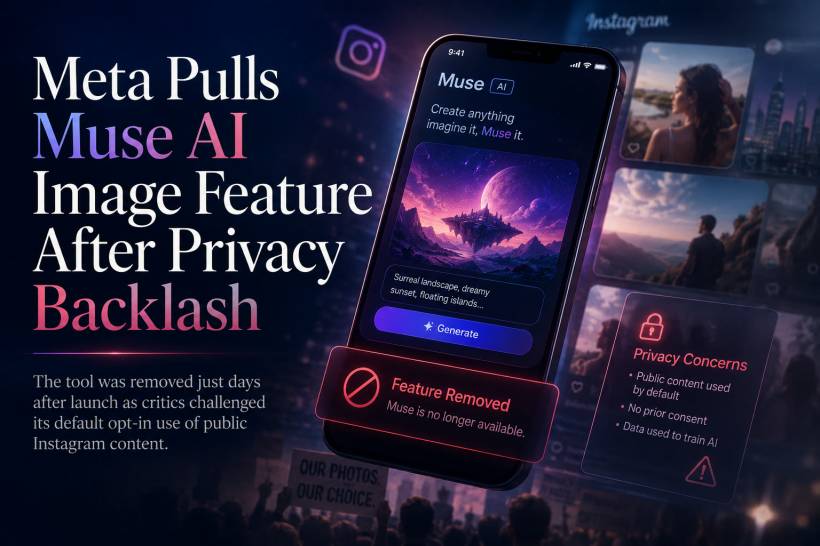
Meta has withdrawn a newly introduced Muse Image feature that allowed artificial intelligence tools to reference content from public Instagram accounts when generating images. The feature disappeared only days after launch following criticism from users, performers and industry representatives who argued that publicly visible photographs should not automatically be made available for AI-assisted image creation.
Meta acknowledged that the rollout had not matched what users expected from the platform. The company said its original intention was to offer a creative tool while allowing people to control whether their public content could be referenced, but accepted that the implementation had caused concern.
A Creative Feature That Quickly Became a Privacy Controversy
Muse Image was introduced as part of Meta's growing collection of generative AI tools across Instagram, WhatsApp and Meta AI.
The technology could create or modify images using written prompts, uploaded photographs and sketches. It was also connected to more than 30 AI-powered effects for Instagram Stories, giving users additional ways to transform images and produce stylised content.
However, the controversy was not mainly about what the model could create. The larger issue was how Meta planned to use content already posted publicly on Instagram.
Many users became concerned that their photographs, artwork or personal images could be referenced by the AI feature without them first giving clear and active permission.
Although Meta provided an option to disable the feature, it was reportedly activated by default. Users were therefore expected to opt out rather than being asked whether they wished to participate.
That distinction became central to the backlash.
Why Default Opt-In Settings Matter
An opt-in system requires users to make a deliberate choice before their content becomes available for a particular feature.
An opt-out system works in the opposite direction. Participation is enabled automatically, and users must locate the relevant setting if they do not want to be included.
For ordinary platform features, this difference can already create confusion. When artificial intelligence and personal likenesses are involved, the consequences can feel far more significant.
Users may post images publicly so that friends, followers or potential customers can view them. That does not necessarily mean they expect those same images to be referenced by an AI generator.
The controversy therefore highlighted an important difference between content being publicly visible and content being available for automated reuse.
Public Content Is Not the Same as Explicit Consent
Social media platforms have often relied on the idea that public posts can be discovered, shared or recommended more widely.
Generative AI introduces a more complicated situation.
An AI system may be able to study, reference or transform an image in ways the original user never anticipated. A photograph uploaded for a personal update could potentially contribute to a generated image, altered likeness or synthetic scene.
This becomes especially sensitive when the image includes a recognisable person.
Public availability does not automatically answer questions about consent, context or acceptable reuse. Users may be comfortable with others viewing a photograph while strongly objecting to that same photograph being used as material for AI-generated content.
Meta's decision to remove the feature shows how quickly a platform can face resistance when it treats those two activities as equivalent.

Performers Raised Concerns About Digital Replicas
The backlash received greater attention after performers and entertainment industry representatives spoke out.
Actor Hannah Einbinder criticised the feature after finding that it had reportedly been enabled automatically on her Instagram account. She encouraged other users to review their settings and disable the option.
SAG-AFTRA, which represents actors and other media professionals, also advised Instagram users to opt out.
The union's concern reflected a broader debate surrounding AI-generated likenesses and digital replicas. Performers increasingly worry that photographs, recordings and other publicly available material could be used to create synthetic versions of their faces, voices or performances without meaningful consent.
For actors, presenters and other public figures, a recognisable likeness is not only personal information. It can also form part of their professional identity and earning ability.
SAG-AFTRA welcomed Meta's decision to withdraw the feature, describing the reversal as the responsible response to concerns over non-consensual AI-generated likenesses.
The Feature Lasted Only a Few Days
Muse Image's public-content referencing capability was removed just three days after its introduction.
Such a rapid reversal is unusual for a major technology company, particularly when the feature forms part of a wider product launch.
Muse Image was introduced alongside Muse Video as part of Meta's expanding work in generative media. The tools were developed to create and edit visual content across the company's platforms.
The speed of the withdrawal suggests that the criticism was not treated as a minor interface issue. It raised a more fundamental question about whether the feature should have launched with default access to public content at all.
Rather than adjusting the language or making the setting easier to find, Meta removed the capability entirely.
Meta's Content Seal Did Not Address the Consent Issue
Images generated through Muse carried Meta's Content Seal watermark.
The company designed the marker to remain detectable even after an image had been cropped, edited or captured through a screenshot. This was intended to help identify AI-generated media and reduce confusion about whether an image was authentic.
Persistent labelling can be useful for transparency, particularly as synthetic images become more convincing.
However, a watermark addresses the output of the system. It does not resolve questions about the source material used to create that output.
Users were not only worried that AI-generated images might be mistaken for real photographs. They were also concerned that their own content could be referenced without explicit permission.
This illustrates why transparency tools and consent mechanisms need to be treated as separate parts of AI governance.
AI Labels Help, but They Are Not a Substitute for Permission
A clearly marked AI-generated image can tell viewers that the final content was created or modified using artificial intelligence.
It cannot tell the original account holder whether their image was involved, how it was referenced or whether the resulting output resembles them closely.
It also does not prevent harmful uses such as impersonation, harassment, misleading endorsements or synthetic replicas.
For AI features involving personal images, users may expect more than a hidden setting and a watermark on the final result. They may want clear explanations about:
The response to Muse Image suggests that people increasingly expect these questions to be answered before a feature is activated.
The Problem Was the Rollout, Not Only the Technology
Meta described Muse Image as a creative tool, and many users may have welcomed its image-generation and editing capabilities.
The strongest criticism focused on the way the public-content feature was introduced.
Had Meta required users to opt in through a clear permission screen, the reaction may have been different. Users could have decided whether the creative benefits justified allowing their public content to be referenced.
Instead, the default setting created the impression that Meta had made the decision on behalf of account holders.
For technology companies, this is an important product-design lesson. A feature involving personal data can be technically impressive while still failing because the consent process feels unclear or unfair.
Creators Face a Different Kind of Risk
The issue extends beyond photographs of individuals.
Illustrators, designers, photographers and other creators often use Instagram as a public portfolio. Their work may be visible to attract clients, build an audience or promote their services.
Allowing an AI tool to reference that material by default could raise concerns about style imitation, commercial reuse and loss of control over original work.
A public portfolio is intended to be viewed, but creators may not want it to become input for automated image generation.
This is particularly sensitive when platforms benefit commercially from tools built around content supplied by their users.
Creators are increasingly asking whether visibility on a platform should require acceptance of every future AI use the company introduces.
A Wider Warning for Technology Companies
The short lifespan of the Muse Image feature demonstrates how quickly attitudes towards AI consent have changed.
A few years ago, many users may not have examined how generative systems interacted with public posts. Today, people are more aware of image cloning, deepfakes, voice replication and synthetic identity risks.
Technology companies can no longer assume that users will accept broad AI permissions simply because the source content is public.
Features involving likenesses, artwork or personal media now require clearer communication and more cautious defaults.
An opt-in approach may slow adoption, but it gives users a genuine choice and can prevent the kind of backlash that forces a complete product reversal.
Meta's AI Expansion Is Likely to Continue
Removing this particular capability does not mean Meta is stepping away from generative AI.
Muse Image, Muse Video and other AI-powered tools remain part of the company's broader strategy across Instagram, WhatsApp and Meta AI.
The challenge will be introducing those tools without weakening user trust.
Meta will need to show that creativity, personalisation and automation can coexist with meaningful consent. That may require more transparent settings, clearer explanations and stronger boundaries around how user content is used.
The company may also need to distinguish between content users actively upload to an AI tool and material that happens to be publicly available elsewhere on the platform.
Final Thoughts
Meta's rapid removal of the Muse Image public-content feature shows that AI innovation cannot be separated from privacy and consent.
The creative technology itself may have offered useful image-generation capabilities, but the default opt-in approach made many users feel that control over their photographs and likenesses had been taken away.
The controversy also demonstrates that making content public does not necessarily mean granting permission for every possible automated use.
For platforms developing AI tools, the safer approach is to ask first, explain clearly and allow users to make an informed choice. Labels and watermarks remain important, but they cannot replace consent.
Meta's reversal may ultimately become a useful lesson for the wider technology industry: when AI features involve people's identities, images or creative work, trust must be designed into the product before launch—not added only after users object.











Comments 0