

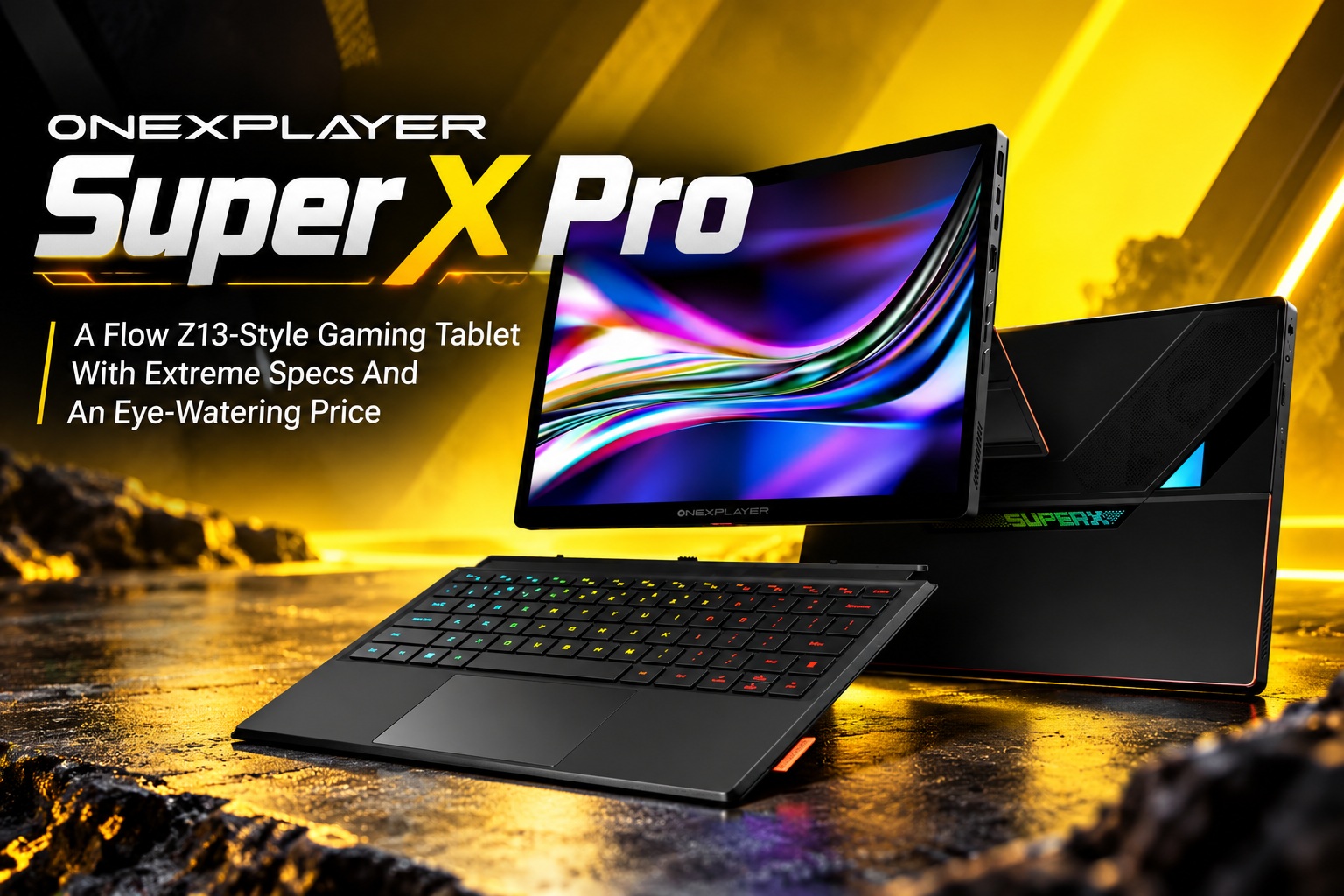
ONEXPLAYER has never been particularly shy about building powerful and expensive portable gaming hardware, but the new Super X Pro takes that philosophy to another level. Powered by AMD's Ryzen AI Max+ Pro 495 processor and configurable with as much as 192GB of memory, this 14-inch gaming tablet is closer to a portable workstation disguised as a handheld gaming machine.
Personally, I really like the concept behind the Super X Pro because it reminds me quite a lot of the Asus ROG Flow Z13 series. I have always liked that tablet-style approach where you essentially get a powerful Windows PC behind a touchscreen, attach a keyboard when you need productivity and remove it when you want something more portable. The Super X Pro takes that idea to a much more extreme level, particularly with its memory configuration and AMD Gorgon Halo hardware. Unfortunately, the price is equally extreme, especially once you look at the 192GB model.
Think ROG Flow Z13, But Taken To The Extreme
The basic concept will feel immediately familiar to anyone who has followed the Asus ROG Flow Z13.
Instead of building another traditional gaming laptop, ONEXPLAYER has put high-performance PC hardware into a large Windows tablet. The magnetic detachable keyboard converts it into something resembling a conventional notebook when required, while removing the keyboard leaves a much cleaner tablet-style machine.
That flexibility is one of the things I personally find appealing about this category. A device like this can theoretically function as a gaming PC, workstation, media tablet and travelling productivity machine without requiring multiple separate devices.
The problem is that achieving that level of performance in such a compact format is far from cheap.
AMD Ryzen AI Max+ Pro 495 Is The Heart Of The Machine
Inside the Super X Pro sits AMD's Ryzen AI Max+ Pro 495, based on the company's Gorgon Halo platform.
The processor features:
• 16 CPU cores
• 32 threads
• Up to 5.2GHz boost clock
• Configurable 45W to 120W TDP
• Radeon 8065S integrated graphics
• 40 Compute Units
• RDNA 3.5 graphics architecture
Those specifications immediately separate the Super X Pro from conventional gaming handhelds.
This is not something designed merely to run games at 720p while sitting on the sofa. The Ryzen AI Max+ Pro platform targets considerably heavier workloads, including gaming, professional applications and increasingly local AI workloads.
Radeon 8065S Gives The Tablet Serious Integrated Graphics
The Radeon 8065S is particularly interesting because it provides 40 Compute Units based on AMD's RDNA 3.5 architecture.
That is an enormous amount of integrated graphics hardware compared with what we traditionally associate with an APU.
AMD's recent high-end integrated platforms have increasingly blurred the distinction between an integrated GPU and an entry-level or mid-range discrete graphics solution.
For something designed around the tablet form factor, having this much graphics performance available without requiring a conventional dedicated GPU potentially offers major advantages in power efficiency, cooling and physical size.
It also makes the Super X Pro an interesting alternative to thin gaming laptops.
128GB Is Somehow The Entry-Level Memory Option
Perhaps the most ridiculous specification is the memory.
The Super X Pro is available with either:
• 128GB Unified Memory
• 192GB Unified Memory
Just stop and think about that for a moment.
We are talking about a gaming tablet where 128GB is effectively the lower-memory configuration.
Many high-end gaming desktops still ship with 32GB of RAM. Even 64GB is generally considered excessive unless the machine is being used for professional content creation, virtual machines or AI workloads.
ONEXPLAYER starts at twice that amount.
And Then There Is The 192GB Version
The flagship configuration goes all the way to 192GB.
At that point, calling the Super X Pro simply a gaming tablet feels slightly misleading.
That amount of memory makes considerably more sense for local AI workloads, huge datasets, professional content creation and other memory-intensive applications than it does for gaming.
No modern game needs anywhere close to 192GB.
But if you want one compact machine capable of gaming and running extremely demanding workstation workloads, the specification becomes much easier to understand.
The real problem begins when you see what that extra memory costs.
The 128GB Model Starts Around RM19,176
The liquid-cooled Super X Pro with 128GB memory is priced at US$4,699, equivalent to approximately RM19,176.
That is already extremely expensive.
At nearly RM20,000, you could build a very powerful desktop gaming PC or purchase a premium gaming laptop with a dedicated high-end GPU.
Still, the Super X Pro offers something those systems generally cannot: this level of hardware inside a 14-inch tablet form factor.
Whether that portability is worth the premium will depend entirely on the buyer.
192GB Pushes The Price To RM33,000
Then we reach the flagship model.
The 192GB configuration costs US$8,079, or approximately RM33,000.
That means increasing the memory from 128GB to 192GB adds approximately:
• US$3,300
• Around RM13,467
That is an astonishing premium for another 64GB of memory.
The difference alone costs more than many complete gaming laptops.
This is where my enthusiasm for the device begins colliding very hard with reality. I genuinely like the Super X Pro concept, but RM33,000 for a gaming tablet is extremely difficult to swallow.
Memory Pricing Has Become Painful
The huge gap between the two configurations also demonstrates how expensive high-capacity memory has become.
The Super X Pro is certainly an extreme example, but it is not the only Gorgon Halo system carrying five-figure pricing.
Other manufacturers have already introduced machines around similar AMD hardware, particularly for AI and workstation applications.
High memory capacities are becoming increasingly desirable because local AI workloads can consume enormous amounts of RAM or VRAM.
Unfortunately, the demand is also pushing high-capacity configurations into increasingly expensive territory.
The Framework Desktop Faces The Same Problem
The Framework Desktop is another interesting example.
It also takes advantage of AMD's high-memory architecture and has attracted attention as a compact AI and workstation machine.
Unfortunately for Malaysian enthusiasts, Framework hardware remains difficult or impossible to purchase officially in Malaysia.
That makes devices such as the ONEXPLAYER Super X Pro potentially more interesting locally, assuming proper availability.
Of course, paying RM19,000 to RM33,000 simply to gain access to the platform is another matter entirely.
Minisforum Is Targeting Similar Hardware
Minisforum has also introduced compact PCs using similar AMD hardware.
Those products make considerably more sense if portability is not important because manufacturers can dedicate more physical space to cooling while potentially charging less than a premium tablet design.
The Super X Pro therefore needs to justify itself through mobility.
You are paying for the ability to take workstation-class specifications and place them into something that can still function as a portable touchscreen computer.
That is precisely why I keep coming back to the ROG Flow Z13 comparison.
The Asus ROG Flow Z13 Comparison Is Hard To Ignore
The form factor immediately reminds me of the Asus ROG Flow Z13.
Both devices essentially ask the same question: why does a powerful gaming PC need to look like a conventional laptop?
Put the hardware behind the screen, add a detachable keyboard and suddenly you have something much more flexible.
I really like this style of machine because I already appreciate what Asus has been doing with the Flow Z13 family. It works particularly well when travelling because you can use it like a laptop at a desk and then remove the keyboard when you want something more compact.
ONEXPLAYER appears to be taking that same philosophy and pushing the specifications much further.
A 14-Inch 3K AMOLED Display Fits The Concept Perfectly
The Super X Pro uses a 14-inch AMOLED display with a resolution of 2,880 x 1,800.
That gives it a 3K-class resolution with a maximum refresh rate of 120Hz.
For a device that combines gaming and professional workloads, those specifications make sense.
The high resolution should provide plenty of workspace for productivity and content creation, while 120Hz keeps gaming and general interface animations smooth.
AMOLED also brings the usual benefits of strong contrast, deep blacks and vibrant colours.
It is exactly the kind of display you would expect on an ultra-premium device.
The 14-Inch Size Makes It More Laptop Than Handheld
Despite ONEXPLAYER's roots in gaming handhelds, describing the Super X Pro as a handheld would be stretching the definition considerably.
At 14 inches, this is a proper tablet computer.
You probably are not going to hold it in both hands while lying on the sofa in the same way you would use a Steam Deck or smaller ONEXPLAYER device.
Instead, the Super X Pro sits closer to the Surface Pro and ROG Flow Z13 philosophy.
The detachable keyboard reinforces that positioning.
It is essentially a high-performance 2-in-1 Windows PC built with gaming and AI hardware.
The Magnetic Keyboard Makes It A Real Productivity Machine
A detachable magnetic keyboard is included as part of the design.
That immediately makes the Super X Pro much more versatile.
For gaming, you can remove it and connect a controller.
For work, snap the keyboard back into place and use it more like a conventional laptop.
That flexibility is exactly what I enjoy about this form factor.
Traditional gaming laptops give you excellent performance, but the keyboard and display are permanently attached in one orientation. A tablet PC gives you much more freedom over how the machine is positioned and used.
4TB Storage Comes As Standard
Both configurations reportedly include 4TB of storage.
ONEXPLAYER has not specified the exact PCIe generation, though PCIe 4.0 would be a reasonable expectation based on current hardware trends.
Four terabytes is a very healthy capacity for a portable machine.
Modern AAA games regularly exceed 100GB, while AI models, video files and professional projects can consume storage extremely quickly.
A device costing this much should not leave buyers immediately shopping for another SSD, so including 4TB from the beginning makes sense.
Liquid Cooling Is Available On Both Configurations
Both the 128GB and 192GB Super X Pro variants are available with liquid cooling.
That sounds almost absurd when discussing a tablet, but it also illustrates how far performance hardware has evolved.
The Ryzen AI Max+ Pro 495 can operate at up to 120W, which creates substantial thermal requirements.
Trying to sustain that level of performance inside a slim tablet chassis requires much more sophisticated cooling than a conventional mobile processor.
If the system can maintain high performance without excessive temperatures or fan noise, the cooling design could become one of the most interesting parts of the device.
An 85.58Wh Battery Powers Everything
The Super X Pro includes a sizable 85.58Wh battery.
For a tablet, that is substantial.
However, battery capacity does not automatically translate into long endurance when the hardware includes a 16-core processor and powerful Radeon graphics.
Actual battery life will depend heavily on how aggressively the Ryzen AI Max+ Pro is configured.
Under light productivity workloads, the integrated design may provide reasonable efficiency.
Gaming at high performance is obviously another story.
Connectivity Is Surprisingly Comprehensive
ONEXPLAYER has managed to include a useful selection of ports:
• Two USB4 ports
• One USB-A port
• HDMI 2.1
• microSD card reader
• 3.5mm headphone jack
That is impressive for a tablet-style machine.
USB4 provides fast storage, docks and external display support, while the dedicated HDMI port makes connecting a television or monitor straightforward.
The inclusion of USB-A is also welcome.
Many premium thin devices have become overly dependent on USB-C dongles, so having one conventional port remains useful.
This Could Function As A Desktop Replacement
Connect the Super X Pro to a monitor, keyboard and mouse and it essentially becomes a compact desktop workstation.
Then disconnect everything, attach the magnetic keyboard and you have a mobile PC again.
That is another reason the high price is at least somewhat easier to understand.
The device potentially replaces several machines:
• Gaming tablet
• Premium laptop
• Desktop workstation
• Local AI machine
• Portable creator PC
Whether someone actually needs all of those capabilities inside one device is another question.
But the flexibility is undeniably attractive.
192GB Makes Much More Sense For AI Than Gaming
The flagship memory configuration is clearly not intended primarily for gamers.
The interesting use case is AI.
Large local AI models often become limited by available memory long before compute performance becomes the problem.
Having 192GB accessible to the system could allow developers to experiment with models that simply cannot fit comfortably on conventional laptops.
That potentially makes the Super X Pro useful for developers, researchers and creators who need substantial local AI capacity while travelling.
Suddenly, RM33,000 begins looking less like an outrageous gaming-tablet price and more like an outrageous portable-workstation price.
Still outrageous, though.
The Radeon 8065S Removes The Need For A Discrete GPU
Using Radeon 8065S integrated graphics also allows ONEXPLAYER to avoid fitting a conventional discrete GPU into the chassis.
That simplifies the physical layout and enables the Unified Memory architecture.
Traditional gaming laptops divide their memory between system RAM and dedicated graphics VRAM.
An integrated architecture can potentially give the graphics processor access to a much larger shared memory pool.
For gaming, 128GB or 192GB is unnecessary.
For AI and professional workloads, however, that flexibility becomes extremely interesting.
This Is Probably Not For Normal Gamers
Despite the gaming branding, the Super X Pro is difficult to recommend purely as a gaming machine at these prices.
Someone spending RM33,000 specifically for gaming could build an extraordinary desktop system with substantially more graphics performance.
Even the RM19,176 base configuration sits firmly in ultra-premium territory.
The appeal lies in having exceptional hardware inside this particular form factor.
If you specifically want a high-performance Windows tablet similar to a massively upgraded ROG Flow Z13, then there are far fewer alternatives.
The Price Is The Only Thing Killing My Enthusiasm
This is ultimately where I land personally.
I really like the ONEXPLAYER Super X Pro.
The concept is almost exactly the kind of machine that interests me: a powerful Windows gaming tablet, detachable keyboard, large high-refresh AMOLED screen, massive memory capacity and enough connectivity to function as a desktop when needed.
It feels like someone looked at the Asus ROG Flow Z13 and asked, "What happens if we take this idea to the absolute extreme?"
Unfortunately, the answer is apparently RM33,000.
And that makes it very difficult to get excited without immediately thinking about everything else the same money could buy.
The 128GB Model Is Probably The Sensible Choice
Calling a RM19,176 computer "sensible" feels ridiculous, but within the Super X Pro lineup, the 128GB model clearly offers much better value.
You still get:
• The same Ryzen AI Max+ Pro 495
• Radeon 8065S graphics
• 128GB memory
• 4TB storage
• 3K 120Hz AMOLED display
• Liquid cooling option
• The same tablet form factor
Unless you have a specific workload that genuinely requires more than 128GB, spending another RM13,000-plus for 192GB is difficult to justify.
And 128GB is already far beyond what almost any game requires.
A Fascinating Glimpse At Where Portable PCs Are Heading
The Super X Pro may also represent where premium Windows computers are heading over the next few years.
Processors are becoming more tightly integrated.
Integrated graphics are becoming powerful enough for serious gaming.
Unified Memory is allowing systems to support enormous capacities accessible to both CPU and GPU workloads.
AI is making 64GB, 128GB and even 192GB configurations relevant to users who previously would never have considered such amounts of memory.
At the same time, increasingly capable hardware can fit behind a 14-inch display.
That combination is genuinely exciting.
The challenge is bringing the price down to something ordinary enthusiasts can actually afford.
Final Thoughts
The ONEXPLAYER Super X Pro is one of the most interesting Windows gaming tablets I have seen recently, largely because it takes a concept I already really like from the Asus ROG Flow Z13 and pushes it to an almost ridiculous level.
You get a 16-core Ryzen AI Max+ Pro 495, Radeon 8065S graphics with 40 RDNA 3.5 Compute Units, a 14-inch 2,880 x 1,800 AMOLED display running at 120Hz, 4TB of storage, an 85.58Wh battery and up to an astonishing 192GB of memory.
As a portable gaming and AI workstation, it sounds fantastic.
The problem is the price.
At approximately RM19,176 for 128GB and an eye-watering RM33,000 for the 192GB model, the Super X Pro sits far beyond what most PC gamers could realistically consider.
Personally, I love the machine's concept. Give me the tablet-style flexibility of an ROG Flow Z13, powerful integrated Radeon graphics and massive Unified Memory, and I am immediately interested.
But at RM33,000, I would spend more time admiring it than actually considering buying one.
If this type of hardware eventually reaches more realistic pricing, however, I could absolutely see powerful gaming tablets becoming one of the most interesting categories in the Windows PC market.











Comments 0