

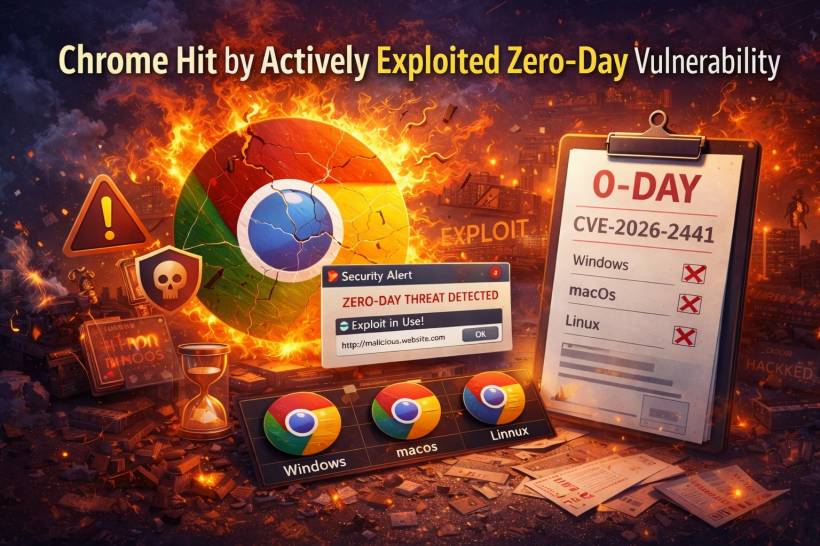
If you use Google Chrome on desktop, this is one of those security stories where the boring advice is also the correct advice: update immediately. Google has released urgent security updates for a zero-day vulnerability that's already being actively exploited in the wild. In other words, attackers aren't waiting for you to patch, they're counting on you not doing it
What's Going On?
The vulnerability is tracked as CVE-2026-2441 and has a High severity rating with a CVSS v3.1 score of 8.8/10. It's described as a memory corruption issue in Chrome's CSS handling code, confirmed to be actively exploited.
More specifically, it's a use-after-free bug in Chrome's CSS processing component. That means Chrome can end up reusing memory that should no longer be used, which can corrupt memory and potentially allow attackers to run code within the browser sandbox.
How Attacks Typically Happen
The attack path is the classic web trap:
• A victim visits a malicious page (often through a lure)
• The page delivers specially crafted HTML/CSS that triggers the bug
• The attacker may then be able to execute malicious code within the browser context
One key detail: exploitation requires user interaction, such as visiting a malicious website. That's why phishing and "you should totally click this" tactics are expected to be part of the playbook.
What We Know (And What We Don't)
Google has confirmed active exploitation, but there aren't many public details beyond that.
• Real-world exploitation is confirmed
• Campaign details and threat actor attribution have not been disclosed
• No indicators of compromise (IoCs) were provided at publication time
That "limited details" approach is common with zero-days, because sharing too much too soon can help attackers scale up before patches land everywhere.
Who's Affected?
If you're on desktop Chrome and not fully updated, you're in the affected group:
• Windows: versions prior to 145.0.7632.76
• macOS: versions prior to 145.0.7632.76
• Linux: versions prior to 144.0.7559.75
And it's not just Chrome. Other Chromium-based browsers (Edge, Brave, Opera, Vivaldi) may also be affected if they haven't yet pulled in the relevant Chromium patch.
What You Should Do Right Now
The recommended mitigation is straightforward: update to the patched versions immediately. Fixed versions listed:
• Linux: 144.0.7559.75 or later
For organizations managing many devices, the guidance is also clear:
• Push the update through centralized patch management / enforced update policies
• During rollout, advise users to avoid untrusted or suspicious sites, because visiting a malicious page is the trigger
• Longer-term: enable and enforce automatic browser updates to shrink future zero-day exposure windows
Final Thoughts
Zero-days are nasty mainly because they're already in motion while people are still reading about them. Here, the story boils down to one practical takeaway: if your browser isn't on the fixed version yet, you're leaving the door open. Patch quickly, then make sure auto-updates stay on—because the next "surprise" won't announce itself nicely ahead of time.











Comments 0