

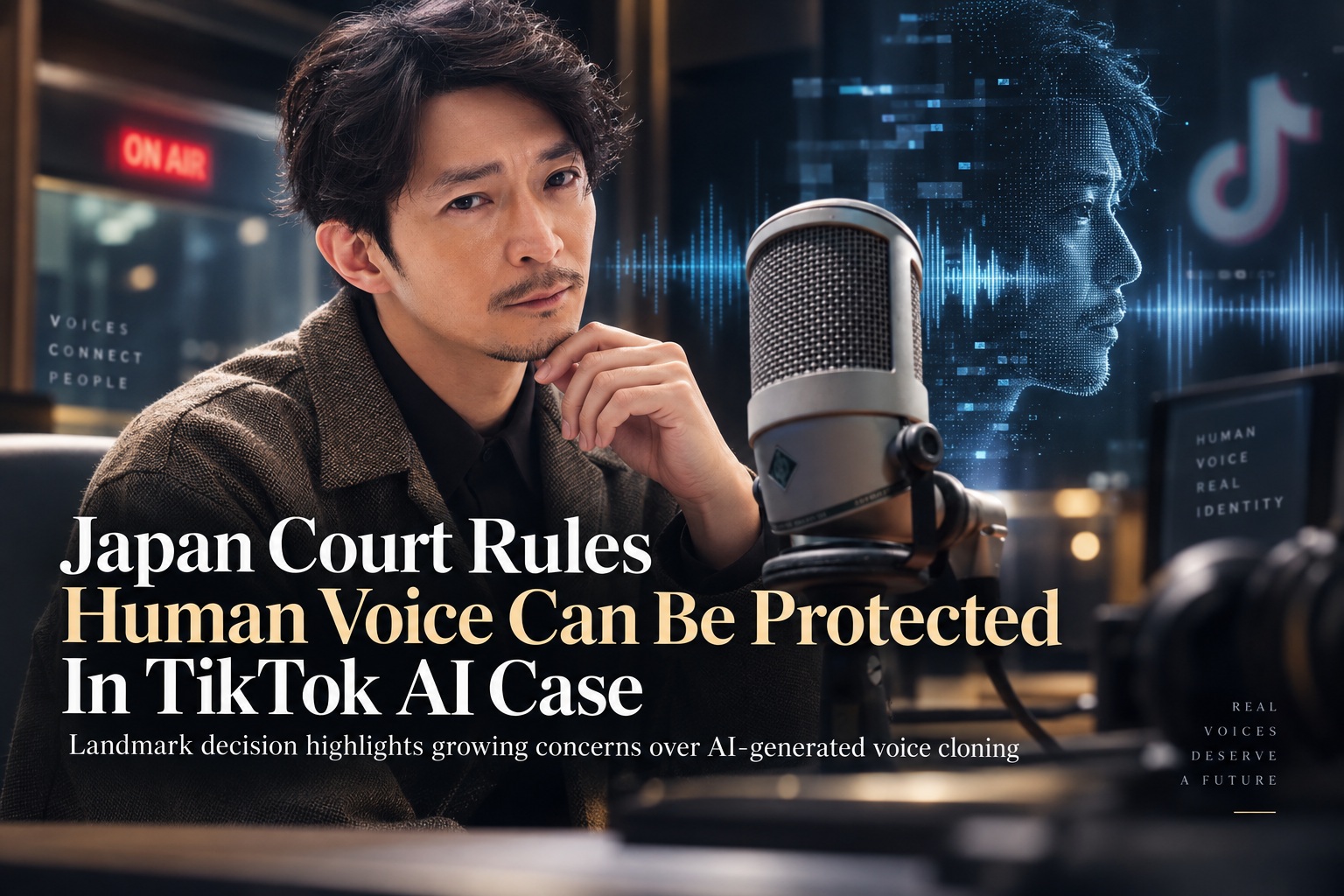
A landmark court decision in Japan has recognised that a person's voice can potentially be protected under publicity rights, marking an important development in the growing debate around AI-generated voice cloning. The Tokyo District Court made the ruling following a lawsuit filed by prominent anime voice actor Kenjiro Tsuda over TikTok videos that allegedly used an AI-generated imitation of his distinctive voice. Although the court acknowledged that unauthorised commercial use of a recognisable voice could infringe publicity rights, it ultimately dismissed Tsuda's request to have the videos removed because they had already been deleted by the account responsible.
The case arrives at a time when Japanese performers are becoming increasingly concerned about generative AI being used to reproduce voices without permission. Voice actors in particular have raised questions over how their performances, vocal characteristics and public identities should be protected as AI cloning technology becomes more accessible. The Japan Actors Union has also launched a campaign opposing the unauthorised use of performers' voices and likenesses in generative AI content, warning that uncontrolled cloning could have long-term consequences for the entertainment industry.
Court Recognises Voice As Part Of A Person's Identity
According to the court ruling, the unauthorised use of a performer's voice may constitute an infringement of publicity rights when that voice is being used primarily for its commercial appeal. Presiding judge Aya Takahashi reportedly stated that a person's voice can function as a symbol of their personality, much like a photograph or other recognisable aspect of their appearance. This effectively acknowledges that vocal identity can carry commercial value independently of a performer's physical image.
Publicity rights generally allow individuals to control or benefit from the commercial exploitation of recognisable elements of their identity. Traditionally, discussions around these rights have focused heavily on names, photographs and likenesses, but AI-generated voice technology is increasingly forcing courts to consider whether a distinctive voice should receive similar protection. The Tsuda case is believed to be the first lawsuit in Japan specifically seeking legal protection against an AI-generated imitation of an individual's voice.
More Than 180 Videos Allegedly Used Tsuda's Voice
Kenjiro Tsuda is widely known for his work across major anime franchises including The Way of the Househusband, Jujutsu Kaisen and Yu-Gi-Oh!. His complaint centred on an anonymous TikTok account that allegedly uploaded more than 180 videos narrated by a voice closely resembling his own. The account reportedly also used a profile image resembling a character associated with Tsuda and published content covering subjects such as urban legends, occult phenomena and conspiracy theories.
At one point, the TikTok account reportedly attracted more than 200,000 followers. Tsuda's legal complaint estimated that the videos could have generated more than JPY500,000, approximately RM12,925, in monthly revenue. This commercial aspect became particularly relevant because the court's interpretation of publicity rights focused on whether a recognisable voice was being used to take advantage of its commercial value.
TikTok disputed the allegation that the narration specifically replicated Tsuda's voice. According to court records, the platform argued that the videos used a generic male voice and that any perceived similarity to Tsuda was subjective. The dispute therefore raised a wider challenge that may become increasingly important in future AI-related cases: determining when a synthetic voice is sufficiently similar to a real person for legal protections to apply.
Court Did Not Order TikTok To Remove The Videos
Despite recognising that unauthorised commercial use of a performer's voice could violate publicity rights, the Tokyo District Court did not issue an order requiring TikTok to remove the disputed content. The anonymous account responsible had already deleted the videos several months after Tsuda filed the lawsuit, meaning the specific removal request was effectively no longer necessary. As a result, the legal decision established an important principle without requiring further action against videos that were no longer available.
Tsuda's lawyer, Takashi Hirano, described the result as one where both sides could claim some form of victory. Tsuda secured recognition that a person's voice may qualify for protection under publicity rights, while TikTok avoided a direct court order requiring content removal. TikTok said it would respect the court's decision while reviewing the ruling and considering what steps to take next.
Why Voice Protection Is Particularly Important In Japan
Voice acting, commonly associated with the Japanese term "seiyuu", occupies a particularly prominent position within Japan's entertainment industry. Voice actors frequently build public careers that extend well beyond simply recording dialogue for anime characters, with many also working across video games, radio programmes, music, live events, advertising and television appearances. Some performers develop large fanbases where their voices become instantly recognisable and closely associated with their professional identity.
This strong connection between a performer and their voice helps explain why AI voice cloning has become a particularly sensitive issue in Japan. A well-known voice actor's vocal characteristics can have considerable commercial value, much like an actor's face or a celebrity's name. If AI tools can reproduce those voices without permission, performers may face situations where their vocal identity is used to create content they never recorded, approved or received compensation for.
AI Voice Cloning Is Not Always Unauthorised
The court case does not suggest that all forms of AI-generated voice replication are inherently problematic. Voice cloning technology can also be used with the clear permission of the person whose voice is being recreated. One prominent example involved the late James Earl Jones, who in 2022 gave Disney permission to use an AI-generated version of his iconic Darth Vader voice for future Star Wars projects.
That arrangement involved the performer granting consent for his voice to be reproduced, with Ukrainian company Respeecher providing the voice-cloning technology. It illustrates an important distinction within the wider AI debate: the technology itself can be used legitimately when appropriate permission, licensing and contractual arrangements are in place. The larger legal and ethical problem arises when someone's recognisable voice is replicated and commercially exploited without their approval.
A Potentially Important Precedent For Generative AI
The Tokyo District Court ruling could have wider implications as AI-generated media becomes increasingly convincing and easier to produce. Modern generative AI systems can already recreate voices from relatively small samples, making it possible to generate entirely new dialogue that sounds similar to a particular performer. As these tools improve, distinguishing between authentic recordings and synthetic voices may also become increasingly difficult for audiences.
The ruling therefore adds another dimension to discussions around identity protection in the AI era. Courts, technology companies and content platforms may increasingly need to consider not only a person's name and likeness, but also recognisable characteristics such as their voice. For performers whose careers depend heavily on vocal identity, these protections could become particularly significant as synthetic media continues to evolve.
Final Thoughts
Kenjiro Tsuda's case represents an important moment in the evolving relationship between generative AI and personal identity rights. By recognising that a distinctive voice can potentially be protected under publicity rights when used for commercial purposes, the Tokyo District Court has acknowledged that vocal identity can carry similar value to a person's image or likeness. While the court did not order TikTok to remove the videos because they had already been deleted, the broader legal principle established by the case may prove more significant than the individual dispute itself.
AI voice technology is likely to continue improving, making questions surrounding consent, licensing and ownership increasingly important. There is nothing inherently wrong with using AI to recreate a performer's voice when that person has knowingly agreed to it, but unauthorised cloning presents a very different situation. As governments and courts around the world continue adapting existing laws to generative AI, Japan's recognition of the commercial importance of a person's voice could become an important reference point for future cases.











Comments 0