

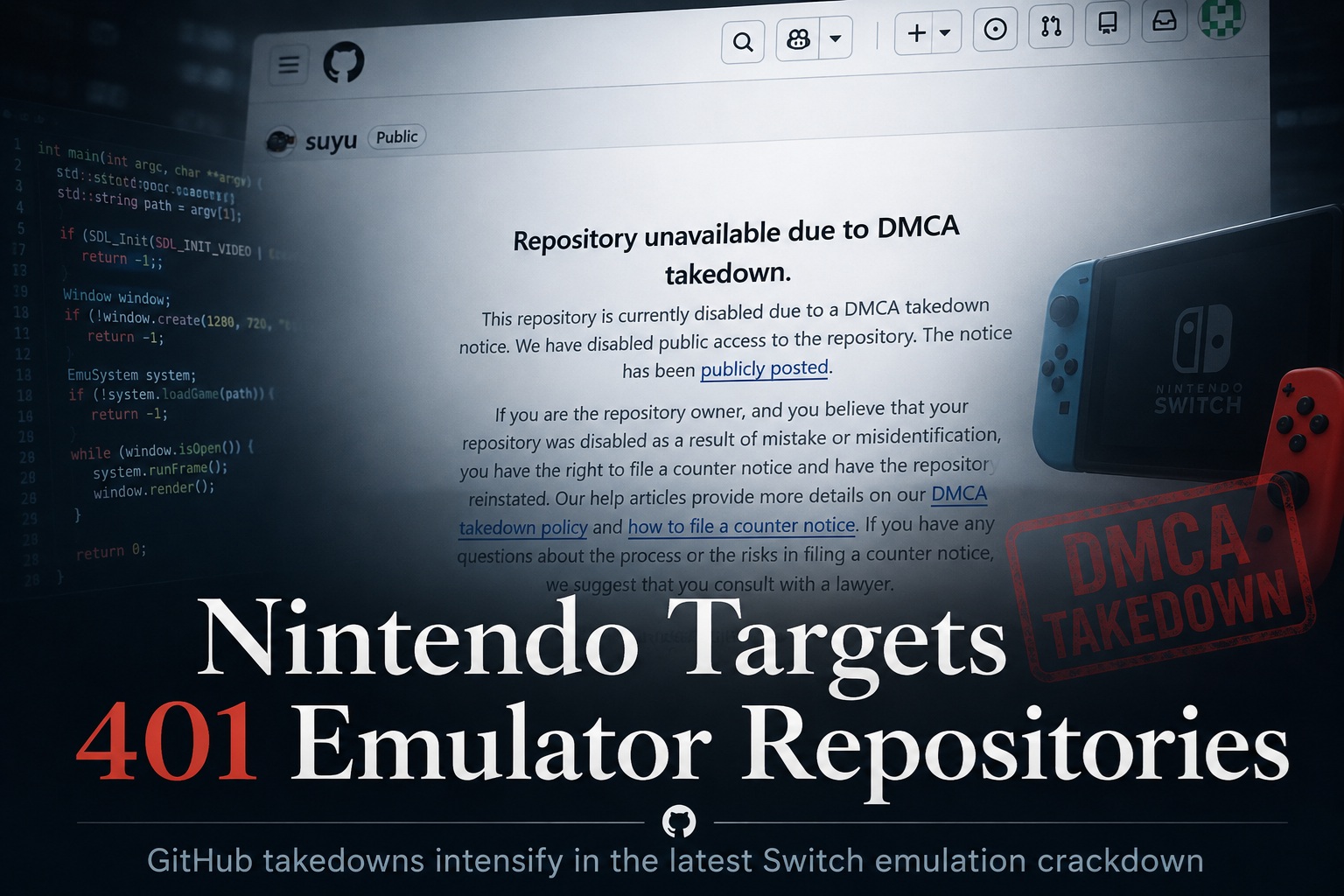
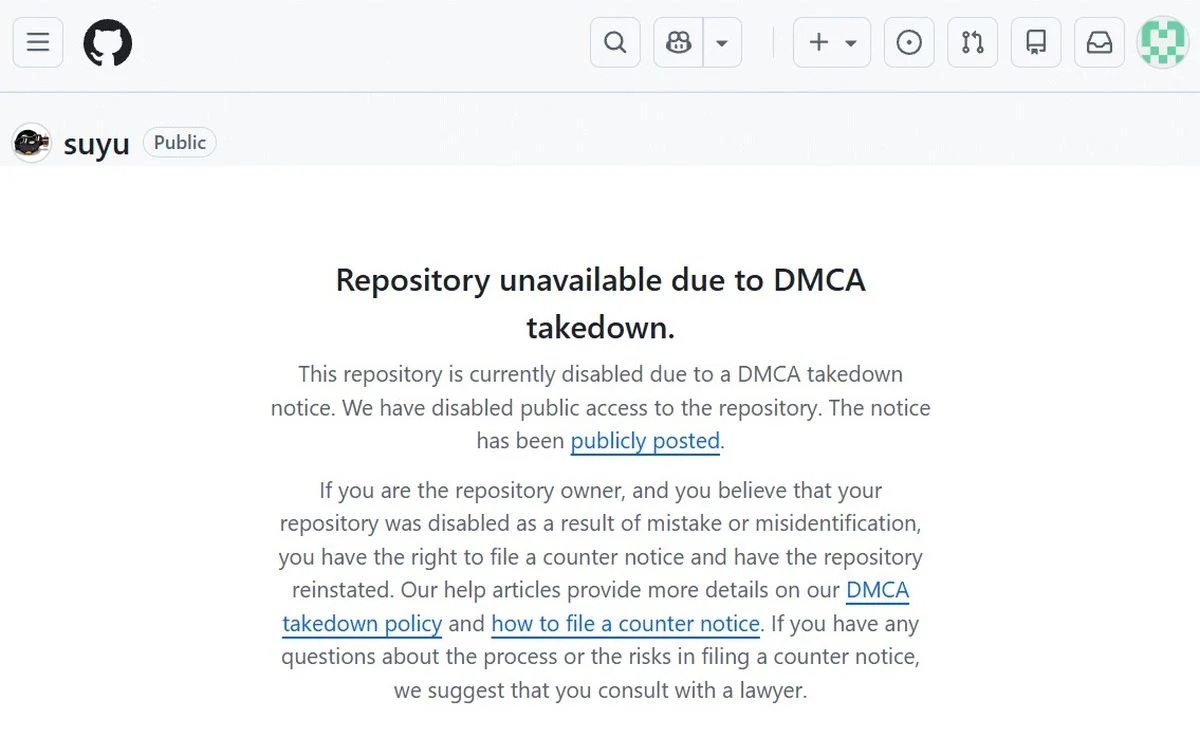
Nintendo has continued its aggressive campaign against Nintendo Switch emulation, with the company reportedly targeting 401 GitHub repositories connected to emulators such as Suyu, Yuzu and Skyline. The figure does not mean Nintendo discovered 401 completely different Switch emulators. Many of the repositories were forks or copies of the same projects, meaning a single emulator could have hundreds of versions scattered across GitHub.
Nintendo's latest action once again highlights how determined the company is to stop software it believes bypasses the Switch's technological protection measures.
Suyu Accounts for Most of the Takedowns
Suyu appears to have been the largest target in the latest enforcement action.
According to the reported figures, Nintendo targeted the following repositories and forks:
Suyu alone therefore accounted for more than three-quarters of the repositories involved.
The project emerged following the shutdown of Yuzu and was based heavily on the original emulator's open-source code.
Once a project is publicly available on platforms such as GitHub, however, removing the original repository does not necessarily make the software disappear.
Users can create forks, mirrors and modified versions, sometimes producing hundreds of repositories containing essentially the same code.
That appears to be exactly what Nintendo is now attempting to clean up.
Nintendo Says the Emulators Circumvent Switch Protections
Nintendo's legal argument focuses heavily on the technological protection measures used to secure Nintendo Switch games.
Switch software relies on cryptographic systems and encryption keys that help prevent unauthorised access to game data.
Nintendo argues that certain emulators and related tools circumvent those protections, potentially placing them within the anti-circumvention provisions of the Digital Millennium Copyright Act (DMCA).
The company has also reportedly highlighted repositories distributing or referencing cryptographic keys.
That distinction is important because emulation itself exists in a complicated legal area.
An emulator can theoretically recreate the behaviour of hardware without distributing copyrighted games.
However, Nintendo's argument has focused on whether the tools require users to bypass encryption or other technological restrictions before commercial Switch software can actually run.
That gives the company a much stronger route for pursuing projects under anti-circumvention law rather than simply arguing that an emulator resembles Nintendo's hardware.
The Yuzu Case Changed the Switch Emulation Scene
Anyone following Switch emulation will already be familiar with Nintendo's previous action against Yuzu.
Nintendo sued Tropic Haze, the organisation behind Yuzu, resulting in a settlement that effectively ended development of the emulator.
Tropic Haze agreed to pay Nintendo US$2.4 million, equivalent to roughly RM9.7 million, while permanently stopping development and distribution of Yuzu.
The settlement also required the organisation to surrender various assets connected with the project, including website domains and emulator-related material.
More importantly, the developers agreed not to create future software designed to circumvent Nintendo's technological protections.
That settlement had an immediate impact across the emulator community.
Yuzu disappeared as an officially maintained project, but because its source code had previously been available publicly, derivatives quickly appeared.
Suyu became one of the most prominent examples.
This created an obvious challenge for Nintendo.
Shutting down one development team does not automatically erase every copy of open-source code already distributed across the internet.
GitHub Forks Make Takedowns Complicated
GitHub makes collaborative software development incredibly convenient because anyone can create a fork of a public repository.
That is extremely useful when developers want to experiment with software, submit improvements or continue abandoned projects.
The same feature also makes permanent removal difficult.
Imagine that one repository has 300 forks.
Removing the original repository still leaves hundreds of copies that may contain most or all of the original code.
Those copies can then themselves be forked again.
The result is something resembling digital whack-a-mole.
Nintendo can issue takedown notices, GitHub can remove repositories, but copies may already exist elsewhere.
That explains why the headline number of 401 repositories is so large despite the relatively small number of underlying emulator projects involved.
Skyline and MonoNX Were Also Included
Nintendo's action was not limited to Yuzu derivatives.
Repositories associated with Skyline and MonoNX were also reportedly included.
These projects represent different attempts at Nintendo Switch emulation, particularly on Android and other platforms.
Their inclusion demonstrates that Nintendo is not concentrating exclusively on one famous emulator.
The company appears to be taking a broader approach toward repositories that it believes contain software capable of circumventing Switch security mechanisms.
That approach is likely to continue as long as copies and derivative projects remain publicly accessible.
Nintendo Has a Long History of Aggressive Enforcement
Nintendo's willingness to pursue emulation projects should not surprise anyone familiar with the company's legal history.
The company has repeatedly taken action against ROM-distribution websites, modchip sellers, console hackers and other organisations it believes facilitate piracy or bypass its security systems.
One particularly notable case involved Gary Bowser, a member of Team Xecuter.
Bowser received a 40-month prison sentence after being convicted in connection with the group's console-hacking business.
Nintendo also pursued substantial civil damages, obtaining orders requiring millions of dollars in payments.
The case became controversial partly because of the scale of the financial consequences imposed on an individual defendant.
Regardless of opinions surrounding the punishment, it demonstrated just how seriously Nintendo treats attempts to circumvent the protection systems used by its consoles.
Why Nintendo Is So Protective of the Switch
Nintendo's position becomes easier to understand when looking at the commercial lifespan of the Switch.
Emulation becomes particularly sensitive when the platform being emulated is still actively generating significant software revenue.
Classic console emulation generally attracts less immediate attention because the hardware and software may have been commercially inactive for decades.
The Nintendo Switch is different.
Its games remain commercially valuable, and many titles continue to sell at relatively high prices years after release.
Modern Switch emulators can also sometimes run games shortly after launch, or even before official release dates when leaked copies appear online.
That creates a very different situation from preserving a game originally released for a console from the 1980s or 1990s.
From Nintendo's perspective, Switch emulation potentially competes directly with current hardware and software sales.
Emulation and Piracy Are Not Exactly the Same Thing
There is an important distinction worth maintaining.
Emulation itself does not automatically equal piracy.
Emulators can serve legitimate purposes, including software preservation, accessibility, research and allowing owners to run software they have legally acquired on different hardware.
The controversy emerges when copyrighted game files, encryption keys or circumvention tools become part of the process.
Nintendo's current strategy appears to focus particularly heavily on this latter area.
That is why cryptographic keys are so important in the company's takedown arguments.
The technical and legal boundaries can become complicated very quickly, which is also why emulator projects increasingly need to think about more than just whether their source code directly contains Nintendo's copyrighted material.
Open Source Makes Emulator Projects Difficult to Completely Erase
The broader challenge for Nintendo is that once source code has been released publicly, permanently removing it from the internet becomes extremely difficult.
Copies can exist on personal computers, alternative Git hosting platforms, archive services and private repositories.
Even if GitHub removes hundreds of repositories, the underlying code may continue circulating.
That does not mean takedowns have no effect.
Removing projects from GitHub dramatically reduces visibility, makes collaboration harder and prevents casual users from finding downloads easily.
Development communities may also fragment when their central repository disappears.
Nintendo does not necessarily need to make every copy vanish.
Making development and distribution difficult enough may already achieve much of the company's objective.
The Fight Is Likely to Continue
The latest 401-repository takedown demonstrates that Nintendo's enforcement campaign did not end when Yuzu shut down.
If anything, the aftermath of the Yuzu settlement appears to have moved the battle toward derivative projects and repository mirrors.
Every time a major emulator disappears, forks can appear under new names.
Nintendo can then pursue those projects individually.
This cycle could continue for a long time, particularly while Switch software remains commercially important.
The situation may also become more complicated as preservation advocates, emulator developers and gaming companies continue debating where legitimate emulation ends and unlawful circumvention begins.
Final Thoughts
Nintendo's reported takedown of 401 Switch-emulator-related GitHub repositories is another reminder that the company remains extremely serious about protecting the Switch ecosystem.
Most of those repositories were not entirely different emulators. They were forks and copies of a much smaller group of projects, with Suyu alone accounting for 311 repositories.
Nintendo's argument continues to focus on circumvention of technological protections and the use or distribution of cryptographic keys rather than simply the existence of emulation software.
The shutdown of Yuzu showed that Nintendo is willing to pursue developers directly, while this latest action demonstrates that it is equally willing to chase the many forks that appear afterwards.
For the Switch emulation community, the lesson is increasingly clear: once Nintendo identifies a project as crossing its legal boundaries, simply moving the same code into another GitHub repository is unlikely to make the problem disappear.











Comments 0